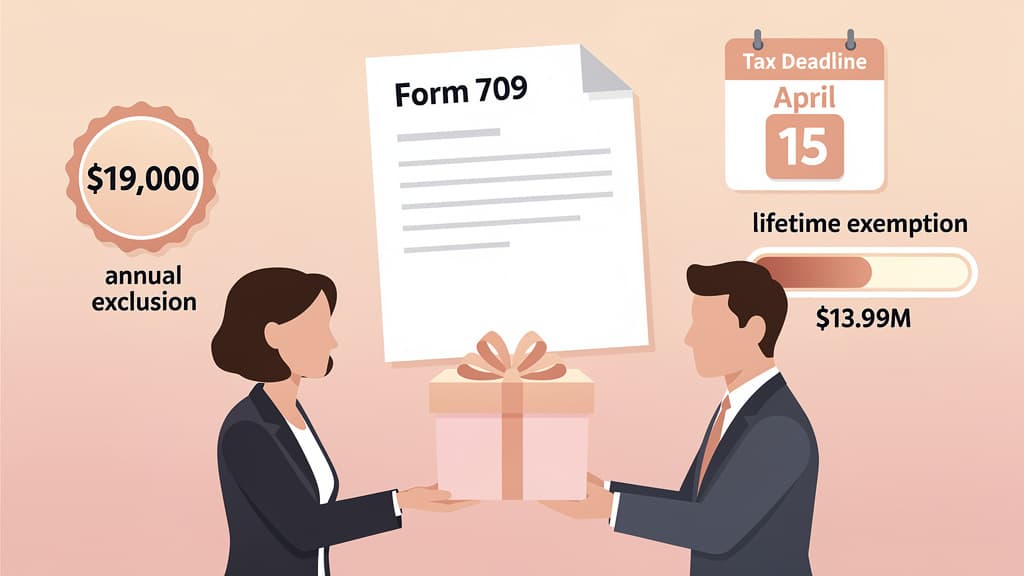
Form 709, the United States Gift (and Generation-Skipping Transfer) Tax Return, for 2025 gifts was due April 15, 2026. If you filed Form 4868 to extend your income tax return, your Form 709 deadline moved to October 15, 2026 automatically. If you missed the deadline entirely, file now: when no gift tax is owed (true for most filers, thanks to the lifetime exemption), there is no late-filing penalty, but the statute of limitations on your gift never starts running until the return is filed. Form 709 for 2026 gifts is due April 15, 2027.
Key numbers and dates:
Item
Details
Form
Form 709 (United States Gift and Generation-Skipping Transfer Tax Return)
Filing deadline
April 15 of the year after the gift (2025 gifts: April 15, 2026; 2026 gifts: April 15, 2027)
Extended deadline for 2025 gifts
October 15, 2026 (automatic if Form 4868 or Form 8892 was filed by April 15, 2026)
Annual exclusion
$19,000 per recipient for both 2025 and 2026 gifts
Gift splitting (married)
$38,000 per recipient
Non-citizen spouse exclusion
$190,000 (2025 gifts) / $194,000 (2026 gifts)
Lifetime exemption
$13.99 million (2025 gifts) / $15 million (2026 gifts, OBBBA)
You must file Form 709 if, during the calendar year, you:
Give more than $19,000 to any single recipient. This is the 2026 annual exclusion amount. Gifts to the same person that total more than $19,000 in a calendar year (cash, property, or other assets) require a filing.
Make a gift of a future interest. Any gift where the recipient can't immediately use, possess, or enjoy the property is a future interest gift. These require Form 709 filing regardless of value. Gifts to most trusts fall into this category.
Give more than $194,000 to a non-citizen spouse. Gifts between US citizen spouses are unlimited (the marital deduction). But gifts to a spouse who is not a US citizen are capped at $194,000 for 2026 ($190,000 for 2025 gifts) before Form 709 filing is required.
Make generation-skipping transfers. Gifts to grandchildren or individuals more than one generation below you may trigger generation-skipping transfer (GST) tax reporting.
Elect gift splitting with your spouse. If you and your spouse agree to "split" gifts (treating each gift as if half came from each spouse), a Form 709 must be filed to make the election, even if neither spouse's individual gifts exceed the annual exclusion.
Who does NOT need to file:
Anyone whose gifts to each individual recipient stay at or below $19,000 for the year (and who doesn't elect gift splitting)
Anyone who only makes gifts that qualify for the educational or medical exclusions (discussed below)
Anyone who only makes gifts to their US citizen spouse
The amount, the recipient, and a splitting election decide whether a return is due — filing almost never means owing tax.
$
Cash, property, forgiven loans — everything to the same person, at fair market value.
Yes — file Form 709
The first $19,000 is covered by the 2026 annual exclusion. The remaining $100,000 is a taxable gift that cuts your lifetime exemption from $15,000,000 to $14,900,000 — you owe $0 gift tax, but the return is mandatory and it starts the IRS's 3-year clock on valuing the gift.
2026 amounts from Rev. Proc. 2025-32 and OBBBA, per the article. A 2026 gift goes on the Form 709 due April 15, 2027 (October 15 with a Form 4868 or 8892 extension). Future-interest gifts — most gifts to trusts — and generation-skipping transfers require a return regardless of amount and aren't modeled.
Form 709 is due April 15 of the year after the gift was made, the same deadline as your individual income tax return (IRC §6075). The return for 2025 gifts was due April 15, 2026; the return for 2026 gifts is due April 15, 2027.
Tax Year
Filing Deadline
Extended Deadline
2025 gifts
April 15, 2026
October 15, 2026
2026 gifts
April 15, 2027
October 15, 2027
For the full tax deadline calendar, see our complete guide with all federal filing dates.
An income tax extension covers your gift tax return too. Per the Form 709 instructions, any extension of time granted for filing your federal income tax return automatically extends the time to file your federal gift tax return. So if you submitted Form 4868 by April 15, 2026, your Form 709 for 2025 gifts is due October 15, 2026. No separate gift tax extension request is needed.
Form 8892 is the standalone route: taxpayers who didn't need an income tax extension but wanted more time for Form 709 filed Form 8892 by April 15, 2026 for the same automatic 6-month extension to October 15. Form 8892 also works as a payment voucher for any gift tax due.
The extension gives you more time to file, not more time to pay. If you actually owe gift tax (rare — most people haven't exhausted their lifetime exemption), the tax was still due by April 15, 2026, and interest accrues on any unpaid balance from that date. For more details on how extensions work, see our Tax Extension Guide.
A late Form 709 with no gift tax due carries no dollar penalty. The late-filing and late-payment penalties under IRC §6651 are calculated as a percentage of the unpaid tax, and most Form 709 filers owe zero because the lifetime exemption absorbs the taxable gift. Extensions can't be requested retroactively after April 15, so the fix is simple: prepare the return and file it now.
The real cost of never filing is an open statute of limitations. The IRS's 3-year window to challenge the value of your gift starts only when the gift is adequately disclosed on a filed Form 709. Skip the return, and the IRS can question the gift's valuation at any time, including decades later during estate settlement. The same rule governs amended gift tax returns: the 3-year clock runs from whenever the gift is first adequately disclosed, whether on an original, late, or amended Form 709. This matters most for hard-to-value gifts like business interests and real estate.
The annual gift tax exclusion for 2026 is $19,000 per recipient, unchanged from 2025 (Rev. Proc. 2025-32). This means you can give up to $19,000 to as many different people as you want in a calendar year without any gift tax filing requirement. There is no separate "deadline" to use the annual exclusion beyond the calendar year itself: a 2026 gift must be completed by December 31, 2026 to count against the 2026 exclusion. For the planning side — gift splitting, the 529 five-year election, and the unlimited tuition and medical exclusions — see our annual gift tax exclusion guide.
The exclusion applies per donor, per recipient. You can give $19,000 each to 50 different people (a total of $950,000) with zero gift tax reporting. But give $20,000 to a single person, and you must file Form 709 to report the $1,000 over the exclusion. Both spouses in a married couple each get their own $19,000 exclusion per recipient.
Married couples can elect to "split" gifts, treating each gift as if half came from each spouse. This effectively doubles the annual exclusion to $38,000 per recipient without using any lifetime exemption.
Example: You give your daughter $36,000. Without gift splitting, you've exceeded the $19,000 exclusion by $17,000 and must file Form 709. With gift splitting, each spouse is treated as having given $18,000 — both under the $19,000 exclusion.
The catch: Electing gift splitting always triggers a Form 709 filing, even when each spouse's share of every gift is under $19,000. The general rule is that both spouses file their own Form 709. The Form 709 instructions allow one exception: when only one spouse made gifts, every gift was a present interest, and gifts to each recipient totaled $38,000 or less, only the donor spouse files, and the other spouse signs the consent line on that return. The $36,000 example above fits this exception, so it needs one return with the consenting spouse's signature, not two.
When your gifts to a single person exceed the $19,000 annual exclusion, the excess reduces your lifetime gift and estate tax exemption. For 2026 gifts, the lifetime exemption is $15 million per person ($30 million for a married couple), set by the One Big Beautiful Bill Act (OBBBA). For 2025 gifts, reported on the Form 709 that was due April 15, 2026, the exemption is $13.99 million.
Say you give your daughter $119,000 in 2026. The first $19,000 is covered by the annual exclusion. The remaining $100,000 is a taxable gift reported on Form 709, which reduces your lifetime exemption from $15 million to $14.9 million. You owe zero gift tax because you still have exemption remaining.
No tax is owed until you exhaust the entire lifetime exemption. For most people, this never happens. But the IRS still requires Form 709 filings to track your cumulative exemption use over your lifetime.
The TCJA of 2017 doubled the lifetime exemption, originally scheduled to sunset after 2025 (dropping back to roughly $7 million). OBBBA ended the sunset. It amended IRC §2010(c)(3) to set the basic exclusion amount at $15 million for 2026 and made it permanent, indexed for inflation in future years. Married couples can now transfer $30 million to heirs without federal gift or estate tax.
Tuition paid directly to an institution — pay the school, not the student. If you reimburse the student, it's a gift subject to the $19,000 exclusion. (IRC §2503(e))
Medical expenses paid directly to the provider — same principle: pay the hospital or doctor, not the patient
Gifts to your US citizen spouse — unlimited marital deduction, no Form 709 required (does not apply to non-citizen spouses)
Gifts to qualified charities — deductible, don't count toward exclusion or lifetime exemption
Gifts to political organizations — exempt under IRC §2501(a)(4)
If you exhaust your lifetime exemption, gift tax applies at graduated rates from 18% to 40%.
The rates start at 18% on the first $10,000 of taxable gifts and climb to 40% on amounts over $1 million. These are the same rates that apply to the estate tax — because the gift tax and estate tax share a unified system. Every dollar of lifetime exemption used by gifts during your life reduces the exemption available to your estate after death.
Transferring business interests to family members is one of the most common triggers for Form 709 filing among business owners.
Common scenarios: Giving LLC membership interests to children (a 10% interest in an LLC valued at $500,000 is a $50,000 gift), transferring business ownership to a spouse (covered by the marital deduction for US citizens, but not for other family members), and family limited partnership transfers used in estate planning.
When gifting minority interests in a closely held business, the fair market value may be reduced by valuation discounts:
Minority interest discount. A 20% interest in a company is typically worth less than 20% of the company's total value, because the holder can't control the business.
Lack of marketability discount. Interests in a private company are harder to sell than publicly traded stock, which reduces their fair market value.
These discounts are legitimate but must be supported by a qualified appraisal. The IRS scrutinizes valuation discounts closely, and unsupported discounts can trigger penalties.
Any transfer of a business interest that exceeds the annual exclusion must be reported on Form 709. Even if valuation discounts bring the reported value below $19,000, filing is advisable for substantial transfers — it starts the statute of limitations running on the IRS's ability to challenge the valuation.
This is the most frequent error. If you give someone $50,000, you must file Form 709 — even though you owe zero gift tax thanks to the lifetime exemption. The form is required to report the taxable gift and document your use of the exemption. Without it, the IRS has no record of how much exemption you've used, which creates complications later for your estate.
If you and your spouse elect to split gifts, the election itself requires a Form 709, even when each spouse's "share" of every split gift is under $19,000. Generally both spouses file; when only one spouse made present-interest gifts of $38,000 or less per recipient, one return works, but the consenting spouse must sign it. A splitting election without the spouse's consent signature is invalid.
The tuition and medical exclusions only work when you pay the institution directly. Writing a check to your grandchild for "tuition" doesn't qualify — it's a gift to the grandchild, subject to the $19,000 annual exclusion. Same with medical expenses: pay the hospital, not the patient. This distinction has cost people unnecessary Form 709 filings and lifetime exemption usage.
The gift tax and estate tax are a unified system. They share the same lifetime exemption and the same tax rates. Every dollar of taxable gifts you make during your lifetime reduces the exemption available to your estate. Treating them as separate systems leads to planning mistakes — particularly when business owners make large gifts without considering the estate tax impact.
Large transfers between accounts, especially to family members, are exactly the kind of transactions that can trigger Form 709 filing requirements without you realizing it. Jupid connects to your bank accounts and automatically categorizes transactions with 95.9% accuracy, which means unusual outflows get flagged.
When Jupid sees a $25,000 transfer to a family member's account, a large loan forgiveness, or a series of payments that add up past the $19,000 threshold to the same person, it identifies those as potential gift tax triggers. Instead of discovering the filing requirement months later (or not at all), you know in real time.
Jupid's AI accountant is available through WhatsApp and iMessage, plus the web interface and Claude Code. Ask "Did I make any gifts over $19,000 this year?" and get an answer based on your actual bank data.
With a $19,000 annual exclusion and a $15 million lifetime exemption, most gift-givers will never owe gift tax. But the filing requirement exists to create a paper trail, and ignoring it creates problems that surface during estate settlement.
If you made gifts above the annual exclusion in 2025 and extended your income tax return, your Form 709 is due October 15, 2026. If the April 15 deadline slipped past without an extension, file the return now: it costs nothing in penalties when no tax is due, and it starts the clock on the IRS's ability to question your numbers. For large gifts planned in 2026, especially business interest transfers, start documenting today.
Disclaimer
This article provides general information about the federal gift tax and Form 709 filing requirements. It is not tax, legal, or estate planning advice. Gift tax rules involve complex interactions with estate tax, generation-skipping transfer tax, and state-level transfer taxes. Valuation of non-cash gifts requires professional appraisal. Consult a qualified tax professional or estate planning attorney for advice specific to your situation.
Fintech CEO with 10+ years building accounting and financial technology products. Previously co-founded and scaled an AI-powered accounting platform to $30M revenue and 100K+ business users, achieving 30,000 customers per accountant through automation — recognized by CNBC as a top fintech company. Holds a Master's in Management Information Systems. At Jupid, he leads the development of AI-native bookkeeping, tax, and compliance tools designed for freelancers and small business owners.