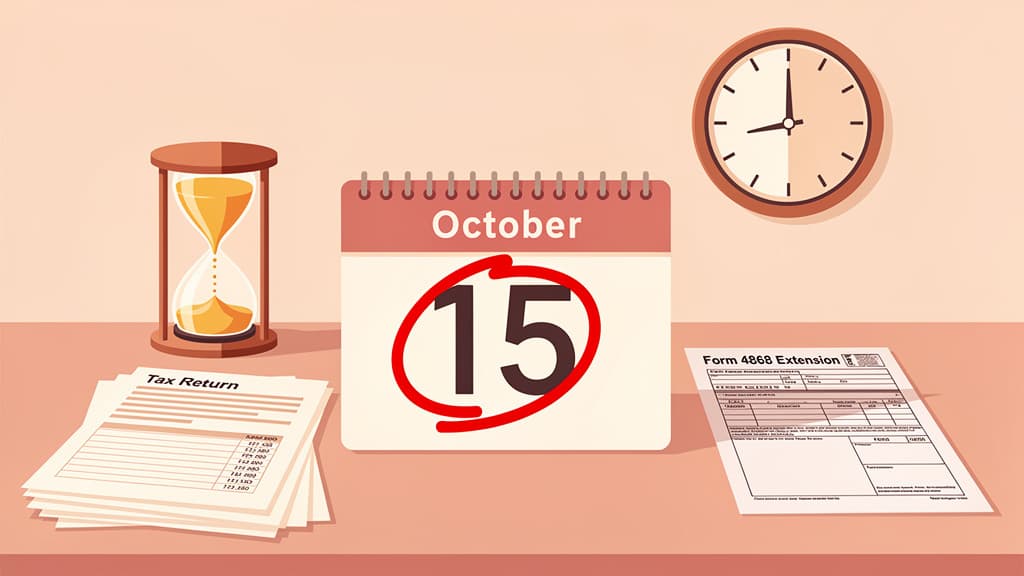
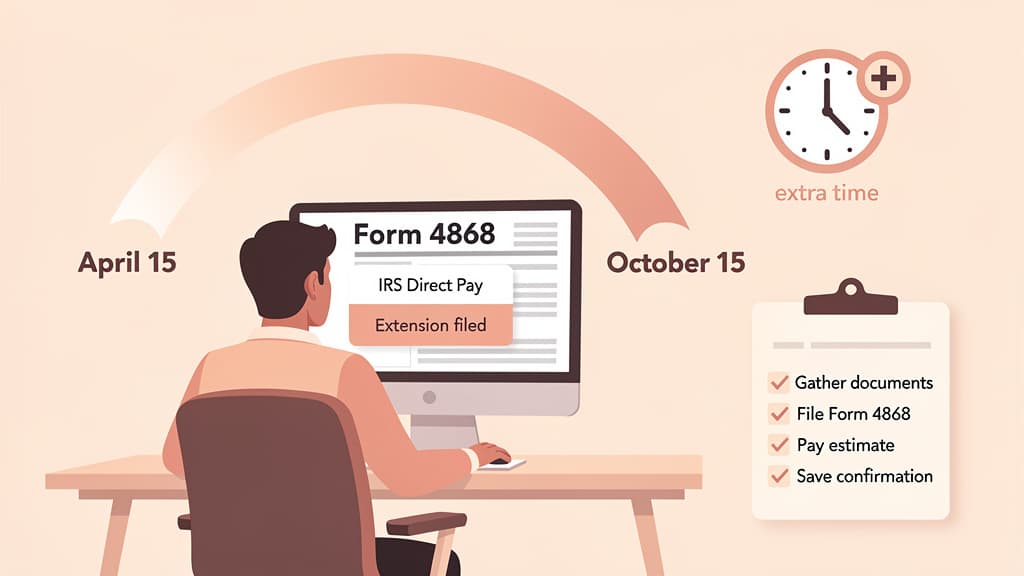
A federal tax extension moves your filing deadline six months, from April 15 to October 15, 2026, and it is free and automatic: Form 4868 for individuals, Form 7004 for businesses. The deadline to request one for tax year 2025 was April 15, 2026, and it has passed. If you filed the extension, you have about six weeks left: extended individual returns are due October 15, 2026, and there is no second extension. If you didn't, you cannot get an extension retroactively; filing your return now is what stops the 5%-per-month failure-to-file penalty from growing.
Key takeaways:
- Form 4868 extends individual returns (Form 1040, including Schedule C); Form 7004 extends business returns (Forms 1065, 1120-S, 1120)
- An extension extends filing, not payment: 2025 tax was due April 15, 2026, and unpaid balances accrue a 0.5% monthly penalty plus interest (7% in Q3 2026)
- Extended individual and C corporation returns are due October 15, 2026; extended partnership and S-Corp returns are due September 15, 2026
- If you extended, you can still fund a SEP-IRA for tax year 2025 (up to $70,000) until October 15, 2026
- Missed both deadlines? Once a return is over 60 days late, the minimum late-filing penalty is $525 or 100% of the tax due, whichever is less
What is a tax extension? An automatic 6-month extension of time to file your federal tax return: from April 15 to October 15, 2026.
2026 Extension Overview:
| Factor | Details |
|---|
| Individual extension form | Form 4868 |
| Business extension form | Form 7004 |
| Original filing deadline | April 15, 2026 |
| Extended filing deadline | October 15, 2026 |
| Payment deadline | April 15, 2026 (no extension) |
| Cost to file extension | Free |
| Failure-to-file penalty | 5% per month, up to 25% |
| Failure-to-pay penalty | 0.5% per month, up to 25% |
| Minimum late-filing penalty | Lesser of $525 or 100% of tax owed |
Key point: The extension is automatic. You do not need to explain why you need more time. File the form on time and the IRS grants the extension without question.
Legal basis: IRC Section 6081 (extensions of time for filing returns), IRC Section 6651 (penalties for failure to file or pay), IRS Publication 17

A tax extension gives you additional time to file your federal tax return. For individuals, Form 4868 provides an automatic 6-month extension. For businesses, Form 7004 serves the same purpose.
The word "automatic" matters here. Unlike some IRS requests that require approval, the extension is granted as long as you submit the form correctly and on time. No justification required. No approval process. No waiting.
What an extension does:
- Moves your filing deadline from April 15 to October 15, 2026
- Eliminates the failure-to-file penalty for returns submitted by October 15
- Gives you time to gather documents, wait for K-1s, or handle complex returns
What an extension does not do:
- Extend your deadline to pay taxes owed
- Reduce or eliminate interest on unpaid taxes
- Extend your deadline for estimated tax payments
- Give you extra time to fund a Traditional IRA or Roth IRA (those are due April 15 regardless)
Legal citation: IRC Section 6081(a) authorizes the Secretary to grant a "reasonable extension of time for filing any return" not to exceed 6 months.
Any individual who needs more time to file Form 1040, 1040-SR, or 1040-NR. This includes:
- Sole proprietors filing Schedule C
- Single-member LLC owners
- Freelancers and independent contractors
- Partners and S Corp shareholders (for their personal return)
- Anyone with complex individual tax situations
There are four filing routes: IRS Free File, tax software, a mailed paper form, or an electronic payment marked as an extension request (IRS Direct Pay and EFTPS both let you designate a payment as an extension, which replaces the form entirely). The step-by-step extension filing guide walks through each method, including the payment-as-extension route, for when the window reopens for 2026 returns in early 2027.
Form 4868 is straightforward. You'll provide:
- Your name, address, and Social Security number
- An estimate of your total 2025 tax liability
- Your total tax payments already made (withholding, estimated payments)
- The amount you're paying with the extension
April 15, 2026, the same as the original return deadline. The form must be filed (or postmarked, if mailing) on or before this date. April 15, 2026 was a Wednesday, so there was no weekend shift.
For tax year 2025, this deadline has passed, and Form 4868 cannot be filed late. If you didn't request the extension by April 15, 2026, your return is now overdue and the failure-to-file penalty accrues at 5% per month; file as soon as possible and see What Happens If You Don't File Taxes for penalty-relief options. If you did file the extension, your runway ends October 15, 2026. The October 15 deadline guide covers exactly what's due that day and the penalty math if you miss it.
The difference between Form 4868 and Form 7004 comes down to who files it: Form 4868 extends individual returns (Form 1040, including Schedule C sole proprietors), while Form 7004 extends business entity returns. Our Form 7004 instructions guide maps every line and form code. Form 7004 covers entities that file their own tax returns:
- S Corporations (Form 1120-S): original deadline March 16, 2026
- Partnerships (Form 1065): original deadline March 16, 2026
- C Corporations (Form 1120): original deadline April 15, 2026
- Multi-member LLCs taxed as partnerships: original deadline March 16, 2026
Note for sole proprietors and single-member LLCs: You don't file Form 7004. Your business income goes on Schedule C of your personal Form 1040, so you use Form 4868 instead.
| Entity | Form | Original Deadline | Extension Length | Extended Deadline |
|---|
| Sole proprietor | 1040 + Sch C | April 15, 2026 | 6 months | October 15, 2026 |
| Partnership | 1065 | March 16, 2026 | 6 months | September 15, 2026 |
| S Corporation | 1120-S | March 16, 2026 | 6 months | September 15, 2026 |
| C Corporation | 1120 | April 15, 2026 | 6 months | October 15, 2026 |
| Multi-member LLC | 1065 | March 16, 2026 | 6 months | September 15, 2026 |
Why the March 16 deadline matters for S Corps and partnerships: These entities issue K-1s to their owners. The earlier deadline is designed to give owners their K-1s before the April 15 individual filing deadline. When the entity files an extension, K-1s are often delayed too, which creates a cascade of extensions for the individual owners.
This is the single most important thing to understand about tax extensions, and the point where most self-employed filers make costly mistakes.
Filing an extension gives you more time to file your return. It does not give you more time to pay your taxes.
Your tax payment is still due April 15, 2026. If you owe money and don't pay by that date, you'll face:
- Rate: 0.5% of unpaid tax per month (or partial month)
- Maximum: 25% of unpaid tax
- The 90% safe harbor: if at least 90% of your actual tax was paid by April 15 (through withholding, estimated payments, or a payment sent with Form 4868) and you pay the rest when you file, the IRS waives this penalty for the extension period (per the Form 4868 instructions)
- Rate: Federal short-term rate plus 3%, compounded daily
- Current rate: 7% for Q3 2026 (it was 6% in Q2); the IRS resets the rate quarterly — check the quarterly interest rates page for the Q4 rate that applies from October 1
- Runs from: April 15 until the date you pay in full
| Scenario | Filing Penalty | Payment Penalty | Interest |
|---|
| Filed extension, paid on time | None | None | None |
| Filed extension, didn't pay | None | 0.5%/month | Yes |
| No extension, no payment | 5%/month (up to 25%) | 0.5%/month | Yes |
| Filed late (60+ days), didn't pay | Minimum $525 | 0.5%/month | Yes |
The takeaway: Even if you can't pay your full tax bill, file the extension. The failure-to-file penalty (5% per month) is 10 times higher than the failure-to-pay penalty (0.5% per month). Filing the extension eliminates the more expensive penalty entirely.
Legal citation: IRC Section 6651(a)(1) imposes the failure-to-file penalty. IRC Section 6651(a)(2) imposes the failure-to-pay penalty. When both apply in the same month, the failure-to-file penalty is reduced by the failure-to-pay amount, capping the combined monthly penalty at 5%.
Payment was due April 15 even with the extension. If you skipped that payment or lowballed it, the same estimate tells you what to pay now, because the 0.5% monthly penalty and interest stop accruing only on amounts you've paid. Here's a practical approach:
Add up your 2025 business revenue and subtract your business expenses. Use your bank statements, accounting software, or Jupid's auto-categorization to get a reasonable estimate.
Multiply your net self-employment income by 92.35% (this accounts for the employer-equivalent portion), then multiply by 15.3%.
Example: $100,000 net SE income x 0.9235 = $92,350 x 0.153 = $14,130 in self-employment tax
Use the self-employment tax calculator to run your specific numbers.
Take your total income, subtract above-the-line deductions (half of SE tax, health insurance premiums, retirement contributions), and subtract the standard deduction: $15,750 for single filers for tax year 2025, per the One Big Beautiful Bill Act. Run the result through the tax bracket calculator.
Subtract any W-2 withholding and quarterly estimated tax payments you've already made during 2025.
If you owe, pay that amount. Past April 15, the fastest route is IRS Direct Pay: penalties and interest stop accruing on whatever you pay, from the day you pay it.
Pro tip: If you're unsure about the exact amount, it's better to overpay slightly. You'll get the excess back as a refund when you file your return. Underpaying triggers the failure-to-pay penalty and interest.
Filing an extension isn't a failure of planning. In many situations, it's the smart move:
If you're a partner in a partnership or a shareholder in an S Corporation, you need Schedule K-1 to complete your personal return. When the business entity files its own extension, your K-1 may not arrive until September. You can't file an accurate return without it.
Sole proprietors with multiple income streams, significant deductions, or first-year business expenses often need additional time to properly categorize and document everything. Rushing to meet April 15 can lead to errors that trigger audits or leave money on the table.
Freelancers and consultants who traveled for work or had clients in multiple states may need to file multiple state returns. Sorting out which income is taxable in which state takes time.
Starting a business, converting from sole proprietorship to LLC, making an S Corp election, selling a business, or buying significant assets all create complex tax situations that benefit from extra preparation time.
While IRA contributions are due by April 15 regardless of extensions, if you have a SEP-IRA, you can contribute up to the extended filing deadline (October 15) if you file an extension. This is a significant advantage: you can fund up to $70,000 (the 2025 limit; it rises to $72,000 for 2026) in a SEP-IRA as late as October 15, 2026 for the 2025 tax year.
CPAs and tax preparers are overwhelmed during tax season. Filing an extension gives your preparer more time to give your return the attention it deserves, rather than rushing through it in the April crunch.
Federal and state extensions are separate filings. Here's what you need to know:
Many states grant an automatic extension when you file a federal extension. You don't need to file a separate state form. These typically include:
- California: automatic 6-month extension (to October 15); no separate form needed if no tax due
- New York: automatic 6-month extension if you file Form IT-370 or have a federal extension
- Texas: no state income tax (no extension needed)
- Florida: no state income tax (no extension needed)
- Illinois: automatic 6-month extension; file IL-505-I to make a payment
Some states require their own extension form regardless of your federal extension:
- New Jersey: file Form NJ-630
- Connecticut: file Form CT-1040 EXT
- Georgia: file separate extension if you owe state taxes
Alaska, Florida, Nevada, New Hampshire (limited), South Dakota, Tennessee, Texas, Washington, Wyoming
Important: Even in states that accept the federal extension, you may still need to pay estimated state taxes by the original deadline. Check your state's specific rules.
| Date | Action |
|---|
| April 15, 2026 | Extension filed, estimated payment made |
| June 15, 2026 | Q2 estimated payment for 2026 (already passed; pay now if you skipped it) |
| September 15, 2026 | Q3 estimated payment for 2026 due; S Corp/Partnership extended returns due |
| October 15, 2026 | Individual extended returns due; SEP-IRA contribution deadline |
| January 15, 2027 | Q4 estimated payment for 2026 due |
As of September 2026, the two dates left on the runway are September 15 (Q3 estimated payment, plus extended S Corp and partnership returns — which means late K-1s typically land in the second half of September) and October 15 (your extended Form 1040). The October 15 deadline guide breaks down the penalty math for missing the final date.
- Gather missing documents: K-1s, corrected 1099s, final expense records
- Make additional payments: if your April estimate was too low, pay the difference through IRS Direct Pay to reduce penalties and interest
- Continue quarterly estimated payments: your 2026 estimated tax payments are due on their regular schedule regardless of your 2025 extension (use the quarterly tax calculator to size them)
- Prepare your return carefully: the whole point of the extension is having time to file an accurate return
When you file your return before October 15, you don't need to do anything special. Just file normally. The IRS already has your extension on record. If you overpaid with your extension, the overpayment will be applied to your refund.
This is by far the most common and most expensive mistake. The extension gives you six extra months to file. It gives you zero extra days to pay. Pay what you owe by April 15 or face penalties and interest starting that day.
Some people avoid filing the extension because they can't afford to pay. This is backwards. The failure-to-file penalty (5% per month) is dramatically worse than the failure-to-pay penalty (0.5% per month). Always file the extension, even if you can't pay a single dollar.
Your extension applies to your 2025 tax return. Your 2026 quarterly estimated tax payments follow their own schedule and are completely unaffected by the extension. Missing Q2 or Q3 payments while waiting to file your extended return can create a new penalty problem.
An extension gives you flexibility, not an excuse to procrastinate. If your documents are ready by June, file in June. The sooner you file, the sooner any overpayment is refunded, and the less interest accrues on any underpayment.
Just because the IRS accepted your federal extension doesn't mean your state did. Check whether your state requires its own extension form or payment. Missing a state deadline can result in separate state-level penalties.
The extension bought you time; Jupid makes sure the return you file with it is right. Connect your bank account and Jupid separates business income from personal deposits, categorizes deductible expenses into Schedule C categories with 95.9% accuracy, and calculates your self-employment tax from actual net income instead of an April guess. When you're ready to file, ask the AI accountant in WhatsApp or iMessage "What's my estimated 2025 tax bill?" and get an answer built from your real transactions. Try Jupid.
A tax extension is a free, automatic, no-questions-asked tool that gives you six months of breathing room. The only rule that trips people up is that payment is still due April 15. Pay down any remaining balance now, and use the months you bought to file an accurate return rather than a rushed one. For 2025 returns, the runway ends October 15, 2026.
Disclaimer: This article is for informational purposes only and does not constitute tax, legal, or financial advice. Tax laws change frequently, and individual circumstances vary. Consult a qualified tax professional for advice specific to your situation. Jupid provides AI-powered transaction categorization and tax estimates but is not a substitute for professional tax counsel.