Published: May 10, 2026
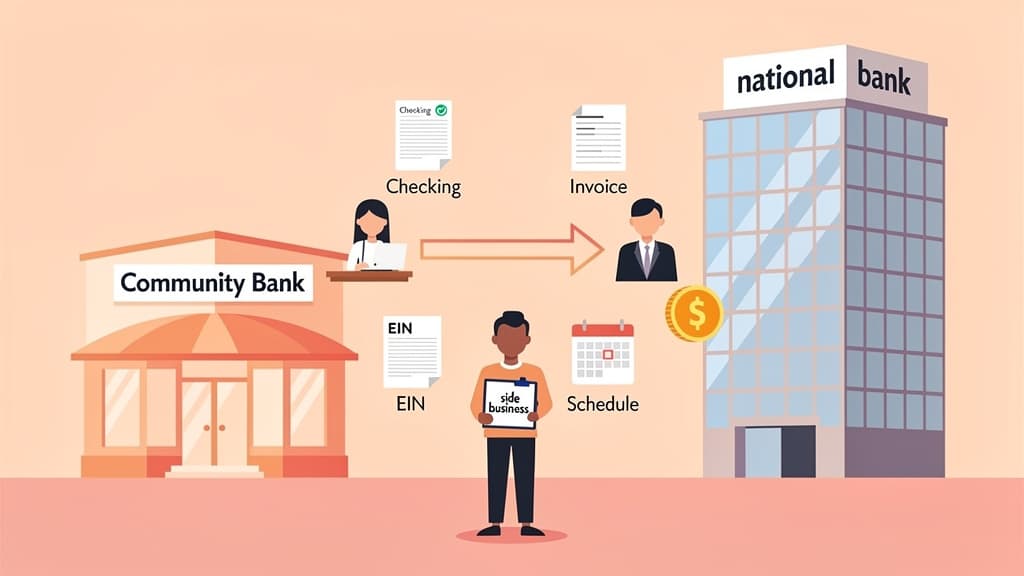
JPMorgan's American Dream Initiative is worth paying attention to, even if you are not trying to compete with JPMorgan on scale.
The bank announced a goal to grow from 7 million to 10 million small business clients, backed by more lending, more small business bankers, coaching, and a broader set of tools around cash flow, payroll, invoicing, supplier discounts, retirement plans, and healthcare.
For credit unions and community banks, the takeaway is not "copy JPMorgan."
Most community financial institutions cannot, and should not, try to recreate a national-bank small business ecosystem overnight.
But the announcement does make one thing very clear: small business banking is becoming a full relationship strategy again.
It is not just about opening a business checking account. It is not just about lending. It is not just about merchant services. It is about becoming the place a business owner turns when they are trying to get paid, stay organized, separate personal and business finances, understand cash flow, prepare for taxes, hire, borrow, and grow.
That is a big strategic shift.
And it creates a very practical question for community FIs:
Can a small business owner get from "I am starting something" to "I know my next step" inside your institution?

Many business relationships do not begin with someone walking into a branch and saying, "I would like to become a business banking customer/member."
They begin much earlier and much more casually.
An account holder says they started doing work on the side.
Someone asks whether they can deposit a check from a client.
An account holder mentions they are forming an LLC.
Someone asks if it is okay to keep using their personal account for business income "just for now."
Another account holder says they are not ready for a business loan, but they may need one later.
These moments are easy to miss because they often show up inside consumer banking conversations, not business banking conversations.
That is where community FIs have an advantage. They already have trust. They already have local relationships. They often hear about the business before the business looks like a "business banking prospect" in the data.
But that advantage only matters if the signal is recognized, routed, and followed up.
When a large bank makes a major SMB announcement, it is tempting to respond with a big strategic question:
What products do we need to add?
That question matters, but it may not be the best first question.
A better first question is:
What happens today when a customer/member tells us they are starting or running a business?
If the answer depends on which branch they visit, which call center representative they reach, or which banker happens to be available, the institution may have a growth gap before it has a product gap.
The first opportunity may be much simpler:
- give frontline teams clear business-intent trigger phrases;
- give them one approved response;
- create a clean handoff to the right business banking owner;
- record the signal even if the owner is not ready to open today;
- follow up with something genuinely useful.
This is not a replacement for stronger digital banking, treasury services, payments, account opening, or lending. Those capabilities still matter.
But before adding complexity, it is worth fixing the handoff.
Here is a simple diagnostic any credit union or community bank can run in a 15-minute internal huddle.
Pick one common scenario:
"I have a side business and I am still using my personal account."
Then ask five questions.
Is it the branch? The contact center? Digital support? Lending? Marketing? A community event? A financial wellness program?
Business intent can appear almost anywhere. The institution needs to know which teams are most likely to hear it first.
If ten employees hear the same sentence from an account holder, do they respond in a similar way?
The goal is not to turn every employee into a business banker. The goal is to give them enough language to be helpful and create a clean next step.
Does the employee know where to route the account holder?
Is there a named business banking contact, branch specialist, appointment flow, digital form, or follow-up process?
If the next step is unclear, the opportunity will usually disappear.
Not every owner is ready to open a business account today.
That does not mean the conversation has no value.
If the account holder says they are starting a business, using a personal account for business income, thinking about an LLC, receiving client payments, or preparing to borrow later, that signal should be captured somewhere.
Otherwise, the institution has no way to nurture the relationship.
This is where many good conversations break down.
The owner may trust the institution enough to mention the business, but if nobody follows up, they may go online later and open elsewhere.
A follow-up does not need to be aggressive. It can simply offer guidance on separating finances, preparing documents, understanding account requirements, or thinking through payment needs.
Recognizing business intent is only the first step.
The harder part is giving frontline teams language that is helpful, compliant, and easy to remember.
A good response should do four things:
- acknowledge the business owner without judgment;
- explain why separation matters;
- avoid giving legal, tax, or accounting advice;
- create a next step without pushing a product.
This is where a simple script can help. The script does not need to turn a teller, branch employee, or contact center representative into a business banker. It only needs to help them recognize the moment and route it cleanly.
Recognizing the signal is only the beginning.
The next step is building a simple operating path: what to say, where to route the conversation, what context to preserve, and what to measure over the first 30 days.
We included the more practical templates in the downloadable SMB Intent Handoff Checklist:
- a next-best-step menu for common small business moments;
- a routing note template;
- a follow-up email template;
- a scorecard for branch, contact center, digital support, or business banking teams;
- simple metrics to review after the first 30 days.
The goal is to make the invisible opportunity visible before the relationship goes elsewhere.
You can download the PDF by entering your email below, or email me directly at anna@jupid.com and I can send it over.
Download the SMB Intent Handoff Checklist
Enter your email and the 5-page PDF opens right away — a sample frontline script, a routing note template, a follow-up email template, a team scorecard, and a 30-day plan.
We'll use this to send you the resource and the occasional note on community FI & small business banking. No spam, unsubscribe anytime. Prefer email? Write to anna@jupid.com.
JPMorgan's announcement is a scale signal.
It shows that major banks are treating small business owners as long-term, multi-product relationships.
For community FIs, the opportunity is different.
It is about recognizing local business intent earlier, helping owners take the right next step, and making the relationship easier to keep.
That does not require copying JPMorgan.
It requires making sure that when a customer/member says, "I am starting something," your institution knows what to do next.
I'm Anna Khalzova, Co-founder of Jupid. We help credit unions and community banks win and retain small business members through embedded AI-native financial services. You can download the SMB Intent Handoff Checklist above, or email me at anna@jupid.com.