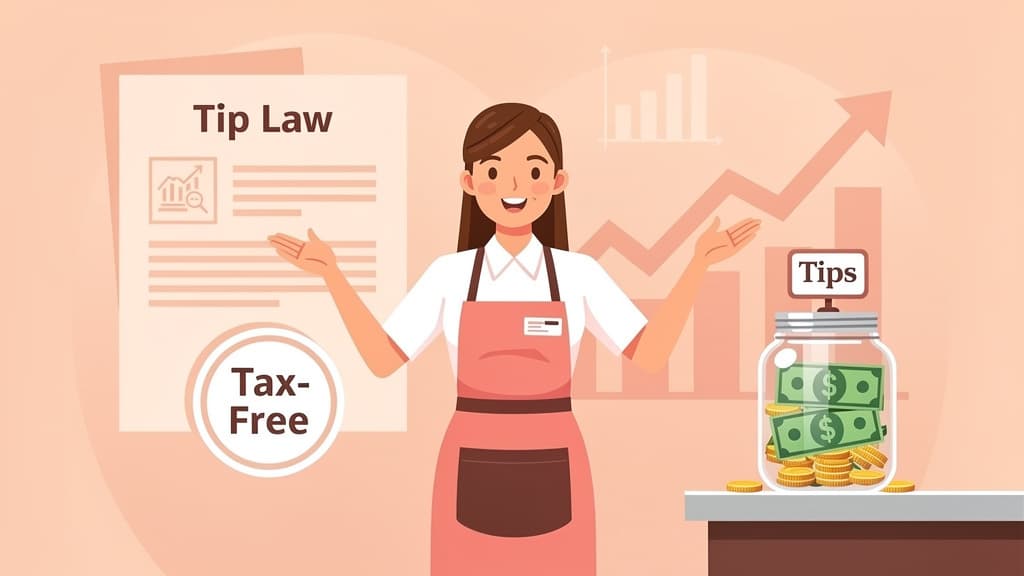
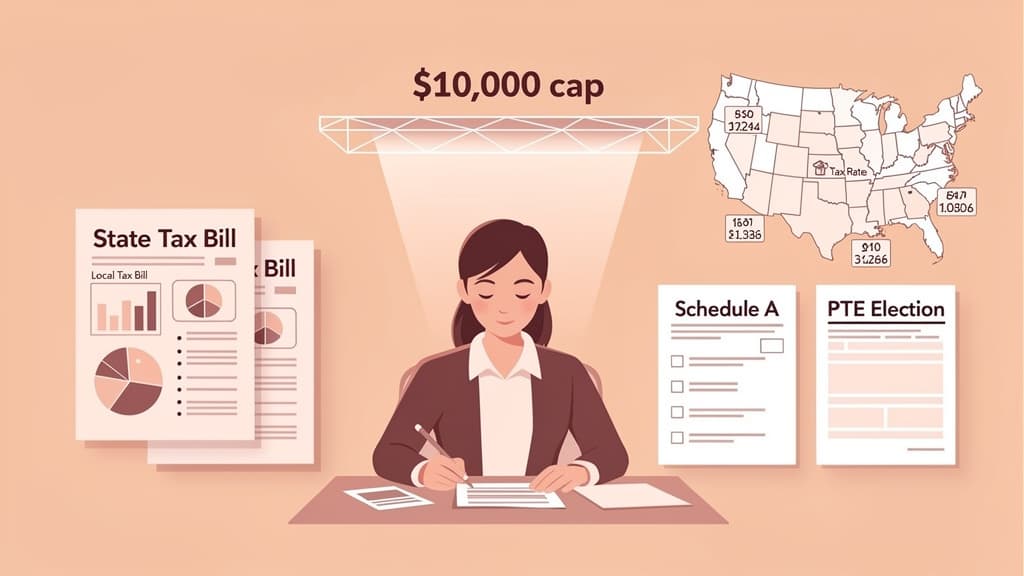
The OBBBA "No Tax on Tips" deduction lets qualifying tipped workers deduct up to $25,000 of tip income from federal income tax for tax years 2025 through 2028. It is a deduction, not a full exemption. Your tips are still taxed for Social Security and Medicare (the 7.65% FICA share for employees, or 15.3% self-employment tax if you work for yourself), and the deduction does not lower your adjusted gross income (AGI). You claim it on the new Schedule 1-A, whether or not you itemize.
Key takeaways:
- Cap: up to $25,000 of qualified tips per year (2025–2028). It phases out above $150,000 MAGI (single) or $300,000 (married filing jointly), dropping $100 for every $1,000 over the threshold.
- How you claim it: on the new Schedule 1-A, available even if you take the standard deduction. It reduces taxable income but not AGI.
- The catch: tips still owe payroll tax. Employees see 7.65% withheld; self-employed workers owe the full 15.3% self-employment tax on every tip dollar.
- Who qualifies: only the 68 IRS-listed occupations that "customarily and regularly" received tips before 2025. Specified Service Trade or Business (SSTB) jobs are excluded.
- On your paycheck: qualified tips may appear under the payroll code OBBBTIP. On your W-2 they show in Box 12, code TP, with your occupation code in Box 14b.

Save this cheat sheet — the deduction cap, phase-outs, and forms in one image.
OBBBTIP is a payroll earnings code that providers such as ADP, Paychex, and OnPay use to label the portion of your tips that counts as qualified tips under the One Big Beautiful Bill Act (OBBBA). When you see OBBBTIP on a 2026 pay stub, it means your employer has flagged those tips as eligible for the "No Tax on Tips" deduction. The code is informational: OBBBTIP tips are still included in your wages and are still subject to federal income tax withholding plus Social Security and Medicare tax during the year.
The payroll code maps to two official W-2 fields for 2026 (the forms you receive in early 2027):
- Box 12, code TP reports the total qualified tips you received during the year.
- Box 14b carries your IRS occupation code, which confirms you work in a tip-eligible occupation.
You use the Box 12 code TP figure to fill in Schedule 1-A when you file. If your employer runs cash tips or controlled tips through the OBBBTIP earnings code but your job is not on the IRS occupation list, the tips still will not qualify for the deduction.
OBBBA did not remove tips from income. It created a new deduction, claimed on Schedule 1-A, that you can take whether or not you itemize. Your qualified tips still appear as income on your return, but the deduction reduces your taxable income by the amount of qualifying tips, up to $25,000. Unlike a true above-the-line deduction (student loan interest or IRA contributions), the tip deduction does not reduce your adjusted gross income. It sits below the AGI line.
This means:
- Income tax: reduced by the deduction (this is the benefit).
- Social Security tax: still applies to all tip income (6.2% employee share, or the employee plus employer share for self-employed).
- Medicare tax: still applies to all tip income (1.45% employee share, 2.9% for self-employed).
- State income tax: depends on your state. Most states do not conform to this deduction yet.
The savings depend on your federal income tax bracket. If you earn $25,000 in qualified tips and sit in the 22% bracket, the deduction saves you $5,500 in federal income tax. Potential savings by bracket:
| Tax Bracket | Max Deduction ($25,000) | Federal Tax Saved |
|---|
| 10% | $25,000 | $2,500 |
| 12% | $25,000 | $3,000 |
| 22% | $25,000 | $5,500 |
| 24% | $25,000 | $6,000 |
For most tipped workers earning under $150,000, the 12% or 22% bracket applies, so the annual savings run from roughly $3,000 to $5,500.
What you still owe on that $25,000 in tips: self-employment tax of 15.3% (if self-employed) or the 7.65% employee share of FICA. The tip deduction does nothing to reduce these amounts.
Not every worker who receives tips qualifies. Your occupation, your income, and how you report the tips all decide whether you can claim the deduction.
Treasury's proposed regulations list 68 occupations, grouped into eight categories, that "customarily and regularly" received tips on or before December 31, 2024. Your occupation must appear on that list.
Qualifying occupations include (partial list):
- Waiters, waitresses, and food servers
- Bartenders
- Baristas and coffee shop workers
- Bussers and hosts/hostesses
- Valets and parking attendants
- Hairdressers, barbers, and salon workers
- Nail technicians and estheticians
- Massage therapists (non-medical)
- Taxi and rideshare drivers
- Delivery drivers (food delivery, courier services)
- Hotel bellhops, concierges, and housekeepers
- Casino dealers
- Tour guides
- Personal trainers and fitness instructors
- Pet groomers
- Water taxi operators
- DJs and event service workers
The deduction excludes employees of a Specified Service Trade or Business (SSTB). That means:
- Healthcare workers who receive tips: excluded.
- Performing artists: excluded.
- Athletes: excluded.
- Consultants and advisors: excluded.
If your occupation was not one that customarily and regularly received tips before 2025, you do not qualify, even if you now receive tips through the digital tipping prompts that have spread across counter-service businesses.
The deduction phases out for higher earners:
- Single filers: phase-out begins at $150,000 MAGI.
- Married filing jointly: phase-out begins at $300,000 MAGI.
- Phase-out rate: the deduction drops $100 for every $1,000 of MAGI above the threshold.
Phase-out example (single filer). With $175,000 MAGI, you are $25,000 over the $150,000 threshold. The reduction is $25,000 ÷ $1,000 × $100 = $2,500, so your available deduction is $25,000 − $2,500 = $22,500. At $400,000 MAGI, the deduction is fully phased out.
A self-employed worker in a qualifying occupation, such as a freelance hairdresser or an independent rideshare driver, can claim the deduction too. One extra cap applies: the deduction cannot exceed your net income from the trade or business in which the tips were earned.
Example. You are a self-employed barber with $30,000 in net Schedule C income, of which $20,000 came from tips. Your deduction is limited to $20,000 (the tips actually earned), not the full $25,000 cap.
"Qualified tips" under the OBBBA must be:
- Voluntary. The customer chose to leave the tip; it was not required.
- Received from customers. Either directly or through a tip-sharing or tip-pooling arrangement.
- Cash or charged tips. Both cash tips and tips added to credit or debit card payments qualify.
- Reported properly. Tips must be reported on your return (Form 4070 for employees, Schedule C for self-employed).
Several common forms of tip-like income are specifically excluded:
- Service charges. Mandatory charges added to bills (an 18% auto-gratuity for large parties) are wages, not tips.
- Auto-gratuities. Same as service charges. If the customer has no choice, it is not a tip.
- Administrative fees. Delivery fees, booking fees, and platform fees are not tips.
- Employer-distributed service charges. Even if your employer passes along service-charge revenue to you, it is classified as wages.
This distinction matters most for restaurant workers. If your employer adds an automatic 20% gratuity to every check and distributes it to staff, those amounts are service charges, not qualified tips, regardless of what the receipt calls them.
Tips received through legitimate tip pooling or tip sharing do qualify. If front-of-house staff pool tips and split them with bussers and bartenders, the tips keep their character as "qualified tips" for everyone in the pool.
- All tip income was fully taxable, for both income tax and FICA.
- Employees reported tips to employers on Form 4070 (monthly).
- Tips appeared on the W-2 in Box 1 (wages) and Box 7 (Social Security tips).
- No deduction or exclusion existed for tip income.
- Tip income is still fully reported as income.
- Qualifying workers deduct up to $25,000 of qualified tips on Schedule 1-A.
- FICA and self-employment tax still apply to all tips. No change there.
- Starting with 2026 W-2s, qualified tips appear in Box 12 (code TP) with an occupation code in Box 14b.
- Self-employed workers see qualified tips reported separately on Form 1099-NEC or 1099-K.
- Tip reporting obligations stay the same. You still report all tips to your employer (if employed) or on Schedule C (if self-employed).
- FICA taxes are unchanged. The 7.65% employee share (or 15.3% self-employment tax) still applies to every dollar of tip income.
- State taxes may differ. Most states have not adopted this deduction, so tips can remain fully taxable at the state level.
The "No Tax on Tips" deduction is a worker benefit, not an employer benefit. As a business owner, here is what changes for you:
New reporting requirements. Starting with 2026 W-2s, you must report qualified tips in Box 12 using code TP and add the employee's occupation code in Box 14b. The IRS gave transition relief for 2025, but 2026 reporting should follow the new boxes and codes.
No change to employer FICA. You still owe the employer's 7.65% share of FICA on all employee tip income. The deduction does not reduce employer payroll tax costs.
Recruitment advantage. The deduction raises take-home pay for your tipped employees. A server in the 22% bracket earning $25,000 in annual tips keeps an extra $5,500, without you spending a dime more.
For independent contractors, gig workers, and self-employed individuals in qualifying occupations:
- Claim the deduction on Schedule 1-A (available whether you itemize or not).
- The deduction reduces your income tax but does NOT reduce your self-employment tax.
- Your SE tax on tip income stays 15.3% on net earnings up to the $184,500 Social Security wage base for 2026.
Worked example: self-employed rideshare driver (single). Net Schedule C profit is $37,000, of which $12,000 came from tips. Self-employment tax is $37,000 × 92.35% × 15.3% = $5,227, and the tip deduction does not change it. For income tax, the $12,000 in qualified tips comes off taxable income. At a 12% marginal rate, that saves about $1,440 in federal income tax. The driver still owes the full $5,227 in SE tax on those earnings.
- Report all tips to your employer using Form 4070 or an equivalent system.
- Receive your W-2 and find qualified tips in Box 12 (code TP) with your occupation code in Box 14b.
- Claim the deduction on the new Schedule 1-A, then carry it to your Form 1040.
- No extra forms are needed beyond Schedule 1-A and your standard 1040 filing.
- Report all income, including tips, on Schedule C.
- Track tip income separately from other business income. You need the exact tip figure.
- Claim the deduction on Schedule 1-A, limited to the lesser of $25,000 or your net business income.
- Remember: self-employment tax is calculated on full net income before the tip deduction.
- Records of daily tip amounts (cash and charged).
- Copies of Form 4070 or employer tip reports.
- W-2 forms showing the Box 12 code TP amount.
- For self-employed: records separating tips from other service income.
- Proof that your occupation qualifies, especially for less common occupations.
The deduction covers income tax only. FICA and self-employment tax still apply to every dollar of tip income. For a self-employed worker, that is still 15.3% on tips.
If your job is not among the 68 occupations on the IRS list, you cannot claim the deduction. A digital tip prompt at a counter does not put your occupation on the list.
Mandatory service charges, auto-gratuities, and delivery fees are not qualified tips, even if they are distributed to employees or land in a "tips" line on your pay stub.
If your MAGI passes $150,000 (single) or $300,000 (MFJ), your deduction starts shrinking by $100 per $1,000 over the line. At $400,000 MAGI for single filers, it disappears.
OBBBA created a separate "No Tax on Overtime" deduction (up to $12,500 single, $25,000 MFJ), also on Schedule 1-A. It covers the premium half of overtime pay, not tips. You cannot count the same dollars twice.
Most states have not conformed to the OBBBA tip deduction. Your tips can stay fully taxable at the state level even after you deduct them federally.
Claiming the tip deduction correctly means separating qualified tips from service charges and other income all year long. Jupid is an AI accountant that connects to your bank account and payment apps and categorizes transactions at 95.9% accuracy, so tip income is tagged as it lands. Ask "how much did I earn in tips this quarter?" in WhatsApp or iMessage and get an instant answer, along with a real-time estimate of both your income tax savings and the self-employment tax you still owe on those tips.
Try Jupid
- IRC §224 — deduction for qualified tips (created by OBBBA)
- IRC §3121(q) — tips treated as wages for FICA purposes
- IRC §1401 — self-employment tax rates (still apply to tips)
- IRC §1402 — net earnings from self-employment definition
- One Big Beautiful Bill Act of 2025 — signed July 4, 2025
| Item | 2026 Amount |
|---|
| Maximum tip deduction | $25,000 |
| Phase-out threshold (single) | $150,000 MAGI |
| Phase-out threshold (MFJ) | $300,000 MAGI |
| Phase-out rate | $100 per $1,000 over threshold |
| Provision expiration | December 31, 2028 |
| W-2 reporting | Box 12 code TP + Box 14b occupation code |
| SE tax rate (still applies) | 15.3% |
| Employee FICA share (still applies) | 7.65% |
The "No Tax on Tips" deduction is a real tax benefit for qualifying service workers, but it is not the blanket exemption the name suggests. It cuts your federal income tax on up to $25,000 of qualified tips. It does not touch Social Security or Medicare, and it may not apply at the state level.
Three things to remember:
- Check the occupation list first. If your job is not one of the 68 IRS-listed occupations, you do not qualify, no matter how many tips you receive.
- FICA and SE tax are unchanged. Self-employed workers still owe 15.3% on tip income; employees still see 7.65% withheld.
- This provision expires after 2028. Unless Congress extends it, tip income returns to full income taxation starting in 2029.
For most qualifying tipped workers earning under $150,000, the deduction is worth between $1,500 and $5,500 per year in federal income tax savings. That is meaningful money, so track your tips properly and meet every requirement to claim it.
Disclaimer
This article provides general information about the OBBBA "No Tax on Tips" deduction and should not be considered tax advice. Tax rules, income thresholds, and qualifying occupations may change as the IRS finalizes the proposed regulations. Your actual benefit depends on your occupation, income level, filing status, and tip amounts. For advice specific to your situation, consult a qualified tax professional.
Tax Year: 2026
Last Updated: July 7, 2026