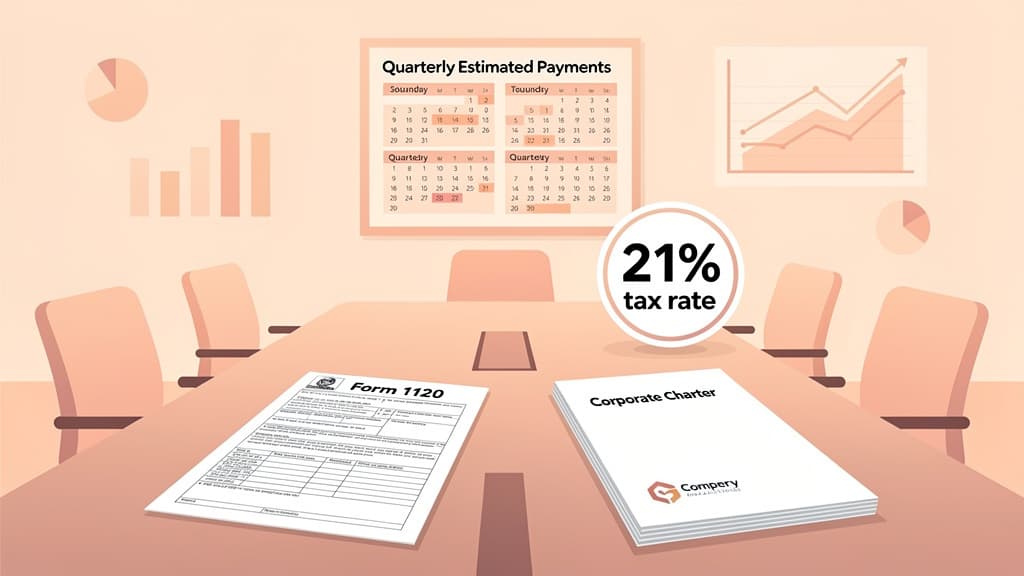
The deadline rhythm for a calendar-year C-Corp in 2026: Form 1120 is due April 15, and estimated tax goes out in four installments — April 15, June 15, September 15, and December 15. That last date is the trap. Individuals pay their fourth installment on January 15 of the following year; a C-Corp's Q4 payment is due December 15 of the current year (IRC §6655). The corporation itself pays a flat 21% on taxable income — before any dollar reaches shareholders.
Key takeaways:
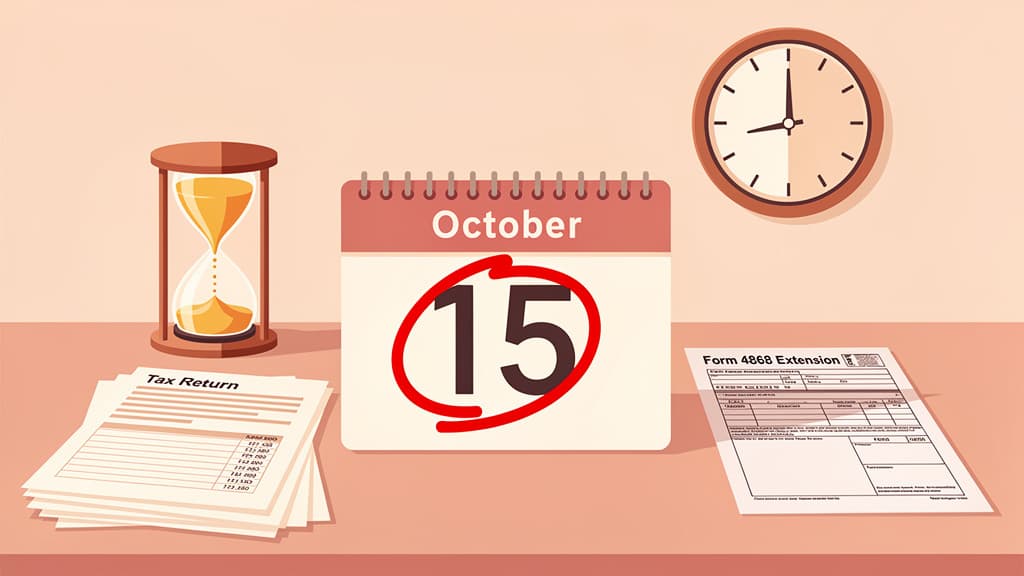
Form 1120 is due April 15, 2026 for calendar-year C-Corps. Form 7004, filed by that date, extends filing — not payment — to October 15, 2026.
Estimated payments are required once the corporation expects to owe $500 or more for the year (a lower bar than the $1,000 individual threshold), and they must go through EFTPS.
The Q4 estimated payment is due December 15, 2026, not January 15. Paying in January costs a month of underpayment penalty on the entire installment.
File Form 1120 more than 60 days late and the minimum penalty is the lesser of $525 or 100% of the unpaid tax — on top of the 5%-per-month late-filing rate.
A "large corporation" ($1M+ taxable income in any of the prior three years) can use the prior-year safe harbor only for Q1; payments for Q2 through Q4 must be based on current-year numbers.
If your C-Corp follows the calendar year (January 1 through December 31), Form 1120 is due April 15, 2026. This is the same date as individual tax returns, which makes sense — unlike S-Corps and partnerships, C-Corps don't generate K-1s that other taxpayers need before filing.
C-Corps that use a fiscal year instead of the calendar year file by the 15th day of the 4th month after the fiscal year ends.
Fiscal Year-End
Form 1120 Due Date
March 31
July 15
June 30
October 15*
September 30
January 15
*One exception: under the IRC §6072(b) transition rule, a C-Corp with a June 30 fiscal year that began before January 1, 2026 (such as the year ending June 30, 2026) still files by the 15th day of the 3rd month — September 15; the October 15 date applies to June 30 tax years beginning after December 31, 2025.
If the due date falls on a weekend or federal holiday, the deadline shifts to the next business day.
Pick your fiscal year end and filing status — the return, extension, and all four estimated-payment dates come from the tables in this guide.
Your Form 1120 deadline
April 15, 2026
Form 1120 due date — the 15th day of the 4th month after your year end. Form 7004, filed by this date, adds six months (to October 15, 2026).
Q1 estimated paymentApril 15, 2026
Q2 estimated paymentJune 15, 2026
Q3 estimated paymentSeptember 15, 2026
Q4 estimated paymentDecember 15, 2026
The Q4 estimated payment is due December 15, 2026 — not January 15 like individuals (IRC §6655 vs §6654). Paying in January costs a month of underpayment penalty on the entire installment.
Calendar-year dates are exact 2026 deadlines; fiscal-year dates recur each year and shift to the next business day when they land on a weekend or federal holiday. Estimated payments are required once the corporation expects to owe $500+ for the year, and must go through EFTPS.
If you file Form 1120 late without an extension, the penalty is 5% of unpaid tax per month (or partial month), up to a maximum of 25%. If the return is more than 60 days late, the minimum penalty is the lesser of $525 or 100% of the unpaid tax (the amount for returns due in 2026).
This is where C-Corps diverge from individuals and pass-through entities. Corporate estimated tax payments follow their own schedule, and the fourth-quarter date is the one that causes the most confusion.
The critical difference: Individual estimated tax Q4 is due January 15 of the following year. C-Corp estimated tax Q4 is due December 15 of the current year. This is because IRC §6655 defines corporate installment dates differently from IRC §6654, which governs individuals.
A C-Corp must make estimated tax payments if it expects to owe $500 or more in tax for the year. That's a lower threshold than the $1,000 threshold for individuals.
C-Corps have a simpler safe harbor than individuals — but with a significant catch for large corporations.
Standard safe harbor: Pay at least 100% of the prior year's tax in four equal installments. There is no 110% rule for corporations (that only applies to individuals with AGI above $150,000).
Current-year method: Pay at least 100% of the current year's tax in four equal installments.
Here's where it gets more restrictive. A "large corporation" — defined as one with $1 million or more in taxable income in any of the three preceding tax years — can only use the prior-year safe harbor for the first quarter (Q1). For Q2 through Q4, a large corporation must base its estimated payments on the current year's expected tax liability.
If a large corporation uses the prior-year method for Q1 and the actual Q1 liability turns out to be higher, it must make up the difference in the Q2 payment.
C-Corps must use the Electronic Federal Tax Payment System (EFTPS) for estimated tax payments. Unlike individuals, corporations generally cannot use IRS Direct Pay or mail a check with a voucher — the IRS requires electronic payment for corporate estimated tax deposits.
To register: visit eftps.gov. Allow 5-7 business days for initial enrollment.
The penalty for underpaying corporate estimated tax is calculated using the federal short-term interest rate plus 3 percentage points, applied to each quarterly underpayment for the number of days the payment was late. The penalty is computed on Form 2220 (Underpayment of Estimated Tax by Corporations).
The Tax Cuts and Jobs Act of 2017 (TCJA) replaced the graduated corporate tax brackets (which ranged from 15% to 35%) with a single flat rate of 21%. The One Big Beautiful Bill Act (OBBBA) of 2025 made the 21% rate permanent — it will not sunset.
No bracket management. Whether your C-Corp earns $50,000 or $5 million, the rate is 21%. There's no benefit to splitting income across brackets because there is only one bracket.
Comparison to individual rates. The top individual rate is 37% (for income above $640,600 in 2026 for single filers). The 21% corporate rate is significantly lower, which is one reason profitable businesses choose C-Corp status — they can retain earnings at 21% instead of distributing them at higher individual rates.
AMT eliminated. The TCJA eliminated the corporate alternative minimum tax (AMT). C-Corps no longer need to compute a separate AMT liability, though the Inflation Reduction Act introduced a 15% corporate minimum tax for corporations with average annual financial statement income exceeding $1 billion.
If your C-Corp needs more time to file Form 1120, you can request an automatic 6-month extension by filing Form 7004 by the original due date (April 15 for calendar-year filers).
Estimated tax payments are still due on their original dates. Filing Form 7004 does not extend the April 15, June 15, September 15, or December 15 estimated payment deadlines.
Interest accrues on any unpaid tax from April 15, regardless of the extension.
The late payment penalty (0.5% per month) applies to unpaid tax from the original due date, even with a valid extension.
Form 7004 must be e-filed. List "1120" as the form code. No payment is required with the form itself, but if you owe tax, paying with the extension request will reduce interest and penalties.
Not all C-Corps use the calendar year. A C-Corp can elect a fiscal year-end as long as it files consistently and the IRS approves (Form 1128 for changes).
All filing and estimated payment deadlines are calculated from the fiscal year-end:
Event
Calendar Year
June 30 Fiscal Year
Form 1120 due
April 15
October 15*
Q1 estimated payment
April 15
October 15
Q2 estimated payment
June 15
December 15
Q3 estimated payment
September 15
March 15
Q4 estimated payment
December 15
June 15
Extended Form 1120
October 15
April 15
*See the June 30 transition note above — a June 30 fiscal year that began before January 1, 2026 (including the year ending June 30, 2026) still files by September 15 under IRC §6072(b).
The formula: estimated payments are due on the 15th day of the 4th, 6th, 9th, and 12th months of the corporation's tax year.
To change your C-Corp's fiscal year, file Form 1128 (Application to Adopt, Change, or Retain a Tax Year). IRS approval is required unless the change qualifies for automatic approval under Revenue Procedure 2006-46. Short-period returns are required for the transition period.
If your C-Corp pays employees — and most C-Corps do, since shareholder-employees must receive "reasonable compensation" — you have payroll tax obligations beyond the corporate income tax.
*October 31, 2026 falls on a Saturday, so the deadline moves to Monday, November 2.**January 31, 2027 falls on a Sunday, so the deadline moves to Monday, February 1.
Due February 1, 2027 (for tax year 2026 — January 31, 2027 falls on a Sunday). If FUTA liability exceeds $500 in any quarter, quarterly deposits are required by the last day of the month following the quarter-end.
Layer 1: Corporate income tax — 21% flat rate on taxable income (Form 1120)
Layer 2: Dividend tax — When the C-Corp distributes after-tax profits as dividends, shareholders pay tax on those dividends at qualified dividend rates:
0% for taxable income up to $49,450 (single) / $98,900 (married filing jointly)
15% for taxable income up to $545,500 (single) / $613,700 (married filing jointly)
20% for taxable income above those thresholds
Plus the 3.8% Net Investment Income Tax (NIIT) for taxpayers with modified AGI above $200,000 (single) / $250,000 (married filing jointly).
Reasonable salary: Shareholder-employees receive W-2 wages, which are deductible to the corporation (reducing the 21% layer)
Retained earnings: Keep profits in the corporation for reinvestment — but watch the accumulated earnings tax
Fringe benefits: C-Corps can deduct certain employee benefits that aren't available to S-Corp shareholders owning 2%+ (health insurance, group term life up to $50K)
C-Corps that retain too much profit without a legitimate business purpose face the accumulated earnings tax — a 20% penalty tax on undistributed earnings.
Threshold: The first $250,000 in accumulated earnings is generally exempt ($150,000 for personal service corporations — accounting, law, health, engineering, architecture, consulting, and performing arts firms)
Rate: 20% on accumulated taxable income above the threshold
Trigger: The IRS looks at whether the corporation has a reasonable business need for retained earnings (expansion, debt repayment, working capital) or is retaining them primarily to help shareholders avoid dividend tax
Document specific, definite business plans for retained earnings. Vague plans like "future growth" may not satisfy the IRS. Board resolutions authorizing specific capital expenditures, acquisitions, or reserve funds provide stronger support.
If you're choosing between entity types or converting, understanding the deadline differences matters. For a full comparison, see S-Corp vs LLC.
Feature
C-Corp
S-Corp
Annual return
Form 1120 (April 15)
Form 1120-S (March 16*)
Extension
6 months (Oct 15)
6 months (Sep 15)
Q4 estimated payment
December 15
January 15 (individual)
Who pays estimated tax
The corporation
Individual shareholders
Tax rate
21% flat
Pass-through (individual rates)
Late filing penalty
5%/month of unpaid tax (up to 25%)
$255/shareholder/month
Estimated tax threshold
$500
$1,000 (individual)
Safe harbor
100% prior year (no 110% rule)
100%/110% of prior year (individual rules)
*March 15 falls on a Sunday in 2026, so the S-Corp deadline is March 16.
The most important difference for planning: with a C-Corp, the entity makes estimated payments. With an S-Corp, each shareholder makes estimated payments on their individual return based on their share of income.
For more on when business taxes are due across all entity types, see our complete business deadline calendar.
Individual taxpayers pay Q4 estimated tax on January 15 of the following year. C-Corps pay Q4 on December 15 of the current year. This is the single most common C-Corp estimated tax mistake. If you miss December 15 and pay January 15 instead, you'll owe a month of underpayment penalties on the entire Q4 installment.
The 21% rate is straightforward, but C-Corp tax planning is not. The accumulated earnings tax (20% on excess retained earnings), personal holding company rules (20% penalty on undistributed personal holding company income), and the interaction between corporate and individual tax on dividends all require active planning. A profitable C-Corp that ignores these rules can face unexpected penalty taxes.
New C-Corps sometimes assume estimated payments aren't required in the first year because there's no prior-year tax to base them on. That's wrong. If the corporation expects to owe $500 or more in its first year, estimated payments are required. Without prior-year tax, you must use the current-year method — estimate your annual tax and pay in four equal installments.
C-Corp shareholders who are also employees have two sets of tax obligations: the corporation's (Form 1120, corporate estimated payments, payroll taxes) and their personal (Form 1040, individual estimated payments on dividends and other personal income, personal state taxes). Mixing these up — or assuming the corporate estimated payments cover your personal tax — leads to underpayment penalties on one side or the other.
Running a C-Corp means managing two layers of tax — the corporate return and your personal return. Jupid connects to your business bank accounts and automatically categorizes corporate income and expenses with 95.9% accuracy, giving you a real-time view of your taxable income at the entity level.
When estimated payment deadlines approach, you know your actual numbers instead of relying on rough projections. Jupid's AI calculates estimated tax based on your current-year transactions, factoring in the 21% corporate rate and your year-to-date income pattern. That matters especially for large corporations that can't rely on the prior-year safe harbor after Q1.
Jupid works through WhatsApp, iMessage, the web interface, and other AI tools like Claude Code. Ask "What's my corporate estimated tax for Q3?" and get an answer grounded in your actual bank data — not a spreadsheet you forgot to update in June.
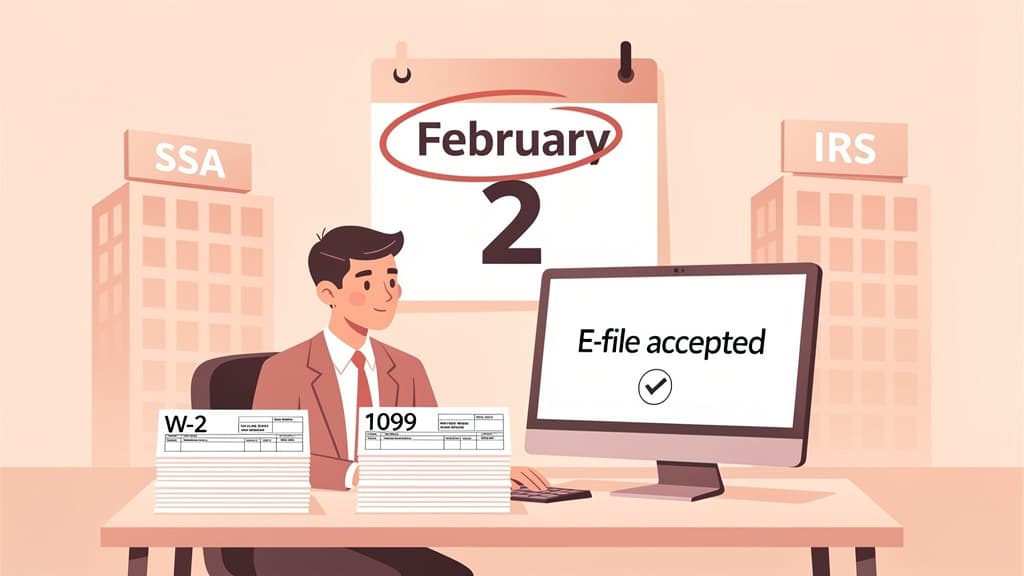
For C-Corp owners tracking contractor payments, Jupid identifies 1099-reportable transactions throughout the year so you're prepared well before the February filing deadline.
C-Corp tax compliance has more moving parts than pass-through entities. You're managing corporate-level estimated payments on a different schedule than individuals, filing Form 1120 separately from your personal return, and navigating rules like the accumulated earnings tax and large corporation requirements that don't apply to S-Corps or sole proprietors.
The single most important thing to remember: your Q4 estimated payment is due December 15, not January 15. Mark it, set a reminder, and don't let it slip. Beyond that, keep your corporate and personal tax obligations clearly separated, document your reasons for retaining earnings, and pay your installments based on actual income rather than guesses.
This article provides general information about 2026 C-Corp tax deadlines and should not be considered tax advice. Tax deadlines can shift when they fall on weekends or holidays, and specific deadlines may differ for fiscal-year filers or corporations in special circumstances. The accumulated earnings tax and personal holding company rules involve fact-specific analysis. State deadlines vary and are not covered here. For advice specific to your situation, consult with a qualified tax professional or refer to IRS Publication 542 and Publication 509.
Fintech CEO with 10+ years building accounting and financial technology products. Previously co-founded and scaled an AI-powered accounting platform to $30M revenue and 100K+ business users, achieving 30,000 customers per accountant through automation — recognized by CNBC as a top fintech company. Holds a Master's in Management Information Systems. At Jupid, he leads the development of AI-native bookkeeping, tax, and compliance tools designed for freelancers and small business owners.