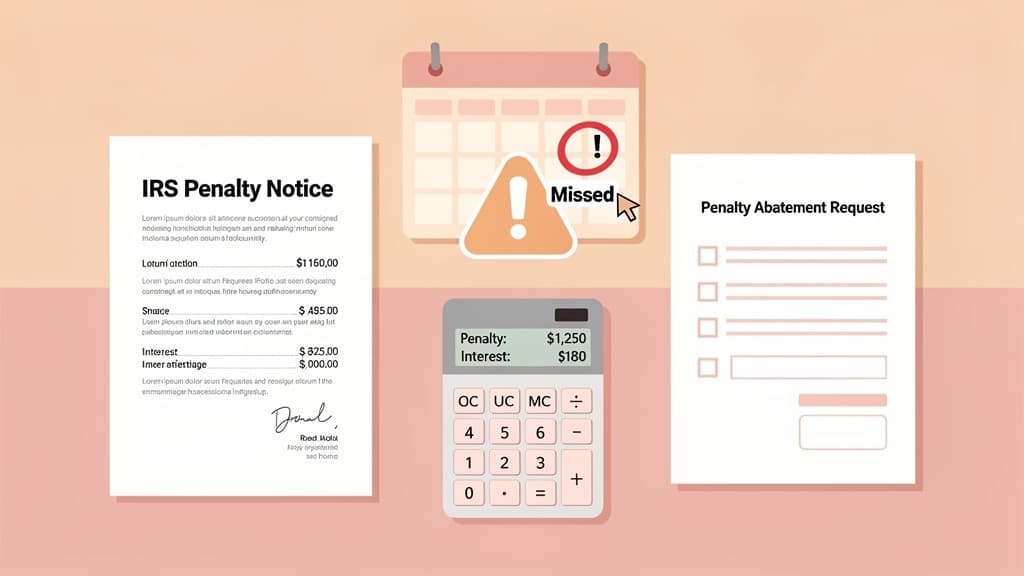
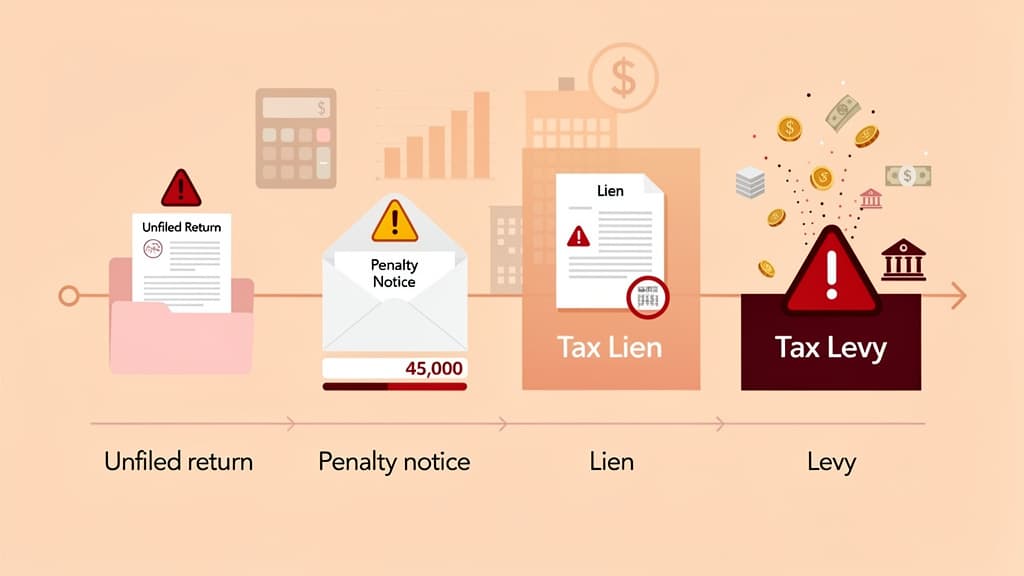
The failure-to-file penalty is 5% of unpaid tax per month, capped at 25% — ten times the 0.5%-per-month failure-to-pay penalty. That asymmetry is the single most important fact in this guide: filing on time, even when you can't pay a dollar, saves you about 90% of the penalty you'd otherwise face. And if your return is more than 60 days late, a minimum penalty kicks in — the lesser of $525 or 100% of the unpaid tax for returns due in 2026.
Key takeaways:
Filing late and paying late together cost 5% per month for the first five months (the 0.5% failure-to-pay is credited against the 5%), then 0.5% per month — up to a combined 47.5% of the unpaid tax.
S-Corp and partnership returns carry their own penalty: $255 per owner per month for up to 12 months, even when the entity owes zero tax.
Interest (federal short-term rate + 3 points, compounded daily) runs on top — 7% for the quarter beginning July 1, 2026, reset quarterly — and unlike penalties, it cannot be abated.
First-Time Penalty Abatement wipes failure-to-file and failure-to-pay penalties if your prior three years are clean — but the IRS only applies it if you ask.
An approved installment agreement cuts the failure-to-pay rate in half, to 0.25% per month.
The failure-to-file penalty is the most aggressive penalty in the IRS toolkit. It's assessed at 5% of the unpaid tax for each month (or partial month) the return is late, up to a maximum of 25%.
The penalty starts the day after the original due date (or extended due date if you filed for an extension). Even one day late triggers the full 5% for that month. Two months and one day late? That's three months of penalties — 15%.
If your return is more than 60 days late, the IRS imposes a minimum penalty: the lesser of $525 or 100% of the unpaid tax (the amount for returns due in 2026). This means even if you owe only $300 in taxes, the minimum penalty is $300 — not $525. But if you owe $5,000, you'll pay at least $525 regardless of how the percentage calculation works out.
The failure-to-pay penalty is far less severe: 0.5% of the unpaid tax per month, up to a maximum of 25%. This is one-tenth the rate of the failure-to-file penalty.
Reduced to 0.25% per month if you have an approved installment agreement with the IRS. This is one of the simplest ways to cut your penalty in half — apply for a payment plan, and the rate drops automatically for the months the agreement is in effect.
Increased to 1% per month if the IRS issues a notice of intent to levy your assets and you don't pay within 10 days. At that point, the penalty doubles from its standard rate.
Unlike the failure-to-file penalty, the failure-to-pay penalty runs from the original due date of the return — not the extended due date. Filing an extension does not protect you from the failure-to-pay penalty. If you file Form 4868 but don't pay your estimated balance by April 15, the 0.5% per month starts accruing immediately.
When both penalties apply simultaneously — you filed late and you didn't pay — the IRS doesn't simply stack them. The failure-to-file penalty is reduced by the failure-to-pay penalty for each month both run concurrently.
Here's how it works in practice:
Months 1–5 (both penalties running):
Failure-to-file: 5% - 0.5% = 4.5% per month
Failure-to-pay: 0.5% per month
Net: 5% per month
Months 6–50 (only failure-to-pay continues):
Failure-to-file: maxed out at 25% after month 5
Failure-to-pay: 0.5% per month continues
Net: 0.5% per month
Maximum combined penalty: 25% (failure to file) + 22.5% (failure to pay for 45 additional months) = 47.5% of the unpaid tax, plus interest.
The takeaway: filing on time, even without paying, eliminates the 4.5% monthly surcharge. You'd only face the 0.5% failure-to-pay penalty.
Enter your balance and how late you are to see both §6651 penalties — and what filing on time would have saved.
$
6 mo
Estimated penalties
$2,550
Filing on time would have cut this to $300 — the $2,250 failure-to-file share is pure late-filing cost.
Failure to file (offset to 4.5%/mo)$2,250
Failure to pay (0.5%/mo)$300
Share of your balance25.5%
IRC §6651 math from the article's examples: 5%/month failure-to-file offset by the 0.5%/month failure-to-pay, 25% caps, and the 60-day minimum penalty. IRS interest accrues on top and isn't included; an approved installment agreement halves the failure-to-pay rate to 0.25%/month.
On top of penalties, the IRS charges interest on any unpaid tax from the original due date until the date of payment. The rate is the federal short-term rate plus 3 percentage points, compounded daily, and it resets every quarter: 7% for Q1 2026, 6% for Q2, and back to 7% for the quarter beginning July 1, 2026 (Rev. Rul. 2026-10).
This is a critical distinction. Unlike penalties, interest cannot be reduced or eliminated through abatement requests, First-Time Penalty Abatement, or reasonable cause arguments. The only way to stop interest from accruing is to pay the balance in full.
Interest also accrues on unpaid penalties, so if you carry a balance for an extended period, you're paying interest on top of penalties on top of the original tax.
S-Corporations and partnerships face a different penalty structure. These are pass-through entities — the entity itself usually doesn't owe tax, but it must file an information return (Form 1120-S or Form 1065) so the IRS can verify that shareholders and partners are reporting their share of income.
The late filing penalty is $255 per shareholder or partner per month, for up to 12 months (the amount for returns required to be filed in 2026, per Rev. Proc. 2024-40). This applies even if the entity owes no tax.
These penalties can be devastating for multi-owner businesses. A 10-member partnership that misses the deadline by a full year faces $30,600 in penalties — for a return that may report zero tax liability.
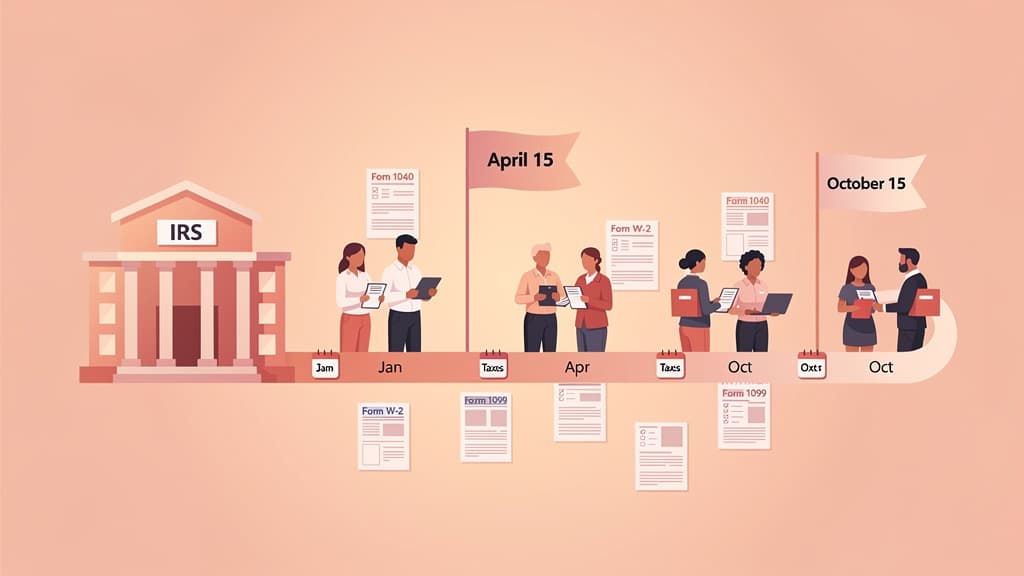
S-Corp and partnership returns are due March 15 (March 16 in 2026 because March 15 falls on a Sunday). The extended deadline is September 15. These deadlines are one month earlier than individual returns because the K-1 forms generated by these returns feed into the owners' personal tax filings.
If your business fails to file information returns (1099s, W-2s) on time or files them with incorrect information, the IRS assesses penalties based on how late the correction is made.
Separate penalties apply for failing to provide correct statements to recipients (contractors, employees). The penalty amounts and tiers mirror the IRS filing penalties above.
The estimated tax underpayment penalty under IRC §6654 is technically not a flat-rate penalty — it's calculated as interest on the underpaid amount for the period of underpayment. The rate equals the federal short-term rate plus 3 percentage points, the same rate used for general underpayment interest.
The penalty is calculated quarter by quarter. Each quarterly payment is evaluated independently, so overpaying in Q4 doesn't retroactively fix an underpayment in Q1.
You can avoid the penalty entirely by meeting either safe harbor:
Pay 90% of your current-year tax through estimated payments and withholding
Pay 100% of your prior-year tax (110% if AGI exceeds $150,000)
The IRS offers several legitimate pathways to reduce or eliminate penalties. These are not loopholes — they are formal provisions in the tax code and IRS administrative policy.
This is the most commonly used and most straightforward relief option. Under the FTA administrative waiver, the IRS will remove failure-to-file and failure-to-pay penalties if you meet three criteria:
Clean compliance history: No penalties (other than estimated tax penalties) for the prior three tax years
All required returns filed: You've filed all currently required returns or valid extensions
Paid or arranged to pay: You've paid the tax due or set up an installment agreement
FTA is available for failure-to-file, failure-to-pay, and failure-to-deposit penalties. It applies to only one tax period per request.
If you don't qualify for FTA, you can request penalty relief by demonstrating reasonable cause. The IRS evaluates whether you exercised "ordinary business care and prudence" but were still unable to comply. Common reasonable cause arguments include:
Serious illness or incapacitation — documented medical condition that prevented filing or paying
Death of an immediate family member — during the period around the filing deadline
Natural disaster — fire, flood, or other casualty destroying records
Reliance on a tax professional — if a CPA or tax preparer failed to file on your behalf (you must show you provided all information and reasonably relied on them)
IRS error or delay — the IRS gave you incorrect advice or delayed processing that caused the late filing
You must provide documentation. A written statement explaining the circumstances, supported by medical records, insurance claims, death certificates, or professional correspondence, strengthens your case.
The IRS periodically issues penalty relief for taxpayers in federally declared disaster areas. This relief typically extends filing and payment deadlines and waives penalties for the affected period. Check the IRS disaster relief page for current declarations.
For First-Time Penalty Abatement, calling is often the fastest route. Call the number on your penalty notice (or the general line at 800-829-1040). Tell the representative you'd like to request First-Time Penalty Abatement. They can process it during the call if you qualify.
For reasonable cause requests, a written explanation is usually required. Address your letter to the IRS service center that sent the penalty notice. Include:
Your name, SSN or EIN, and the tax year
The specific penalty you're requesting relief for
A clear explanation of why you failed to file or pay on time
Supporting documentation
A statement that you've since filed and paid (or arranged payment)
Form 843 (Claim for Refund and Request for Abatement) is the formal method if you've already paid the penalty and want a refund. Attach a written statement explaining your reasonable cause and any supporting documents.
If you owe taxes but can't pay in full, applying for an IRS installment agreement serves two purposes: it gives you a structured repayment plan and reduces the failure-to-pay penalty from 0.5% to 0.25% per month for the duration of the agreement.
You can apply online at IRS.gov/OPA if you owe $50,000 or less in combined tax, penalties, and interest. For larger amounts, file Form 9465.
In rare cases, the IRS may accept an offer in compromise — settling your total tax debt (including penalties) for less than the full amount owed. The IRS evaluates your ability to pay, income, expenses, and asset equity.
Offers in compromise for penalties alone are uncommon. They're more typically used when a taxpayer's total tax debt (tax + penalties + interest) exceeds what they can reasonably pay. Use the IRS OIC Pre-Qualifier Tool to check eligibility.
Plus approximately $330 in interest (at the 2026 quarterly rates — 6% in Q2, 7% from July 1 — on $10,000 for 6 months). Total cost of being 6 months late: ~$2,880.
Because the extension was filed, there is no failure-to-file penalty (assuming the return is filed by the extended deadline). Only the failure-to-pay penalty applies:
Period
Failure to Pay
Monthly Total
Months 1–6
0.5% ($50) each
$300
Total
$300
Plus approximately $330 in interest. Total cost: ~$630.
The difference between filing an extension and not filing at all: $2,250 saved in failure-to-file penalties.
This is the single most costly mistake. The failure-to-file penalty (5% per month) is ten times worse than the failure-to-pay penalty (0.5% per month). Always file your return on time — even if you can't pay a single dollar. You can set up a payment plan afterward.
Many taxpayers pay penalties they don't have to. If you've had a clean filing and payment record for the past three years, the IRS will waive your failure-to-file and failure-to-pay penalties upon request. You have to ask — the IRS won't apply it automatically.
A filing extension gives you more time to file, not more time to pay. If you file Form 4868 but don't pay your estimated balance by April 15, the failure-to-pay penalty and interest start running immediately. Always send a payment with your extension, even if it's an estimate. See our Tax Extension Guide for the full breakdown.
If you owe taxes and can't pay in full, an installment agreement cuts the failure-to-pay penalty rate in half — from 0.5% to 0.25% per month. The application takes minutes online and there's no reason not to do it. It also prevents the IRS from escalating to more aggressive collection actions.
The best way to avoid IRS penalties is to never miss a deadline in the first place. Jupid connects to your bank accounts and automatically categorizes your income and expenses with 95.9% accuracy, so you always know your financial position and estimated tax liability heading into each deadline.
Jupid's AI tracks your transactions in real time and surfaces potential tax obligations before deadlines arrive. Instead of scrambling to calculate what you owe on April 14, you have a running picture of your income, deductions, and estimated tax throughout the year.
You can interact with Jupid through WhatsApp, iMessage, or the web interface. Ask "How much do I owe for this quarter?" or "What's my estimated tax liability?" and get an answer grounded in your actual bank data — not a rough estimate from a spreadsheet you updated three months ago.
If your situation is more complex, Jupid also works through Claude Code and other AI tools, giving you flexibility in how you access your financial data and tax calculations.
IRS penalties follow a clear logic: filing is more important than paying. The penalty system is designed to punish non-filers far more harshly than non-payers. Once you understand that, the strategy becomes obvious — always file on time, pay what you can, and set up a payment plan for the rest.
If you've already been hit with penalties, don't assume they're final. First-Time Penalty Abatement, reasonable cause relief, and installment agreements are all tools that can meaningfully reduce what you owe. The IRS processes millions of abatement requests every year — it's a routine part of the system, not a special favor.
The best approach is prevention. Know your deadlines, track your income throughout the year, and pay estimated taxes quarterly. If something goes wrong — illness, a disaster, an accountant who drops the ball — document it and request relief. The IRS has heard it all before, and when the circumstances are genuine, they do grant relief.
This article provides general information about IRS penalties for the 2026 tax year and should not be considered tax, legal, or financial advice. Penalty amounts, interest rates, and abatement policies are subject to change. Individual circumstances vary, and penalty calculations depend on specific facts including filing status, entity type, and payment history. For advice specific to your situation, consult with a qualified tax professional or contact the IRS directly.
Fintech CEO with 10+ years building accounting and financial technology products. Previously co-founded and scaled an AI-powered accounting platform to $30M revenue and 100K+ business users, achieving 30,000 customers per accountant through automation — recognized by CNBC as a top fintech company. Holds a Master's in Management Information Systems. At Jupid, he leads the development of AI-native bookkeeping, tax, and compliance tools designed for freelancers and small business owners.