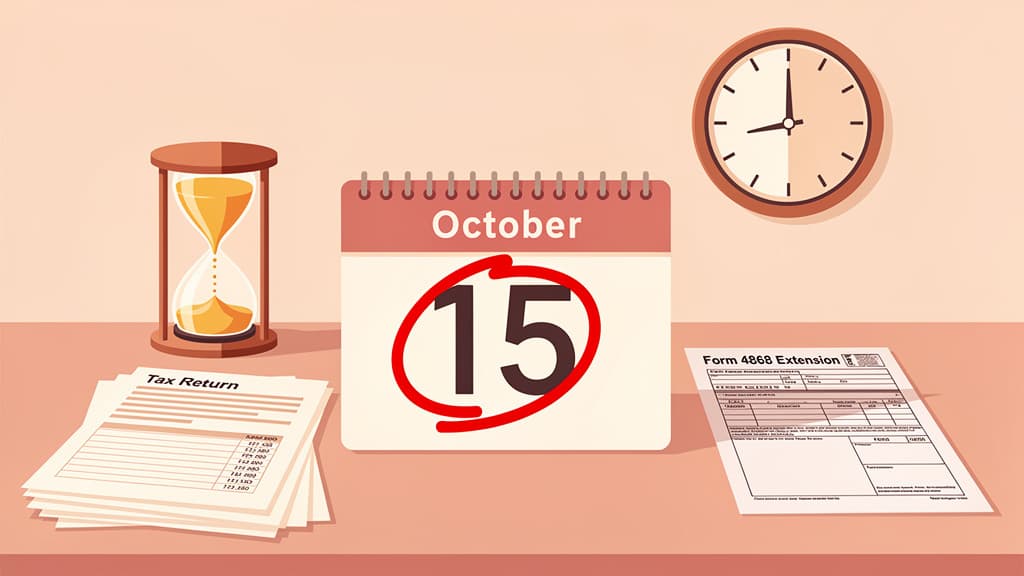
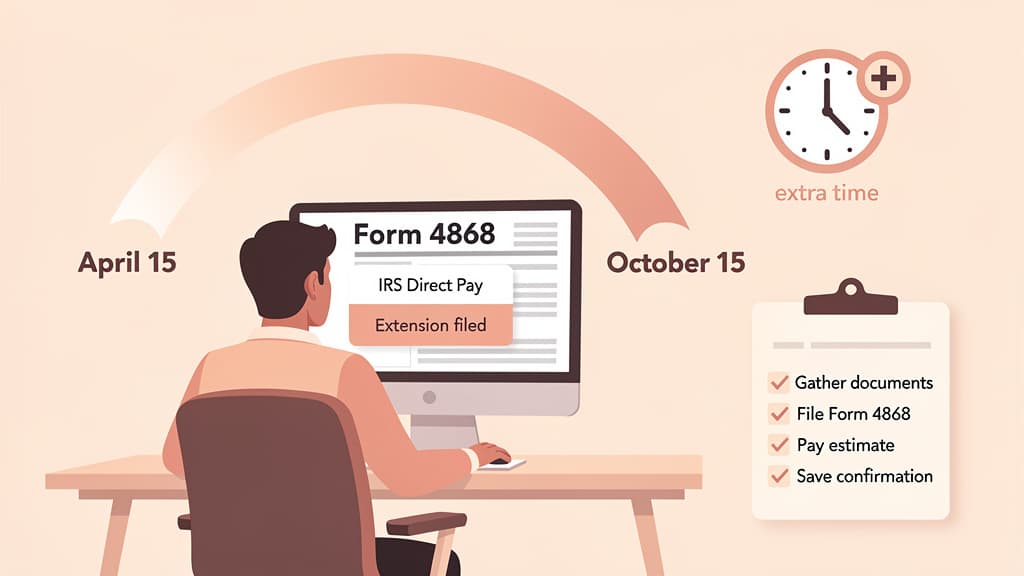
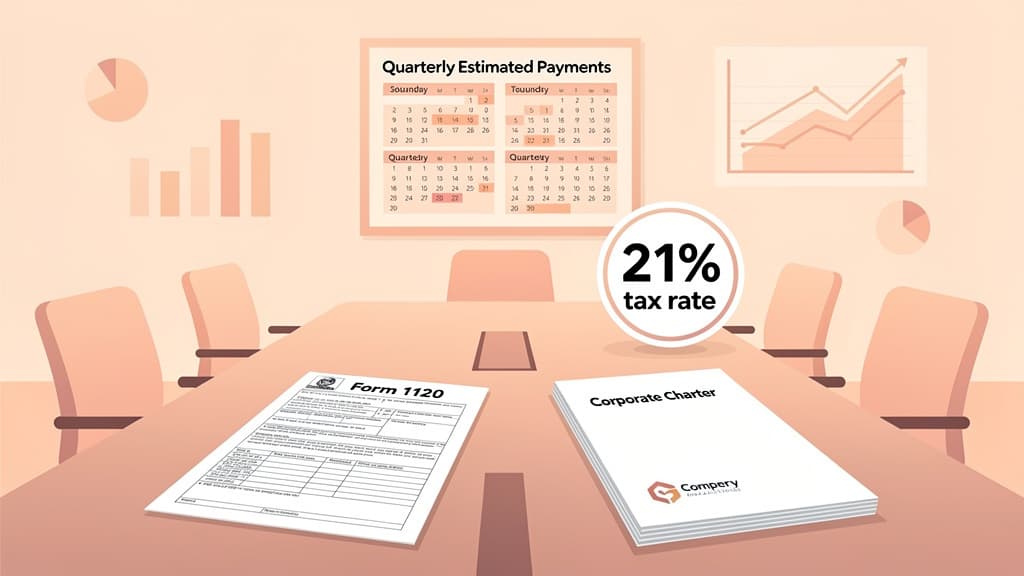
October 15, 2026 (a Thursday) is the final deadline to file your 2025 federal income tax return if you requested an extension by April 15. It applies to individual Form 1040 returns extended with Form 4868 and calendar-year C corporation Form 1120 returns extended with Form 7004. There is no second extension: file after October 15 and the failure-to-file penalty runs 5% of unpaid tax per month, on top of the 0.5% monthly late-payment penalty and daily-compounding interest that have been accruing since April 15.
Key takeaways:
- Individual (Form 1040) and C corporation (Form 1120) extended returns are due October 15, 2026
- Trusts and estates on extension file Form 1041 by September 30, 2026; Form 7004 gives them 5½ months, not 6
- The extension moved only the filing date; payment was due April 15, 2026, and interest (7% in Q3 2026, compounded daily) has been running since
- Missing October 15 triggers a 5%-per-month late-filing penalty, capped at 25%, with a $525 minimum once you're more than 60 days late
- Can't pay in full? File anyway and request an installment agreement: streamlined plans run up to 72 months for balances under $50,000
| Return Type | Form | Extension Filed | Extended Deadline |
|---|
| Individual returns | Form 1040 | Form 4868 | October 15, 2026 |
| C-Corporation returns | Form 1120 | Form 7004 | October 15, 2026 |
| Trust and estate returns | Form 1041 | Form 7004 | September 30, 2026 (5½-month extension) |
| Tax-exempt organizations (calendar-year) | Form 990 | Form 8868 | November 16, 2026 |
Not due October 15: S-Corporation (Form 1120-S) and partnership (Form 1065) extended returns are due September 15, 2026, and trust/estate Form 1041 extended returns are due September 30, 2026. For how extensions work in general, see the tax extension guide.
Legal basis: IRC §6081 (extension of time for filing), IRC §6651 (failure to file / failure to pay penalties), IRC §6601 (interest on underpayment)

October 15 is the extended deadline for individual and C corporation returns. Two related deadlines land nearby and are easy to confuse: extended trusts and estates (September 30) and calendar-year nonprofits (November 16).
This is the biggest group. Anyone who filed Form 4868 by April 15, 2026 (sole proprietors, freelancers, W-2 employees, retirees, and anyone else filing an individual return) has until October 15 to submit their completed Form 1040.
This includes Schedule C filers (sole proprietors and single-member LLCs) whose business income flows through their personal return.
C-Corporations with a calendar year-end that filed Form 7004 by April 15, 2026 must submit their completed Form 1120 by October 15. C-Corps with fiscal year-ends have different extension deadlines based on their specific year-end date.
Extended Form 1041 returns are due September 30, 2026, not October 15. Form 7004 grants trusts and estates a 5½-month extension from the April 15 due date, per the Form 7004 instructions. Fiduciaries who assume the individual October 15 date applies pick up two extra weeks of failure-to-file penalty.
Calendar-year nonprofits that filed Form 8868 by May 15, 2026 have until November 16, 2026 to file Form 990 (the 6-month extension lands on Sunday, November 15, so the deadline shifts to Monday). Organizations with fiscal year-ends count 6 months from their own original date; some land on or near October 15. Verify your organization's dates in IRS Publication 509.
You have an October 15 deadline if you fall into one of these categories:
Individuals who filed Form 4868. This includes anyone who requested an automatic 6-month extension of their individual return. You didn't need a reason: Form 4868 grants the extension automatically as long as it was filed (or postmarked) by April 15.
C-Corporations that filed Form 7004. Calendar-year C-Corps that requested an automatic 6-month extension of their corporate return.
Anyone who made a payment designated as an extension payment. If you made a tax payment by April 15 and indicated it was an extension payment, the IRS treats that as an automatic extension request, even without filing Form 4868 separately.
- S-Corporations and partnerships: their extended deadline is September 15, 2026
- Trusts and estates: extended Form 1041 returns are due September 30, 2026 (Form 7004 grants 5½ months)
- Individuals living abroad: US citizens and resident aliens living outside the US get an automatic 2-month extension to June 15, plus can file Form 4868 for an extension to October 15
- Anyone who already filed: if you filed your return before October 15, you're done
- Anyone who didn't file an extension: if you didn't file Form 4868 or Form 7004 by the original deadline, you don't have an extension, and penalties have been accumulating since April
Missing October 15 triggers two separate penalty systems, plus interest. Here's exactly how each one works.
Rate: 5% of unpaid tax per month (or partial month) the return is late
Maximum: 25% of unpaid tax
Legal basis: IRC §6651(a)(1)
This is the big one. The late filing penalty is assessed for each month or fraction of a month that the return is late after October 15. If you file on October 20, that counts as one month. File on November 20, that's two months.
Minimum penalty for returns more than 60 days late: The lesser of $525 or 100% of the unpaid tax. The $525 figure applies to returns required to be filed in 2026, per Rev. Proc. 2024-40. This minimum applies even if you owe very little: if your unpaid tax is $200 and you're more than 60 days late, the minimum penalty equals your entire tax bill.
Rate: 0.5% of unpaid tax per month (or partial month)
Maximum: 25% of unpaid tax
Legal basis: IRC §6651(a)(2)
This penalty has been running since April 15, 2026, not since October 15. The extension extended your filing deadline, not your payment deadline. If you owed $5,000 and didn't pay by April 15, you've been accumulating 0.5% per month ($25/month) in late payment penalties since then.
Key fact: The failure-to-file penalty is 10 times the failure-to-pay penalty. Filing late costs 5% per month; paying late costs 0.5% per month. This means it's always better to file on time (or as close to it as possible), even if you can't pay the full amount.
When both penalties apply simultaneously, the late filing penalty is reduced by the late payment penalty for any month where both are charged. The combined maximum is still 5% per month for the first five months, then 0.5% per month after that. Total maximum: 47.5% of unpaid tax (25% filing + 25% payment, minus the overlap during the first five months).
Rate: Federal short-term rate + 3 percentage points, compounded daily. For the third quarter of 2026 (July through September), the underpayment rate is 7%, per the IRS quarterly interest rates (it was 6% in Q2 and 7% in Q1).
Legal basis: IRC §6601
Interest accrues from the original due date (April 15) on any unpaid tax, and it compounds daily. Unlike penalties, there's no maximum cap on interest; it runs until the balance is paid in full.
Say you owed $10,000 in tax and filed Form 4868 in April but didn't make a payment. You file your return on December 15, 2026, two months after the October 15 extended deadline.
- Late payment penalty (April 15 to December 15 = 8 months): $10,000 × 0.5% × 8 = $400
- Late filing penalty (October 15 to December 15 = 2 months): $10,000 × 5% × 2 = $1,000, minus the late payment overlap of $10,000 × 0.5% × 2 = $100, so net $900
- Interest (8 months at the 2026 quarterly rates of 6–7%, compounded daily): roughly $460
- Total additional cost: approximately $1,760, or 17.6% of the original tax owed
Run your own numbers through the IRS penalty and interest calculator to see exactly what filing this week versus next month costs.
For individual filers, October 15 is the final deadline. The IRS does not grant additional extensions beyond the automatic 6-month extension from Form 4868 except in very limited situations:
- Combat zone or contingency operation service members receive automatic extensions
- Disaster relief: the IRS may postpone deadlines for taxpayers in federally declared disaster areas
- Taxpayers outside the US: certain rules apply, but the October 15 deadline generally still holds
There is no second extension form to file. If you need more time, you should still file by October 15 with the best information available. You can always file an amended return (Form 1040-X) later to correct errors.
C-Corporations cannot generally get a second extension beyond October 15. However, corporations in certain situations (such as those affected by a federally declared disaster) may receive automatic postponements from the IRS.
Here's a scenario many people don't know about: if you paid at least 100% of your tax liability by April 15, there is no late filing penalty and no late payment penalty for filing after the original deadline, even without an extension.
The penalties under IRC §6651 are calculated as a percentage of the unpaid tax. If there's no unpaid tax, the penalty is zero. The IRS cannot charge 5% of $0.
So if you overpaid your estimated taxes or had enough withholding to cover your full liability, you technically face no penalty for filing late. But you should still file your return for two important reasons:
-
The statute of limitations doesn't start until you file. The IRS generally has 3 years from the date you file to audit your return (IRC §6501). If you never file, there's no statute of limitations: the IRS can audit you indefinitely.
-
You can't get your refund. If you overpaid, you're owed a refund. But you must file a return to claim it, and you have only 3 years from the original due date to do so.
If you missed both the April 15 original deadline and didn't file Form 4868, your situation is different from someone who extended but missed October 15. Without an extension, the late filing penalty started running from April 16, so you've been accumulating 5% per month for several months already.
But here's what matters: it is always better to file late than not to file at all.
The 5% monthly late filing penalty caps at 25%. If you're already at the maximum (5 months late = 25%), filing now stops additional penalty accrual. The late payment penalty (0.5%/month) continues until you pay, but that's much lower than the combined penalty rate.
The minimum penalty of $525 (or 100% of tax owed, whichever is less) kicks in for returns filed more than 60 days late. If you owe $300, your penalty is $300, not $525. But this minimum applies regardless, so even small balances face meaningful penalties once you cross the 60-day mark.
For a detailed guide on filing late, see What Happens If You Don't File Taxes. If you have unfiled returns from prior years, see How to File Back Taxes.
The IRS processes approximately 19 million extension requests (Form 4868) every year for individual returns alone. That's roughly 12-13% of all individual tax returns filed. The number has been relatively stable over the past decade.
Reasons people file extensions vary:
- Waiting on K-1 forms from partnerships or S-Corps (these are often delivered late)
- Complex tax situations requiring more preparation time (rental properties, business income, foreign accounts)
- Missing documents: corrected 1099s, late-arriving brokerage statements
- Tax professionals who can't complete all returns by April 15: many CPAs and enrolled agents extend a significant portion of their client returns
Filing an extension is not a red flag. The IRS does not view extensions negatively, and there's no evidence that extended returns are audited at higher rates.
Under IRC §6501, the IRS has 3 years from the date you file your return to initiate an audit (called an "assessment"). This 3-year clock starts on the later of: the date you actually file, or the original due date of the return.
If you file before the due date (say, you file your 2025 return in February 2026), the 3-year period starts from April 15, 2026, not your actual filing date.
But here's the critical point: if you never file a return, the statute of limitations never starts. The IRS can come back 5, 10, or 20 years later and assess tax on an unfiled return. There is no time limit.
There are also exceptions that extend the standard 3-year period:
- 6 years if you omit more than 25% of your gross income
- No limit for fraudulent returns or willful tax evasion
- No limit for unfiled returns
This is why filing matters even if you owe nothing or are owed a refund. Filing starts the clock. Not filing leaves it open indefinitely.
This is the single most expensive misunderstanding in the tax extension system. Form 4868 extends your filing deadline to October 15. Your payment deadline was still April 15. If you owe tax and didn't pay by April 15, you've been accruing late payment penalties (0.5%/month) and interest since then, regardless of your extension.
What to do: If you owe and haven't paid, pay as much as possible now. The penalty and interest stop accruing on the date you pay, not the date you file.
Some people think that since they missed the extended deadline, there's no point in filing. This is wrong and costly. The late filing penalty (5%/month) continues to accrue each month you don't file, up to the 25% maximum. Filing now, even in November or December, stops the bleeding.
File as soon as possible. If you can't afford to pay, file the return anyway and set up a payment plan: streamlined installment agreements run up to 72 months for combined balances under $50,000, and you can apply through the IRS Online Payment Agreement tool or Form 9465. The late filing penalty is 10 times worse than the late payment penalty.
Most states follow the federal October 15 extended deadline for individual returns, but not all. Some states have their own extension rules, different automatic extension periods, or require you to file a separate state extension form. Don't assume your state deadline matches the federal one.
Check your state's tax authority website for the specific extended deadline and any separate filing requirements.
The IRS does not send reminder notices before the October 15 deadline. You won't get a letter, email, or phone call telling you that your extended return is due. The responsibility is entirely on you. By the time you hear from the IRS, it will be a penalty notice, not a reminder.
Set your own reminders. Put October 15 on your calendar with alerts at 30 days, 14 days, and 3 days before the deadline. Use the tax deadline calendar to track all your dates.
If you extended in April, the hard part of October is reconstructing nine months of finances. Jupid does that continuously: connect your bank accounts and it categorizes income and expenses with 95.9% accuracy, so your Schedule C numbers are organized before you sit down to file. Ask the AI accountant in WhatsApp or iMessage "How much did my business earn in 2025?" and get an answer from your real transaction data in real time, not a guess from memory. Try Jupid.
- IRS Publication 509: Tax Calendars (official deadline reference)
- Form 4868: Application for Automatic Extension of Time to File US Individual Income Tax Return
- Form 7004: Application for Automatic Extension of Time to File Certain Business Income Tax, Information, and Other Returns
- Form 8868: Application for Automatic Extension of Time to File an Exempt Organization Return
- IRS: Quarterly Interest Rates: current underpayment and overpayment rates
- IRS: Penalty Relief: How to request penalty abatement
- IRC §6081: Extension of time for filing returns
- IRC §6651: Failure to file tax return or to pay tax (penalty provisions)
- IRC §6601: Interest on underpayment, nonpayment, or extensions of time for payment of tax
- IRC §6501: Limitations on assessment and collection (statute of limitations)
October 15 is the last stop for millions of taxpayers who extended their returns. Unlike April 15, there's no second extension available: this is the final deadline. If you filed Form 4868 or Form 7004, your return needs to be submitted by this date or penalties start stacking on top of any interest that's already been accruing.
The math is straightforward: filing on time (even if you can't pay in full) is always cheaper than filing late. The late filing penalty runs at 5% per month. The late payment penalty runs at 0.5% per month. Filing your return and requesting a payment plan costs a fraction of what the combined penalties would.
If you're reading this and October 15 is approaching, stop putting it off. Gather your documents, calculate what you owe, and file. If October 15 has already passed, file today. Every additional day adds to the cost.
Disclaimer
This article provides general information about the October 15, 2026 extended tax filing deadline and should not be considered tax advice. Penalty calculations, interest rates, and specific deadlines may vary based on individual circumstances, entity type, fiscal year-end, and state of residence. The IRS may adjust interest rates quarterly and may grant relief in certain disaster situations. For advice specific to your situation, consult a qualified tax professional or refer to IRS Publication 509 for the official tax calendar.
Last Updated: July 7, 2026