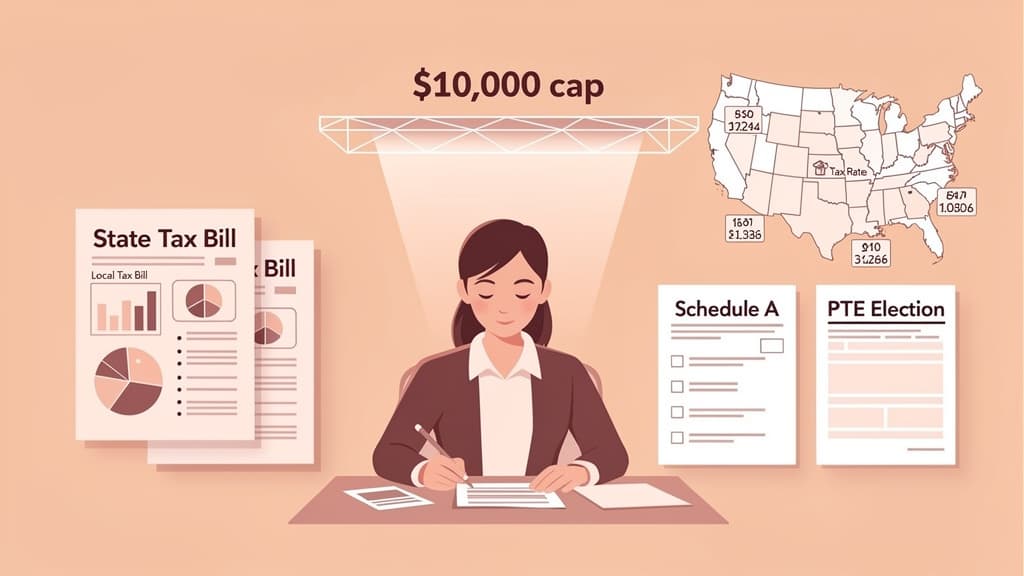
The federal SALT deduction cap for 2026 is $40,400 ($20,200 for married filing separately) under the One Big Beautiful Bill Act (OBBBA), up from $40,000 for 2025. The cap shrinks by 30% of modified adjusted gross income (MAGI) above $505,000 in 2026 ($500,000 in 2025), but never below $10,000, so it bottoms out at about $606,333 of MAGI. The IRS confirmed the 2026 figures, $40,400, $505,000 and the $10,000 floor, in a March 16, 2026 correction to the 2026 Form 1040-ES.
Key takeaways:
2026 cap (the maximum SALT deduction): $40,400 for single, head of household and joint filers alike; $20,200 if married filing separately (2025: $40,000 and $20,000)
Phase-down: above $505,000 of MAGI in 2026, the cap drops by 30% of the excess down to a $10,000 floor. Separate filers use a $252,500 threshold and a $5,000 floor, and their cap falls 15 cents per dollar
The $10,000 cap still governs 2024 and earlier returns, survives as the floor, and returns for everyone in 2030
Outside the cap: property taxes on business assets (Schedule C or E) and state tax that a partnership or S corporation pays under a pass-through entity tax (PTET) election. A sole proprietor's state income tax stays under the cap
Before December 31, 2026: a property tax payment counts for 2026 only if it is made by year-end and the tax was assessed before 2027
Save this cheat sheet: the 2025 and 2026 caps, the phase-down, and the separate-filer numbers in one image.
Key point: The cap only applies to taxes you deduct on Schedule A as itemized deductions: the state and local taxes on lines 5a through 5c, limited on line 5e. Property taxes on business assets, deducted on Schedule C or Schedule E, and state taxes paid at the entity level by a partnership or S corporation sit outside it. The cap reverts to $10,000 in 2030.
Legal basis: IRC §164(a) (deductible taxes); §164(b)(6) (the cap and its exception for property taxes paid in a trade or business); §164(b)(7) (the $40,000 and $40,400 amounts and the MAGI phase-down, added by OBBBA §70120); IRS 2025 Instructions for Schedule A, line 5e worksheet; IRS Notice 2020-75 (entity-level PTE taxes); Rev. Proc. 2025-32 (2026 standard deduction)
Enter your filing status, modified AGI and the state and local taxes you paid. The result applies the 2026 cap and MAGI phase-down, with 2025 alongside for comparison.
$
Form 1040 AGI plus any excluded foreign earned income.
$
State income (or sales) tax + personal property and real estate tax.
Deductible SALT for 2026
$23,900
$14,100 of what you paid is above your 2026 cap and can't be deducted.
Your 2026 cap after the phase-down$23,900
Your 2025 cap at the same MAGI$22,000
Deductible SALT for 2025$22,000
Your MAGI is in the phase-down range: each extra $1,000 of MAGI cuts your 2026 cap by $300 until it reaches $10,000 at about $606,333 of MAGI.
Uses the article's figures (IRC §164(b)(6)–(7) as amended by OBBBA): $40,000 cap and $500,000 threshold for 2025, $40,400 and $505,000 for 2026, a 30% phase-down and a $10,000 floor. Married filing separately uses half the threshold and half the reduced limit, as on the IRS worksheet. MAGI is AGI plus excluded foreign or U.S.-territory income. Property taxes on business assets deducted on Schedule C or E don't count toward the cap.
SALT stands for State and Local Taxes. The SALT deduction allows you to deduct certain state and local taxes on your federal income tax return when you itemize deductions on Schedule A.
You can deduct three categories of state and local taxes:
1. State and local income taxes
Any income tax you pay to your state or local government. This includes withholding on W-2 wages, estimated tax payments, and amounts paid with your state return.
2. State and local sales taxes (alternative to income tax)
Instead of deducting income taxes, you can choose to deduct general sales taxes. This benefits residents of states with no income tax (Texas, Florida, Washington, etc.) who pay high sales taxes. You cannot deduct both — it's one or the other.
3. State and local real property taxes
Property taxes on your home, land, or other real estate. Personal property taxes charged on value alone, such as an annual vehicle tax, go on Schedule A, line 5c and count toward the same cap.
No. The $10,000 cap applied to tax years 2018 through 2024, and it still governs 2024 and earlier returns, including amended ones. For tax years 2025 through 2029, OBBBA raised the cap to $40,000 and above. The $10,000 figure now survives in two places: as the floor the income phaseout cannot cut below, and as the level the cap reverts to in 2030.
The Tax Cuts and Jobs Act (TCJA) of 2017 introduced a $10,000 cap ($5,000 for married filing separately) on the total SALT deduction. Before 2018, there was no cap — you could deduct all your state and local taxes without limit.
The $10,000 cap hit hardest in high-tax states like New York, California, New Jersey, Connecticut, and Illinois, where combined state income taxes and property taxes frequently exceeded $10,000. When I moved to the US from the UK to build Jupid, the SALT cap was my first American tax surprise: a federal limit on deducting taxes I had already paid to the state.
The One Big Beautiful Bill Act of 2025 (OBBBA) significantly increased the SALT cap:
Tax Year
SALT Cap (MFJ/Single)
SALT Cap (MFS)
MAGI Phaseout Threshold
2024 and prior
$10,000
$5,000
None
2025
$40,000
$20,000
$500,000
2026
$40,400
$20,200
$505,000
2027
$40,804
$20,402
$510,050
2028
$41,212
$20,606
$515,151
2029
$41,624
$20,812
$520,302
2030+
$10,000
$5,000
None
Both the cap and the MAGI threshold rise 1% a year. The statute writes in $40,400 and $505,000 for 2026, and each year from 2027 through 2029 is 101% of the year before, so the 2027-2029 rows are that arithmetic rounded to the dollar until the IRS publishes official amounts. The figures sit in IRC §164(b)(7), which OBBBA section 70120 added; they are statutory amounts, not IRS inflation adjustments. From 2030 the cap is a flat $10,000 again and the MAGI phase-down no longer applies, unless Congress changes the law.
The higher SALT cap phases down for higher-income taxpayers. The test uses modified adjusted gross income (MAGI): adjusted gross income plus any foreign earned income or housing amounts excluded under IRC §911 and income excluded under §931 or §933 (U.S. territories and Puerto Rico). For most filers, MAGI is simply the AGI on Form 1040.
For 2026, if your MAGI exceeds $505,000 (single, head of household, or married filing jointly):
Reduction = 30% x (MAGI - $505,000)
Your SALT cap is reduced by 30 cents for every dollar of MAGI above the threshold, but it cannot drop below $10,000, the old TCJA cap. For 2025 returns, including extended ones due October 15, 2026, use the $40,000 cap and a $500,000 threshold.
Married Filing Separately: The Reduction Comes Before the Halving
A married person filing separately does not subtract 30% from $20,200. The IRS worksheet in the 2025 Schedule A instructions starts from the full cap, subtracts 30% of MAGI above half the threshold, applies the $10,000 floor, and only then halves the result. For 2026 that is half of ($40,400 minus 30% of MAGI above $252,500), never below $5,000, so a separate filer's cap falls by 15 cents per dollar and reaches $5,000 at about $353,833 of MAGI. At $300,000 of MAGI, the 2026 cap for a separate return is $13,075: $40,400 minus $14,250 (30% of $47,500) is $26,150, and half of that is $13,075.
Elena and Tom file jointly with $560,000 of MAGI for 2026. They pay $24,000 of state income tax through withholding and estimated payments and $14,000 of property tax on their home, so their SALT total is $38,000. That is under the $40,400 headline cap, but the phase-down still bites.
Step
2026
2025 (same income and taxes)
MAGI over the threshold
$560,000 - $505,000 = $55,000
$560,000 - $500,000 = $60,000
Reduction (30%)
$16,500
$18,000
Cap after the phase-down
$40,400 - $16,500 = $23,900
$40,000 - $18,000 = $22,000
Deductible SALT
$23,900
$22,000
SALT they can't deduct
$14,100
$16,000
While their SALT exceeds the reduced cap, every extra dollar of MAGI in the $505,000 to $606,333 range removes 30 cents of deduction, so that income is taxed at about 1.3 times their bracket. At a 35% bracket, an extra $1,000 of income costs $350 of tax plus $105 on the lost deduction. Lowering MAGI works the other way: a $10,000 pre-tax 401(k) or SEP-IRA contribution would raise their 2026 cap by $3,000, to $26,900.
For business owners, what matters is where a tax is deducted: the SALT cap applies to taxes on Schedule A, while property taxes on business assets and other business-level taxes are deducted on the business return. The exception that trips people up is income tax: a sole proprietor's state income tax on business profit stays on Schedule A, under the cap.
IRC §164(b)(6) exempts real estate and personal property taxes paid in carrying on a trade or business, and the 2025 Schedule C instructions (line 23) list the other business taxes you deduct there. None of these count toward the $40,400 cap:
Real estate and personal property taxes on business assets, such as an office you own or business equipment
Business licenses, regulatory fees and franchise-type taxes, such as California's $800 annual LLC tax
Employer payroll taxes, including the employer share of Social Security and Medicare and state unemployment insurance contributions
Sales taxes imposed on you as the seller, when you include the tax collected in gross receipts
State taxes on gross receipts (not net income) directly attributable to the business, per IRS Publication 334
State and local income taxes on your business profit do not move to Schedule C. IRS Publication 334 lets a sole proprietor deduct a state tax on gross income as a business expense, but other state and local income taxes go on Schedule A, subject to the cap and its phase-down. The same is true for a single-member LLC taxed as a disregarded entity.
Example: Sarah, a freelance designer in California
Sarah earns $150,000 on Schedule C. She pays:
California income tax on her self-employment earnings: $9,500
Property tax on her home: $12,000
California annual LLC tax: $800
Schedule C deductions (not subject to SALT cap):
California annual LLC tax: $800 (deductible as a business expense)
Schedule A deductions (subject to SALT cap):
State income tax: $9,500
Property tax: $12,000
Total SALT: $21,500
Amount deductible: $21,500 (under the $40,400 cap for 2026)
Before the OBBBA, Sarah would have been capped at $10,000 on Schedule A. Under the new rules, she deducts the full $21,500.
Legal citation:IRC Section 164(b)(6) keeps the cap off real estate and personal property taxes paid in carrying on a trade or business, and business license fees and similar taxes are deductible business expenses under IRC Sections 162 and 164(a). State income tax stays under the cap even when the income comes from a business, which is why Sarah's $9,500 is on Schedule A. The OBBBA did not impose a SALT cap on partnerships and S corporations.
The pass-through entity tax (PTE tax or PTET) is a state-level tax paid by partnerships and S Corporations at the entity level rather than by individual owners. Because it's paid by the business entity, it's deducted as a business expense — which is not subject to the SALT cap.
Your S Corporation or partnership elects to pay state income tax at the entity level
The state taxes the entity on its pass-through income
The entity deducts the state tax payment as a business expense on its federal return
Individual owners receive a state tax credit for their share of the entity-level tax
The credit offsets the state tax the individual would otherwise owe
Net effect: The state tax that would have been subject to the $40,400 SALT cap on your personal Schedule A is instead deducted as a business expense with no cap.
High-income phaseout — If your MAGI exceeds $505,000, the $40,400 cap shrinks. PTE tax bypasses this phaseout entirely.
SALT exceeding $40,400 — If your combined state taxes and property taxes exceed the cap, PTE shifts the business portion off Schedule A.
AMT benefits — PTE taxes paid at the entity level reduce AMT income, which the personal SALT deduction does not.
Sunset protection — The $40,400 cap reverts to $10,000 after 2029, while the federal deduction for entity-level PTE tax rests on IRS Notice 2020-75, which has no end date. State laws set their own terms: California's PTE tax runs through 2030, Illinois removed its end date, Virginia made its election permanent in 2026, and Massachusetts ends its excise only if the federal cap goes away.
For tax year 2026, 37 states plus New York City offer a PTE tax election. The AICPA's state map (June 1, 2026) counts 38 enacted PTE taxes, but Washington's does not start until 2028, and Maine's is new for 2026. Four states that tax pass-through income still have no PTE tax: Delaware, North Dakota, Pennsylvania and Vermont (Pennsylvania has bills pending).
Major states with PTE elections for 2026:
State
2026 status
How and when to elect for 2026
California
Elective, 9.3%; SB 132 (2025) extended it through 2030
On the timely filed 2026 return, extensions included (Sept 15, 2027 for S corporations, Oct 15, 2027 for partnerships). The June 15, 2026 prepayment has passed: a shortfall now reduces owners' credits by 12.5% of the unpaid amount instead of voiding the election
New York (and NYC)
Elective; NYC only together with the state election
Closed March 16, 2026 (March 15 was a Sunday). Next window: by March 15, 2027, for tax year 2027
New Jersey
Elective (BAIT)
By March 15, 2027, the original due date; no extension and no retroactive election
Connecticut
Elective since 2024 (mandatory 2018-2023)
On a timely 2026 return: March 15, 2027, or Sept 15, 2027 with an extension
Illinois
Elective, 4.95%; Public Act 104-0453 removed the 2025 sunset
On the 2026 IL-1065 or IL-1120-ST; irrevocable after the extended due date
Massachusetts
Elective 5% excise, plus a second 4% excise (Chapter 63E) on members' income above $1,107,750, new for 2026
Form 63-ELT with the timely 2026 return, extensions included
Georgia
Elective, 4.99% for 2026
By the 2026 return's due date or extended due date (Sept 15, 2027 if extended)
Ohio
Elective, 3%
With the 2026 IT 4738, by its filing deadline
Virginia
Elective, 5.75%; made permanent in 2026 (HB 29)
By a 2026 estimated or extension payment, or Form 502PTET by the Oct 15, 2027 extended due date
Colorado
Elective while the federal SALT cap exists
On the 2026 DR 0106 (due April 15, 2027, with an automatic extension to Oct 15, 2027)
Election deadlines vary by state. New York takes the election early in the tax year; the other states in the table take it on or with the entity's return. Missing the deadline means losing the entity-level deduction for the entire year.
No. PTE tax elections are limited to partnerships and S corporations. A sole proprietorship or a single-member LLC taxed as a disregarded entity has no separate entity to pay the tax, so it cannot elect. Illinois spells this out: its 4.95% PTE tax covers only partnerships (other than publicly traded partnerships) and S corporations, per Illinois Department of Revenue Pub-129, so an Illinois sole proprietor keeps paying Illinois estimated tax personally. A Schedule C filer's state income tax stays on Schedule A, subject to the $40,400 cap and its phaseout.
If you file on Schedule C and your SALT regularly exceeds the cap, the fix is structural: an S corporation election would make the business PTE-eligible in most states. That move adds payroll and filing costs of its own, so run both sets of numbers before switching.
One important consideration: PTE taxes paid at the entity level reduce the pass-through income that flows to your K-1. This means your Qualified Business Income (QBI) for the 20% QBI deduction is also reduced.
Example: If your S Corp earns $400,000 and pays $25,000 in PTE tax, your K-1 shows $375,000 of QBI. Your QBI deduction is 20% of $375,000 = $75,000, not 20% of $400,000 = $80,000.
In most cases, the benefit of bypassing the SALT cap outweighs the reduction in QBI deduction. But run the numbers for your specific situation — or ask your tax professional.
Source: Rev. Proc. 2025-32, reflecting the permanent standard deduction increase under OBBBA.
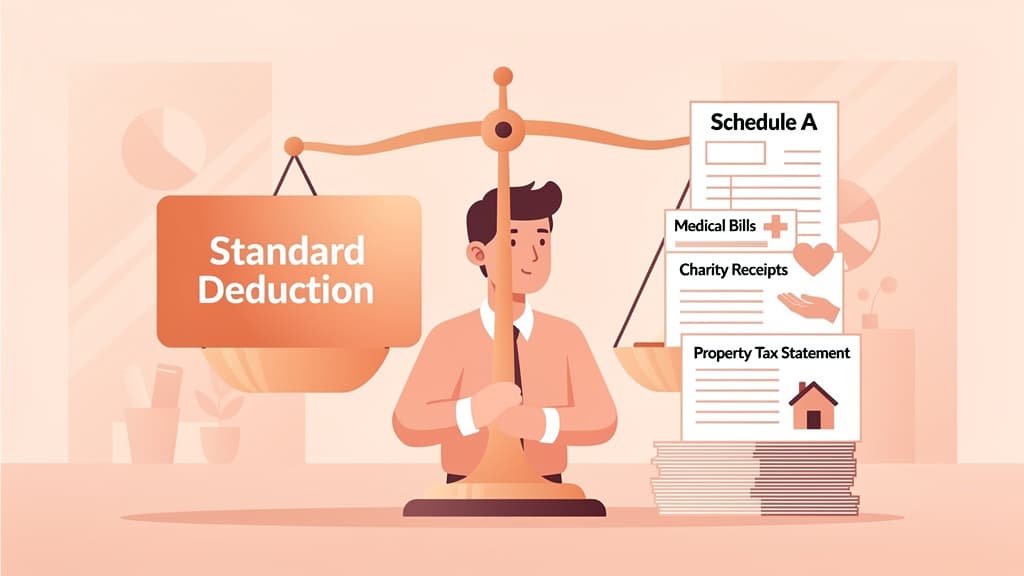
Even with a $40,400 cap available, many filers still come out ahead with the standard deduction. The higher cap only matters once your total itemized deductions clear these amounts.
You should itemize if your total Schedule A deductions — including SALT, mortgage interest, charitable contributions, and medical expenses (above 7.5% of AGI) — exceed your standard deduction.
Example decision (2026, married filing jointly, $200,000 AGI):
Deduction
Amount
SALT (state income tax + property tax)
$25,000
Mortgage interest
$12,000
Charitable contributions ($3,000 given, minus the new 2026 floor of 0.5% of AGI, $1,000)
The 2026 SALT deduction counts state and local taxes paid in calendar 2026, so the last quarter decides how much of your cap you use. Every move below helps only if you itemize and your SALT total is still under your cap; above the cap, an extra payment buys no deduction.
No, not for property taxes that haven't been assessed yet. The IRS rule in the 2025 Schedule A instructions is that only taxes paid in the year and assessed before the next year are deductible for that year, and state or local law decides when a tax is assessed, generally when you become liable for it. For 2026, a payment made by December 31, 2026 counts only if the tax was assessed before 2027. An installment on a bill that has already been issued is different: California counties mail the 2026-27 secured property tax bill by November 1, 2026, with the second installment due February 1, 2027, so paying that second installment in December 2026 moves it into your 2026 SALT total.
State estimated income tax is deductible in the year you pay it. If your final 2026 state estimate is due in January 2027 (California's Form 540-ES sets January 15, 2027), paying it by December 31, 2026 adds it to your 2026 SALT. IRS Publication 17 requires a reasonable basis for the amount: an estimated payment you expect to get back in full as a refund isn't deductible.
In the phase-down range, each $1,000 of extra MAGI removes $300 of cap, and each $1,000 kept out of MAGI restores it. Pre-tax 401(k) deferrals, SEP-IRA or solo 401(k) contributions (Schedule 1, line 16), and the timing of capital gains or, for a cash-method business, year-end invoices all move MAGI. A PTE tax election works on both sides: the entity deducts the state tax, and the lower income passed through to you lowers your MAGI.
Most of the elections in the state table above are still open for 2026, because they are made on the entity's 2026 return in 2027; New York and NYC closed on March 16, 2026. Payment timing still matters this year: IRS Notice 2020-75 lets a partnership or S corporation deduct a PTE tax payment in the tax year the payment is made, so state PTE tax paid by December 31, 2026 reduces 2026 federal income, while the part paid with the return in 2027 is deducted on the 2027 return. New York's last 2026 PTET estimate is due December 15, 2026, and California's balance is due March 15, 2027, with no extension.
Accelerating payments pays off only if your 2026 itemized deductions beat the 2026 standard deduction: $16,100 single or married filing separately, $32,200 married filing jointly, $24,150 head of household. If you're close to the line, bunching (concentrating two years of deductible payments into one year and taking the standard deduction in the other) can flip the result, but property tax can be bunched only as far as it has been assessed. The new 0.5%-of-AGI floor on charitable gifts applies once per year, which makes bunching gifts slightly more valuable from 2026.
The SALT cap applies to taxes on Schedule A. Property taxes on business assets, business license fees and the employer's payroll taxes belong on Schedule C, line 23, outside the cap, and lumping them into the $40,400 limit wastes deduction room. The reverse error is just as common: moving state income tax on business profit to Schedule C. IRS Publication 334 allows that only for a state tax on gross income; income tax on net profit is a Schedule A deduction, subject to the cap.
PTE elections have specific deadlines that vary by state. New York's election for 2026 closed on March 16, 2026, so a New York entity that didn't opt in leaves its owners' state tax under the personal SALT cap for the whole year. New Jersey accepts the 2026 election only until March 15, 2027 and never retroactively; until an eligible entity elects and pays BAIT, its owners carry the state tax on their own New Jersey estimated tax payments. California takes it on the timely filed 2026 return, but its June 15, 2026 prepayment has passed; an underpayment now trims the owners' credits by 12.5% of the shortfall.
The $40,400 cap sounds generous, but if your MAGI exceeds $505,000, it starts shrinking. Above $606,333, you're back to the old $10,000 cap. High earners who assume they get the full $40,400 may underestimate their tax bill. Separate filers should run the IRS worksheet rather than halving every number: the 30% reduction comes off the full $40,400 before the result is halved.
You can deduct state and local income tax OR state and local sales tax — not both. Most taxpayers in states with income taxes benefit more from deducting income tax. But if you're in a no-income-tax state (Texas, Florida, Washington, Nevada, etc.), the sales tax deduction may be your only option.
The higher cap, which rises 1% a year through 2029, expires after 2029. On January 1, 2030, the cap drops back to $10,000 unless Congress passes new legislation. If you're making long-term financial decisions — like buying property in a high-tax state — factor in the possibility that the higher cap may not last.
The SALT cap depends on where each tax payment lands. State income tax and the property tax on your home go to Schedule A, under the cap; property tax on business assets and business license fees go to Schedule C, outside it. Jupid connects to your bank accounts and categorizes every transaction automatically with 95.9% accuracy, so state estimated payments, county property tax installments and business fees sit in separate categories before your preparer sees them. You can also ask the AI accountant in WhatsApp or iMessage how much state tax you have paid so far this year and get the answer from your own transactions.
Filing a 2025 return on extension? Use the $40,000 cap, and if Form 1040, line 11b is over $500,000 ($250,000 MFS), complete the Schedule A line 5e worksheet before the October 15, 2026 deadline
Total your 2026 state and local income tax withheld (latest pay stub) and the state estimated payments made so far
Pull your 2026 property tax bills and note which installments are already assessed and when each is due
Figure your 2026 cap: $40,400 minus 30% of MAGI above $505,000, never below $10,000 (separate filers: half of that, with a $252,500 threshold)
Compare your projected itemized deductions with the 2026 standard deduction ($16,100 single or MFS / $32,200 MFJ / $24,150 HoH)
If you will itemize and are under your cap, pay the final 2026 state estimate and any assessed property tax installment by December 31, 2026
If you own an S corporation or partnership, confirm your state's 2026 PTET election and payment dates with your preparer
Split business property taxes and license fees (Schedule C) from personal state and local taxes (Schedule A) in your records
The SALT deduction got significantly more generous under the OBBBA, but the income phaseout and 2029 sunset mean it's not a permanent fix. For owners of partnerships and S corporations, the PTE tax election remains the most powerful tool to get around the cap — regardless of income level. Know your numbers, make the PTE election on time, and separate your business taxes from your personal SALT.
Last updated: September 28, 2026
Disclaimer:This article is for informational purposes only and does not constitute tax, legal, or financial advice. Tax laws change frequently, and individual circumstances vary. The SALT cap, phaseout thresholds, and PTE tax rules are subject to change. Consult a qualified tax professional for advice specific to your situation. Jupid provides AI-powered transaction categorization and tax estimates but is not a substitute for professional tax counsel.
Fintech CEO with 10+ years building accounting and financial technology products. Previously co-founded and scaled an AI-powered accounting platform to $30M revenue and 100K+ business users, achieving 30,000 customers per accountant through automation — recognized by CNBC as a top fintech company. Holds a Master's in Management Information Systems. At Jupid, he leads the development of AI-native bookkeeping, tax, and compliance tools designed for freelancers and small business owners.