Published: March 26, 2026
Tax Year: 2026
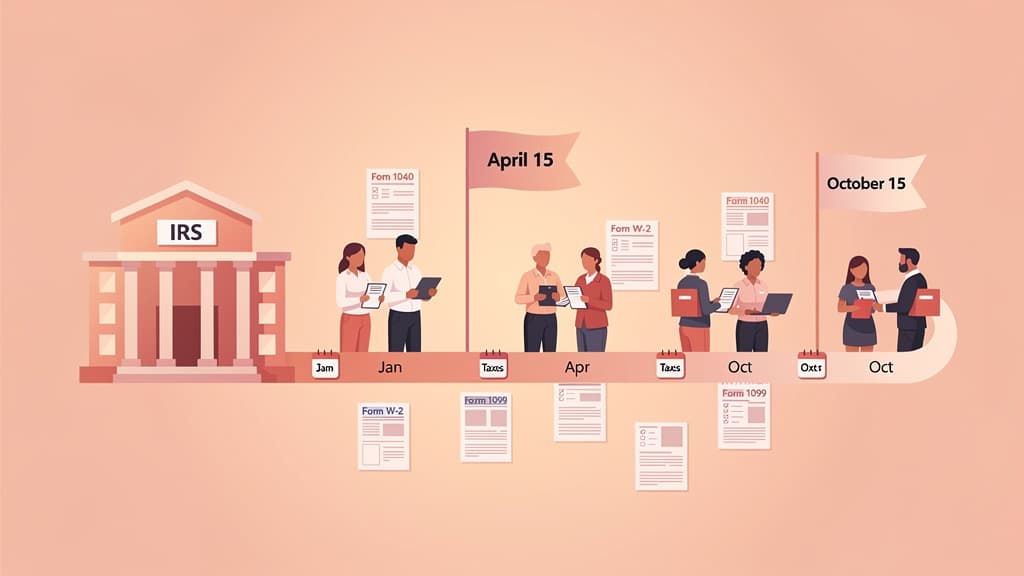
"Tax season" is not a legal term. You won't find it in the Internal Revenue Code or in any IRS regulation. It's a colloquial way to describe the window between when the IRS starts accepting tax returns — typically in late January — and the April 15 deadline for individuals.
But that window matters. Understanding it is the difference between filing calmly with all your documents in order and scrambling on April 14 to find last year's return.
I've been through tax seasons on both sides of the Atlantic. At Anna Money, I watched 60,000+ small business owners in the UK navigate their January self-assessment deadline. In the US, the calendar is more spread out — quarterly estimated payments, different entity deadlines, information return deadlines — but the core stress is the same. People don't panic because the rules are hard. They panic because they didn't plan.
This guide lays out the entire 2026 tax season timeline, from the first IRS Free File opening in January through the October extension deadline. If you know what's coming and when, you can handle each date as it arrives instead of reacting to it after it passes.
| Milestone | Date |
|---|
| IRS Free File opens | January 9, 2026 |
| IRS begins accepting e-filed returns | January 26, 2026 |
| Tax Day (individual deadline) | April 15, 2026 |
| S-Corp / Partnership deadline | March 16, 2026 (Mar 15 is Sunday) |
| Extension deadline (individual / C-Corp) | October 15, 2026 |
| Last day for 2025 IRA/HSA contributions | April 15, 2026 |
Legal basis: IRC §6072 (time for filing), IRC §6081 (extensions), IRC §7503 (weekend/holiday rule)

Tax season begins when the IRS starts accepting and processing electronic tax returns. For the 2026 filing season (covering 2025 tax year income), the IRS began accepting and processing returns on January 26, 2026.
The IRS Free File program opens earlier. For 2026, Free File opened on January 9, giving eligible taxpayers (AGI of $89,000 or less) a head start on preparation. Returns submitted through Free File before the official opening date are held and processed once the IRS systems go live.
What this means for you: You can start preparing your return as soon as you have your W-2s and 1099s (most are due to you by January 31, shifted to February 2 in 2026 because January 31 is a Saturday). But the IRS won't process your return until its systems open in late January.
Here is every major federal tax date for the 2026 filing season, in chronological order.
| Date | What Happens |
|---|
| Jan 9 | IRS Free File opens for early return preparation |
| Jan 15 | Q4 2025 estimated tax payment due |
| Jan 26 | IRS begins accepting and processing 2025 tax returns |
| Date | What Happens |
|---|
| Feb 2 | W-2 and 1099-NEC filing deadline — employers and payers must send to recipients and file with IRS/SSA (Jan 31 falls on Saturday) |
| Feb 2 | Recipient copies of 1099-MISC, 1099-INT, 1099-DIV, 1099-K due |
| Feb 28 | 1099-MISC and other information returns filed with IRS (paper) |
| Date | What Happens |
|---|
| Mar 16 | S-Corporation returns (Form 1120-S) due (Mar 15 is Sunday) |
| Mar 16 | Partnership returns (Form 1065) due (Mar 15 is Sunday) |
| Mar 16 | Last day to file Form 7004 extension for S-Corps and partnerships |
| Mar 31 | 1099-MISC and other information returns filed with IRS (e-file) |
| Date | What Happens |
|---|
| Apr 15 | Individual tax returns (Form 1040) due |
| Apr 15 | C-Corporation returns (Form 1120) due |
| Apr 15 | Q1 2026 estimated tax payment due |
| Apr 15 | Last day to file Form 4868 (individual extension) or Form 7004 (C-Corp extension) |
| Apr 15 | Last day to make 2025 IRA and HSA contributions |
| Date | What Happens |
|---|
| May 15 | Tax-exempt organization returns (Form 990) due |
| Date | What Happens |
|---|
| Jun 15 | US citizens living abroad: individual returns due (automatic 2-month extension) |
| Jun 15 | Q2 2026 estimated tax payment due |
| Date | What Happens |
|---|
| Sep 15 | Extended S-Corp (Form 1120-S) and partnership (Form 1065) returns due |
| Sep 15 | Q3 2026 estimated tax payment due |
| Date | What Happens |
|---|
| Oct 15 | Extended individual (Form 1040) and C-Corp (Form 1120) returns due |
| Date | What Happens |
|---|
| Jan 15 | Q4 2026 estimated tax payment due |
Different filers have different deadlines. Here's a quick breakdown so you can identify which dates apply to you.
- Original deadline: April 15, 2026
- Extended deadline: October 15, 2026 (file Form 4868)
- Form: 1040 (with Schedule C for sole proprietors/single-member LLCs)
If your only income is from a W-2 job, April 15 is your one deadline. If you're self-employed or have a single-member LLC, you also have quarterly estimated tax payments on April 15, June 15, September 15, and January 15, 2027.
- Annual return: April 15 (Schedule C on Form 1040)
- Quarterly estimated taxes: Apr 15, Jun 15, Sep 15, Jan 15 (2027)
Self-employed individuals must pay estimated taxes quarterly if they expect to owe $1,000 or more. Both income tax and self-employment tax (15.3% — 12.4% Social Security + 2.9% Medicare) are covered through these payments.
- Original deadline: March 16, 2026 (Form 1120-S)
- Extended deadline: September 15, 2026 (Form 7004)
- K-1 distribution: Due to shareholders by March 16
S-Corps file a month before individuals so that K-1 forms reach shareholders in time for their personal returns. Missing the March 16 deadline triggers a penalty of $255 per shareholder per month.
- Original deadline: March 16, 2026 (Form 1065)
- Extended deadline: September 15, 2026 (Form 7004)
- K-1 distribution: Due to partners by March 16
Same timeline and penalty structure as S-Corps.
- Original deadline: April 15, 2026 (Form 1120)
- Extended deadline: October 15, 2026 (Form 7004)
Calendar year-end C-Corps file on the same date as individuals. C-Corps with fiscal year-ends file by the 15th day of the 4th month after their fiscal year ends.
- Original deadline: May 15, 2026 (Form 990)
- Extended deadline: November 15, 2026 (Form 8868)
Form 990 is due by the 15th day of the 5th month after the organization's fiscal year ends. For calendar-year nonprofits, that's May 15.
This is one of the most common questions during tax season. The answer depends on your situation.
Faster refund. The IRS typically issues refunds within 21 days of accepting an e-filed return. Filing in late January or early February — before the peak volume hits — often means even faster processing.
Identity theft protection. Tax-related identity theft happens when someone files a fraudulent return using your Social Security Number to claim your refund. If you file first, the fraudulent return gets rejected. Filing early is one of the most effective defenses.
More time to plan. If you owe taxes, filing early gives you advance notice of the amount. You still have until April 15 to pay, but knowing the number in February gives you time to arrange payment.
Less competition for IRS resources. Returns filed in the first few weeks are processed when IRS staffing is at full capacity. April filings compete with millions of others.
You're missing documents. Employers and financial institutions have until February 2 to send W-2s and 1099-NECs. Brokerage firms sometimes issue corrected 1099s in February or March. Filing before receiving all documents means filing an amended return later.
You have a K-1 coming. If you're a partner or S-Corp shareholder, your K-1 may not arrive until March (the entity deadline is March 16). Filing your personal return without it means amending later.
You want to maximize IRA/HSA contributions. You have until April 15 to contribute for the 2025 tax year. Waiting to file gives you more flexibility on contribution amounts.
Best practice: Gather all documents by mid-February, prepare your return, and file once everything is confirmed. Late February to mid-March is the sweet spot for most people.
Not everyone needs to pay for tax software. The IRS offers several free options.
If your adjusted gross income is $89,000 or less, you can use IRS Free File — a partnership between the IRS and commercial tax software companies. Free File opened on January 9, before the IRS started accepting returns. It includes guided preparation, federal return filing at no cost, and in many cases free state preparation as well. Taxpayers above the income limit can use Free File Fillable Forms (available from January 26, any income level).
The IRS Direct File program, which let eligible taxpayers in participating states file federal returns directly with the IRS at no cost, was discontinued after the 2025 filing season and is not available for 2026. If you used Direct File last year, switch to IRS Free File (if eligible) or Free File Fillable Forms.
The IRS also offers free in-person preparation through Volunteer Income Tax Assistance (VITA, for income under $67,000) and Tax Counseling for the Elderly (TCE, for age 60+). Both programs operate at community centers, libraries, and schools during filing season.
Gather these documents before sitting down to prepare your return. Missing even one can delay your filing or require an amendment.
- W-2 — from each employer
- 1099-NEC — for freelance/contract income ($600+ threshold for 2025 payments; rises to $2,000 for payments made in 2026 under OBBBA)
- 1099-MISC — for rents, royalties, other income
- 1099-INT / 1099-DIV — for bank interest and dividends
- 1099-B — for investment sales (stocks, crypto)
- 1099-K — for payment processor income (Venmo, PayPal, Stripe)
- Schedule K-1 — if you're a partner or S-Corp shareholder
- 1098 / 1098-T / 1098-E — mortgage interest, tuition, student loan interest
- Receipts for business expenses — categorized by type
- 1095-A — marketplace health insurance
- Charitable donation receipts — for itemizers
- Prior year tax return — for reference and carryforward amounts
- SSN/ITIN for yourself, spouse, and dependents
- Bank account and routing number — for direct deposit
- Estimated tax payment records — amounts and dates paid during the year
The IRS adjusts standard deduction amounts and tax brackets annually for inflation. The return you file by April 15, 2026 uses 2025 tax year amounts (set by the One Big Beautiful Bill Act); the 2026 tax year amounts (Rev. Proc. 2025-32) apply to the return you'll file in 2027.
| Filing Status | 2025 Tax Year (return filed in 2026) | 2026 Tax Year |
|---|
| Single | $15,750 | $16,100 |
| Married Filing Jointly | $31,500 | $32,200 |
| Married Filing Separately | $15,750 | $16,100 |
| Head of Household | $23,625 | $24,150 |
| Additional (65+ or blind) | $2,000 (unmarried) / $1,600 (married) | $2,050 (unmarried) / $1,650 (married) |
If your itemized deductions exceed these amounts, you should itemize. For most taxpayers, the standard deduction is larger. Self-employed filers take the standard deduction in addition to Schedule C business deductions.
| Account | 2025 Tax Year Limit |
|---|
| Traditional/Roth IRA | $7,000 ($8,000 if 50+) |
| HSA (individual) | $4,300 |
| HSA (family) | $8,550 |
| 401(k) employee contribution | $23,500 ($31,000 if 50+) |
Remember: IRA and HSA contributions for the 2025 tax year can be made up to April 15, 2026. This is one of the few retroactive tax-saving opportunities available.
April 15 isn't the finish line for everyone. Here's what happens in the months that follow.
If you filed Form 4868 by April 15, your extended deadline is October 15. If you filed Form 7004 for an S-Corp or partnership, your extended deadline is September 15. These are firm deadlines — there's no second extension for individuals.
During the extension period, interest continues to accrue on any unpaid tax from April 15 forward. The extension gives you more time to file, not more time to pay. Read the full Tax Extension Guide for details.
If you discover an error after filing — a missing 1099, a forgotten deduction, a math mistake — you can file Form 1040-X. You generally have three years from the filing date (or two years from the date you paid the tax, whichever is later) to amend. Amended returns typically take 16 weeks or longer to process.
The IRS generally has three years from your filing date to audit your return. If you underreported income by more than 25%, that extends to six years. No time limit applies if you didn't file or filed fraudulently. For strategies to reduce audit risk, see our IRS Audit Triggers Guide.
E-filed returns with direct deposit: refunds typically within 21 days. Returns claiming the Earned Income Credit or Additional Child Tax Credit may be delayed until mid-February under the PATH Act. Paper returns take 6-8 weeks. Track your refund at irs.gov/refunds.
The deadline is April 15. That doesn't mean you should start on April 15. Gather your documents in January and February, prepare your return in March, and file with time to spare. Last-minute filing leads to errors, missed deductions, and unnecessary extension requests.
If you own an S-Corp or partnership, your business return is due March 16 — a full month before the individual deadline. Many business owners focus on April 15 and forget that their entity return (and K-1s for shareholders/partners) was due in March. The penalty is $255 per shareholder or partner per month.
You can make IRA contributions (up to $7,000, or $8,000 if 50+) and HSA contributions (up to $4,300 individual or $8,550 family) for the 2025 tax year until April 15, 2026. These contributions can reduce your taxable income. Once April 16 arrives, the window closes permanently for the prior tax year.
Employers and financial institutions have until February 2 to send W-2s and 1099s. Brokerage firms sometimes send corrected 1099s in late February or March. If you file before receiving all your forms, you'll need to amend your return — a process that takes months and invites additional IRS scrutiny.
Tax season is less stressful when you're not starting from scratch in January. Jupid connects to your bank accounts and categorizes every transaction throughout the year — income, expenses, transfers — with 95.9% accuracy. When tax season arrives, your books are already in order.
Instead of digging through twelve months of bank statements to find deductible expenses, you open Jupid and the data is already organized by category: meals, travel, office supplies, software subscriptions, contractor payments. Every transaction is tagged and ready for your Schedule C or your accountant.
Jupid's WhatsApp and iMessage AI accountant lets you check your financial status from anywhere. Ask "How much did I spend on business travel this year?" or "What's my estimated tax liability?" and get an answer based on your actual transactions. You can also access Jupid through the web interface or integrate it with Claude Code and other AI tools for more advanced workflows.
For self-employed filers and small business owners juggling multiple deadlines across entity types, having clean books year-round turns tax season from a crisis into a routine task.
Connect your bank to Jupid and stop scrambling every April.
- IRS Publication 509 — Tax Calendars (the official deadline reference)
- IRS Publication 17 — Your Federal Income Tax (comprehensive individual tax guide)
- IRS Free File — Free tax preparation for eligible taxpayers
- Form 4868 — Application for Automatic Extension of Time to File (individuals)
- Form 7004 — Application for Automatic Extension of Time to File (business entities)
- IRC §6072 — Time for filing income tax returns
- IRC §6081 — Extension of time for filing returns
- IRC §7503 — Time for performance of acts where last day falls on Saturday, Sunday, or legal holiday
| Item | 2025 Tax Year (return filed in 2026) | 2026 Tax Year |
|---|
| Standard deduction (single) | $15,750 | $16,100 |
| Standard deduction (MFJ) | $31,500 | $32,200 |
| Standard deduction (HOH) | $23,625 | $24,150 |
| IRA contribution limit | $7,000 ($8,000 if 50+) | $7,500 ($8,600 if 50+) |
| HSA limit (individual) | $4,300 | $4,400 |
| HSA limit (family) | $8,550 | $8,750 |
| Self-employment tax rate | 15.3% (12.4% SS + 2.9% Medicare) | 15.3% (12.4% SS + 2.9% Medicare) |
| Social Security wage base | $176,100 | $184,500 |
| QBI deduction | 20% of qualified business income | 20% of qualified business income |
| Section 179 maximum | $2,500,000 | $2,560,000 |
| Bonus depreciation | 100% (property acquired after Jan 19, 2025, under OBBBA) | 100% |
| 1099-NEC reporting threshold | $600 (2025 payments) | $2,000 (2026 payments) |
| Free File income limit (AGI) | $89,000 (2026 filing season) | — |
Tax season 2026 runs from late January through April 15 for most filers, with extensions pushing the final deadline to October 15. But the real timeline is longer — quarterly estimated payments, information return deadlines, and contribution windows spread across the entire year.
Identify your filer type, note your deadlines, and work backward from each one to give yourself time to prepare. Tax season doesn't have to be stressful. It just has to be planned.
Free download: Get the printable 2026 Tax Deadline Calendar (PDF) — every federal due date for all entity types on a single page. Planning ahead? The 2027 calendar (PDF) is also available, and an interactive version with calendar exports is at jupid.com/tax-deadline-calendar.
Disclaimer
This article provides general information about the 2026 tax season timeline and is not tax advice. Actual IRS filing season start dates are announced annually and may differ from expected dates listed here. Deadlines shift when they fall on weekends or holidays, and state deadlines may differ from federal. For advice specific to your situation, consult a qualified tax professional or refer to IRS Publication 509.
Tax Year: 2026
Last Updated: July 29, 2026