Small business tax prep comes down to gathering four things before you touch a form: your income records (1099-NEC, 1099-K, and bank deposits), your expenses sorted by Schedule C line, the right forms for your entity, and your highest-value deductions (QBI, home office, vehicle, retirement). Partnership and S corporation returns (Forms 1065 and 1120-S) are due March 15, 2026; sole proprietors and C corporations file by April 15, 2026. The checklist below is built to print and work top to bottom.
Key takeaways:
- Deadlines: Form 1065 and Form 1120-S by March 15, 2026; Schedule C and Form 1120 by April 15, 2026 (extensions to September 15 / October 15)
- Income forms to expect: 1099-NEC ($2,000+ for 2026), 1099-K ($20,000 AND 200+ transactions), 1099-MISC, W-2, Schedule K-1
- 2026 numbers: standard mileage 72.5¢/mile (Jan–Jun) / 76¢ (Jul–Dec), Section 179 up to $2,560,000, QBI up to 20%, SE tax 15.3% on the first $184,500 of net earnings
- Deductions to verify: QBI (Form 8995), home office (Form 8829), vehicle (mileage log), retirement (Solo 401(k) up to $24,500 employee deferral for 2026)
- Keep records at least 3 years (6 years if you underreported income by 25%+), and report all income even when no 1099 arrives
Who this checklist is for: Sole proprietors, single-member LLCs, multi-member LLCs, S Corp owners, and any small business owner preparing their federal tax return.
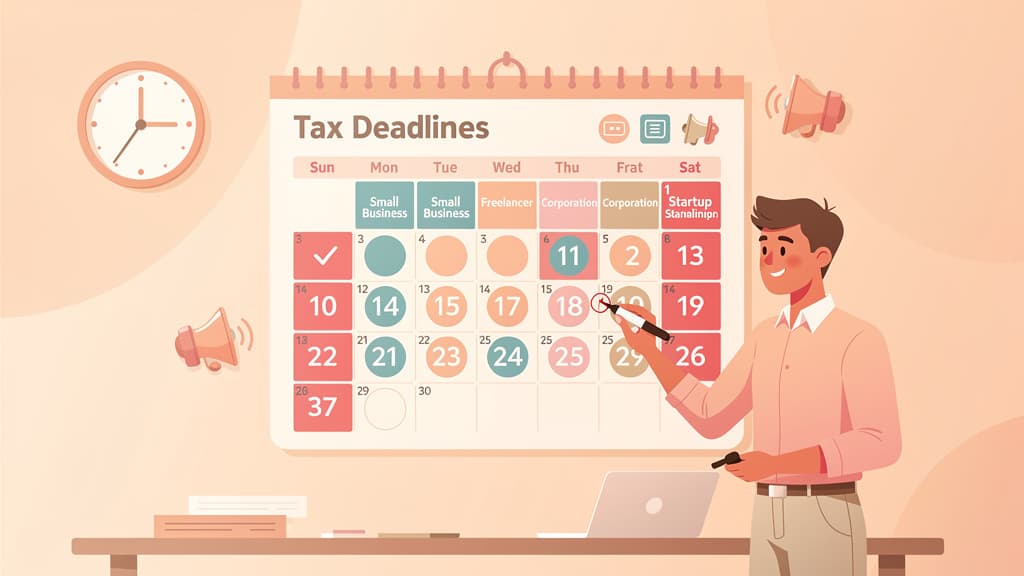
2026 Filing Deadlines:
| Return Type | Standard Deadline | Extended Deadline |
|---|
| Schedule C (sole proprietor) | April 15, 2026 | October 15, 2026 |
| Form 1065 (partnership/multi-member LLC) | March 15, 2026 | September 15, 2026 |
| Form 1120-S (S Corporation) | March 15, 2026 | September 15, 2026 |
| Form 1120 (C Corporation) | April 15, 2026 | October 15, 2026 |
2026 Key Tax Numbers:
| Item | 2026 Amount |
|---|
| SE tax rate | 15.3% |
| Social Security wage base | $184,500 |
| Standard deduction (single) | $16,100 |
| Standard deduction (MFJ) | $32,200 |
| QBI deduction | Up to 20% |
| Standard mileage rate | 72.5¢ (Jan–Jun) / 76¢ (Jul–Dec) |
| Section 179 limit | $2,560,000 |
| Home office simplified method | $5/sq ft (max $1,500) |
Legal basis: IRS Publication 334, IRS Publication 583, IRC §162, IRS Rev. Proc. 2025-32 (2026 inflation adjustments)

Before you touch a single tax form, gather and organize these items. Missing documentation is the #1 cause of filing delays, missed deductions, and unnecessary CPA fees.
Every dollar of income must be reported — even income not reported on an information return. But these forms are your starting point:
| Form | What It Reports | Who Issues It | Due to You By |
|---|
| 1099-NEC | Nonemployee compensation ($2,000+) | Clients who paid you | January 31 |
| 1099-K | Payment card/third-party network payments ($20,000 AND 200+ transactions for 2026, restored by OBBBA) | Payment processors | January 31 |
| 1099-MISC | Rent, royalties, other income | Various payers | January 31 |
| 1099-INT | Interest income ($10+) | Banks, financial institutions | January 31 |
| 1099-DIV | Dividend income ($10+) | Brokerage accounts | January 31 |
| 1099-B | Proceeds from stock sales | Brokers | February 15 |
| W-2 | Employment wages (if you also have a job) | Employer | January 31 |
| Schedule K-1 | Partnership/S Corp pass-through income | Entity | March 15 |
If a 1099-NEC or 1099-K shows an incorrect amount:
- Contact the issuer and request a corrected form (1099 with "CORRECTED" checked)
- If they refuse or don't respond, report the correct amount on your return and attach an explanation
- Keep documentation (invoices, contracts, payment records) to support your numbers
- The IRS matches 1099s to returns — a discrepancy will trigger a notice, so be ready to respond
Organized expense records are where most small businesses either save thousands or lose thousands. Every legitimate business expense reduces your taxable income — but only if you can document it.
Two methods — choose one per vehicle:
Standard mileage rate (72.5¢/mile for Jan–Jun 2026; 76¢ from July 1, per IRS Announcement 2026-11):
Actual expense method:
For a complete vehicle deduction guide, see our car mileage deduction guide.
For guidance on contractor vs. employee classification, see our employees vs. contractors guide.
For Section 179 details, see our Section 179 depreciation guide.
Note: Health insurance premiums for self-employed individuals are deducted on Schedule 1, Line 17 — not Schedule C. See our health insurance deduction guide.
For complete travel deduction rules, see our business travel deduction guide.
For details, see our business meal deduction guide.
For complete home office deduction guidance, see our home office deduction guide.
For a full breakdown of all expense categories, see our business expense categories guide.
| Form | Purpose |
|---|
| Form 1040 | Personal tax return |
| Schedule C | Profit or Loss from Business |
| Schedule SE | Self-Employment Tax |
| Schedule 1 | Additional Income and Adjustments (half SE tax deduction) |
| Form 8995 or 8995-A | Qualified Business Income Deduction |
| Form 1040-ES | Estimated tax payment vouchers |
| Form 8829 | Home office deduction (if using actual expense method) |
| Form 4562 | Depreciation and Amortization (if claiming Section 179 or depreciation) |
For a line-by-line guide, see our Schedule C instructions guide.
| Form | Purpose |
|---|
| Form 1065 | U.S. Return of Partnership Income |
| Schedule K-1 (1065) | Each Partner's Share of Income |
| Form 1040 | Each member's personal return |
| Schedule E, Part II | Report K-1 income |
| Schedule SE | Self-employment tax on K-1 earnings |
| Form 8995 or 8995-A | QBI deduction |
Deadline: March 15 (partnership return), then April 15 (personal returns).
| Form | Purpose |
|---|
| Form 1120-S | U.S. Income Tax Return for S Corporation |
| Schedule K-1 (1120-S) | Shareholder's Share of Income |
| Form W-2 | Shareholder-employee salary |
| Form 940 | Federal Unemployment Tax |
| Form 941 | Quarterly payroll tax return |
| Form 1040 | Each shareholder's personal return |
| Schedule E, Part II | Report K-1 income |
Deadline: March 15 (S Corp return), then April 15 (personal returns).
Don't file until you've verified these high-value deductions. Missing any one of them could cost you hundreds or thousands of dollars.
Potential savings: Up to 20% of net business income deducted from taxable income.
Example: $100,000 of net business income × 20% = a $20,000 QBI deduction, worth about $4,400 at the 22% bracket.
For complete QBI guidance, see our QBI deduction guide.
Legal citation: IRC §199A
Potential savings: $1,500 (simplified method) to $5,000+ (actual expense method).
For details, see our home office deduction guide.
Legal citation: IRC §280A
Potential savings: $3,000-$15,000+ depending on mileage.
Example: 15,000 business miles driven January–June 2026 × $0.725 = a $10,875 deduction (miles driven on or after July 1 count at 76 cents each).
Legal citation: IRC §162, IRC §274(d) (substantiation requirements)
Potential savings: Up to $24,500 (employee deferral) + 25% of compensation (employer) for a Solo 401(k), using 2026 limits.
For details, see our retirement plan deductions guide.
Legal citation: IRC §404 (SEP IRA), IRC §401(k)
Potential savings: Full premium amount deducted above-the-line.
For details, see our health insurance deduction guide.
Legal citation: IRC §162(l)
Automatically calculated: The deductible half of your SE tax reduces AGI.
Example: $90,000 net profit × 92.35% × 15.3% = $12,716 in SE tax. The deductible half, $6,358, goes on Schedule 1, Line 15 and saves about $1,399 at the 22% bracket.
Potential savings: Up to $5,000 deducted immediately (remaining amortized over 180 months).
For details, see our startup expenses tax deduction guide.
Legal citation: IRC §195
| Date | Action Required |
|---|
| January 15, 2026 | Q4 2025 estimated tax payment due |
| January 31, 2026 | Issue W-2s and 1099-NEC to recipients |
| January 31, 2026 | File 1099-NEC with IRS (if paper filing) |
| February 28, 2026 | File 1099-MISC/1099-K with IRS (paper) |
| March 15, 2026 | File Form 1065 / 1120-S (or file extension Form 7004) |
| March 31, 2026 | File 1099-NEC/1099-MISC/1099-K with IRS (e-file) |
| April 15, 2026 | File Form 1040 / 1120 (or file extension Form 4868/7004) |
| April 15, 2026 | Q1 2026 estimated tax payment due |
| April 15, 2026 | Last day for prior year IRA and SEP IRA contributions |
| June 15, 2026 | Q2 2026 estimated tax payment due |
| September 15, 2026 | Extended Form 1065 / 1120-S due |
| September 15, 2026 | Q3 2026 estimated tax payment due |
| October 15, 2026 | Extended Form 1040 / 1120 due |
| October 15, 2026 | Last day for SEP IRA contributions (if extension filed) |
| January 15, 2027 | Q4 2026 estimated tax payment due |
Most states follow federal deadlines, but several have different dates:
| State | Personal Return Deadline | Partnership/S Corp Return |
|---|
| Most states | April 15 | March 15 |
| Iowa | April 30 | March 15 |
| Virginia | May 1 | March 15 |
| Louisiana | May 15 | April 15 |
| Hawaii | April 20 | April 20 |
Check your state's specific requirements — some states also require separate estimated tax payments with different rules than federal.
| State Type | What You File |
|---|
| No income tax states (AK, FL, NV, NH, SD, TN, TX, WA, WY) | No state income tax return, but franchise or gross receipts tax may apply |
| States with income tax | State equivalent of Schedule C, Form 1065, or Form 1120-S |
| States with entity-level tax (CA, TX, NY, IL, etc.) | Separate entity-level return in addition to personal return |
If your business operates in multiple states, you may need to file in each state where you:
- Have physical presence (office, warehouse, employees)
- Have significant sales
- Are registered to do business
Each state has its own rules for apportioning income — typically based on sales, payroll, and property in the state.
The IRS selects returns for audit based on several factors. Avoiding these red flags doesn't mean hiding income or inflating deductions — it means filing accurately and documenting thoroughly.
Excessive Schedule C losses: Reporting net losses year after year triggers the hobby loss rule review. If you show a profit in at least 3 out of 5 years, the IRS presumes a profit motive.
Legal citation: IRC §183 (hobby loss rules)
Large meal and entertainment deductions: Meal deductions that are disproportionate to revenue draw scrutiny. Keep receipts with the date, location, attendees, and business purpose for every meal over $75.
Home office deduction: The IRS knows this deduction is commonly abused. Strict documentation of "regular and exclusive" business use is essential. Use measurements and photos.
Round numbers everywhere: Reporting exactly $5,000 in supplies, $3,000 in travel, and $2,000 in meals suggests estimation rather than actual records. Use exact amounts from receipts and records.
High deductions relative to income: Deductions that exceed 50-60% of gross income may trigger review, especially for service businesses with low overhead. This doesn't mean you shouldn't claim legitimate deductions — just be ready to document them.
Cash-intensive businesses: Restaurants, retail stores, and service businesses that handle significant cash receive extra scrutiny. Maintain daily cash logs and deposit all cash income.
Misclassified workers: Treating employees as independent contractors is a major audit target. The IRS loses revenue when workers are classified as contractors instead of employees. Follow the IRS classification guidelines carefully.
The IRS requires "adequate records" under IRC §274(d) for:
- Travel expenses (date, destination, business purpose, amount)
- Meal expenses (date, location, attendees, business purpose, amount)
- Vehicle expenses (mileage log or actual expense records)
- Listed property (business use percentage documentation)
The general rule: If you can't prove it, you can't deduct it. Keep records for at least 3 years from the filing date (6 years if you underreported income by more than 25%).
✅ You have a simple sole proprietorship with straightforward income and expenses
✅ Your annual revenue is under $75,000-$100,000
✅ You have no employees and no complex transactions
✅ You use accounting software or a service like Jupid that categorizes everything
✅ You're comfortable with Schedule C and have filed before
✅ You have no multi-state filing obligations
✅ You have a multi-member LLC or S Corporation (Form 1065 or 1120-S)
✅ Your business has employees (payroll taxes, W-2s, Form 940/941)
✅ You have complex transactions (real estate, investments, international income)
✅ You made the S Corp election this year and need guidance on reasonable salary
✅ Your revenue exceeds $200,000+ and the risk of errors is high
✅ You have multi-state filing obligations
✅ You have inventory or cost of goods sold calculations
✅ You're being audited or received an IRS notice
| Service | Typical Cost (2026) |
|---|
| Schedule C preparation | $200-$500 |
| Form 1065 preparation | $800-$2,000 |
| Form 1120-S preparation | $1,000-$3,000 |
| Quarterly estimated tax calculations | $200-$500/year |
| Bookkeeping (monthly) | $300-$1,000/month |
| Full-service CPA (prep + advisory) | $2,000-$5,000/year |
Pro tip: Even if you prepare your own return, consider a one-time CPA review of your first filing. They can catch structural mistakes (like missing the S Corp election or incorrectly classifying workers) that compound over years.
Problem: Using a personal bank account and credit card for business transactions, making it impossible to cleanly separate business expenses from personal spending.
Impact: Missed deductions (because you can't identify which personal card purchases were business expenses), inflated deductions (because personal expenses accidentally get categorized as business), and audit risk.
Solution: Use a dedicated business bank account and business credit card. Every business transaction should flow through business accounts. This single step eliminates the most common source of tax preparation chaos.
Problem: Trying to reconstruct a year's worth of business driving in March by looking at calendar entries and guessing distances.
Impact: The IRS requires a "contemporaneous" mileage log — created at or near the time of the trip. Reconstructed logs from memory are less defensible in an audit and often undercount actual business miles.
Solution: Use a mileage tracking app (MileIQ, Stride, or similar) that logs trips automatically. At minimum, maintain a simple spreadsheet with date, destination, purpose, and miles.
Problem: Paying all taxes at filing time instead of quarterly throughout the year.
Impact: Estimated tax penalty of approximately 7% annual rate (the Q3 2026 underpayment rate) on the underpaid amount, calculated per quarter. On $20,000 of tax, a full year of missed payments costs roughly $800-$1,000 in penalties.
Solution: Calculate and pay quarterly estimated taxes by April 15, June 15, September 15, and January 15. Use the prior year safe harbor method for simplicity. For penalty details, see our estimated tax penalty guide.
Problem: Filing Schedule C and calculating self-employment tax without claiming the Qualified Business Income deduction on Form 8995.
Impact: Missing up to 20% deduction on net business income. On $80,000 of QBI, that's a $16,000 deduction — worth $3,520 in tax savings at the 22% bracket.
Solution: Complete Form 8995 or 8995-A with every return that includes business income. Most sole proprietors and LLC members qualify. See our QBI deduction guide.
Problem: Entering income and expenses from memory or rough estimates without comparing to bank and credit card statements.
Impact: Underreported income triggers IRS matching notices (the IRS receives copies of your 1099s and compares them to your return). Overreported expenses trigger audit scrutiny.
Solution: Reconcile every business bank account and credit card statement against your records before filing. Every deposit should have an income source. Every business charge should have a category.
The business owners who spend the least time on their return are the ones whose books are already done. Jupid connects to your business bank accounts and credit cards and categorizes every transaction into the correct Schedule C line with 95.9% accuracy, so your income and expense totals build in real time instead of getting reconstructed in April. Ask your AI accountant on WhatsApp or iMessage "What's my estimated tax bill?" or "How much have I spent on advertising this year?" and get a current answer from your actual data. When it's time to file, export a clean income and expense report for yourself or your CPA.
Try Jupid
- IRC §162: Trade or business expenses (general deduction authority)
- IRC §167, §168: Depreciation rules
- IRC §179: Election to expense certain business assets
- IRC §195: Startup expenses
- IRC §199A: Qualified Business Income deduction
- IRC §274: Meals, travel, and entertainment limitations and substantiation
- IRC §280A: Home office deduction
- IRC §1401: Self-employment tax rates
- IRC §6654: Estimated tax penalty
| Item | 2026 Amount |
|---|
| SE tax rate | 15.3% |
| Social Security wage base | $184,500 |
| Standard deduction (single) | $16,100 |
| Standard deduction (MFJ) | $32,200 |
| QBI deduction | Up to 20% |
| Standard mileage rate | 72.5¢ (Jan–Jun) / 76¢ (Jul–Dec) |
| Section 179 limit | $2,560,000 |
| Home office simplified | $5/sq ft (max $1,500) |
| Business meal deduction | 50% |
| De minimis safe harbor | $2,500/item |
| Form 1065 late penalty | ~$255/partner/month (returns filed in 2026) |
Tax preparation is a process, not an event. The business owners who spend the least time and money on their tax return are the ones who organize their finances throughout the year — not the ones who scramble in March.
The key priorities:
- Separate business and personal finances: A dedicated business bank account eliminates the largest source of preparation headaches
- Categorize expenses as they happen: Real-time categorization means your tax data is ready when you are
- Don't leave deductions on the table: The QBI deduction, home office deduction, retirement contributions, and vehicle expenses are the most commonly missed items for small business owners
Start with this checklist. Work through it methodically. If you get stuck, bring organized records to a CPA — you'll pay less for their time when your data is clean.
Disclaimer
This article provides general information about small business tax preparation and should not be considered tax advice. Tax rules, deduction limits, filing deadlines, and form requirements change annually. Your specific tax situation depends on your business structure, state of residence, income level, and individual circumstances. State filing requirements vary significantly. For advice specific to your situation, consult with a qualified tax professional.
Tax Year: 2026
Last Updated: July 7, 2026