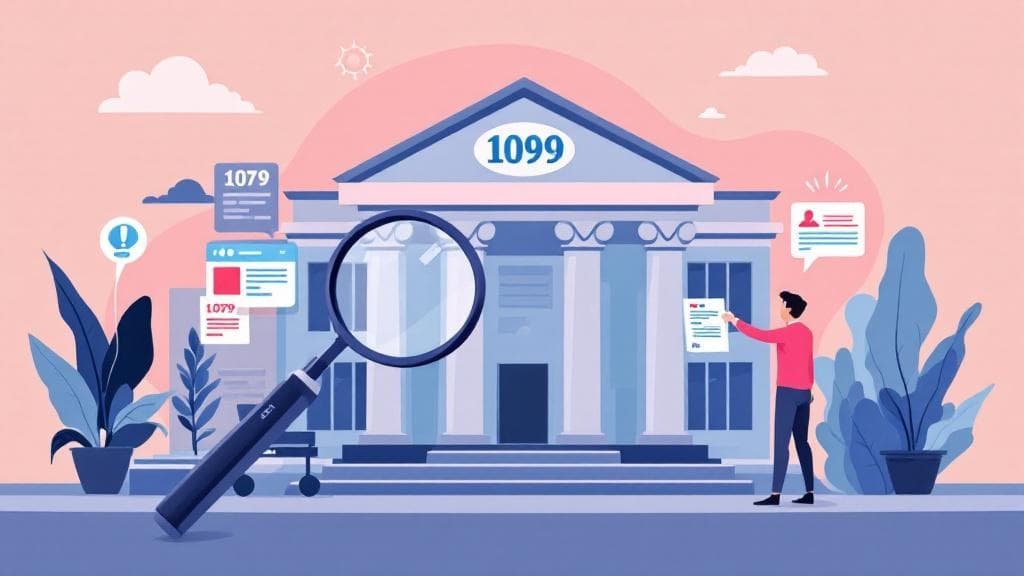
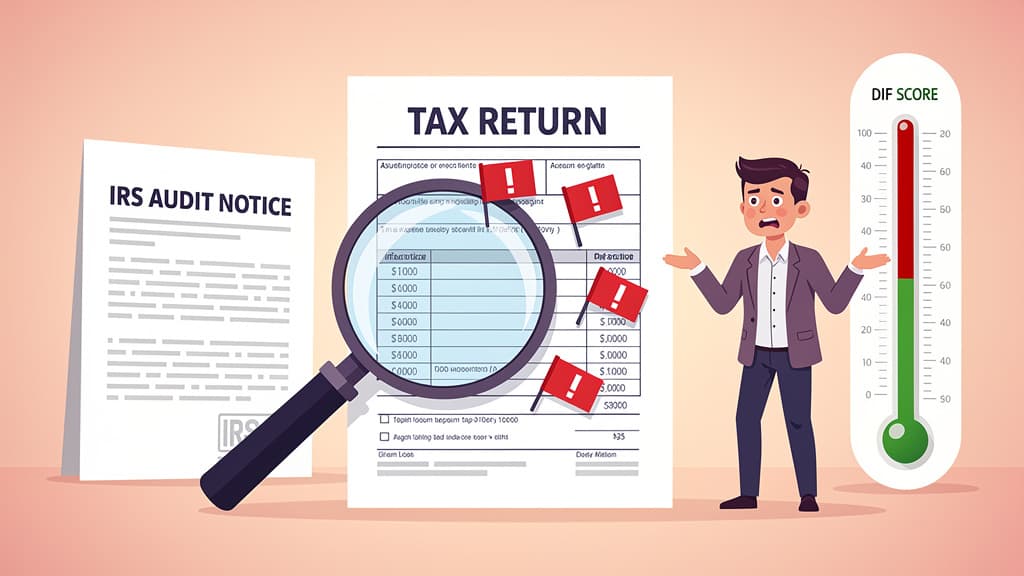
Yes. The IRS matches every Form 1099 that payers file against the income on your tax return through its Automated Underreporter (AUR) program, and a missing 1099 typically triggers a CP2000 notice 12 to 36 months after you file. The notice proposes the extra tax plus a 20% accuracy-related penalty and interest running from the return's original due date.
If you act first, the math changes: filing an amended return before the IRS contacts you usually avoids the 20% penalty entirely. This guide covers how the matching works, what it costs when the IRS catches the omission, and how to fix it now.
Key takeaways:
The AUR program matches 1099-NEC, 1099-K, 1099-R, 1099-INT, and W-2 forms against Form 1040. Most CP2000 notices arrive 12 to 24 months after filing; the 3-year assessment window means some arrive closer to 36 months
A CP2000 adds a 20% accuracy-related penalty (IRC §6662) plus interest at the federal short-term rate + 3% (7% in Q1 2026, 6% in Q2, 7% in Q3)
File Form 1040-X before the IRS contacts you (a "qualified amended return") and the 20% penalty usually disappears; you pay only the tax and interest
For payments made in 2026, the 1099-NEC/MISC filing threshold is $2,000 (the $600 threshold still applied to 2025 payments). Fewer forms does not mean tax-free income: IRC §61 requires you to report every dollar
Form 1099-K is filed only above $20,000 AND 200+ transactions, a threshold OBBBA restored permanently
Example: You earned $8,000 from a freelance client, received a 1099-NEC, but forgot to include it on your return. At the 22% bracket, you owe $1,760 in income tax plus $1,130 in SE tax ($8,000 × 92.35% × 15.3%), totaling $2,890. Add the 20% accuracy penalty ($578) and you're looking at $3,468 before interest.
The IRS doesn't manually review every return. Instead, the Automated Underreporter (AUR) program — sometimes called the "document matching" system — runs an automated comparison between:
Information returns filed by businesses and financial institutions (1099-NEC, 1099-MISC, 1099-K, 1099-INT, 1099-DIV, W-2, etc.)
Your tax return (Form 1040, Schedule C, Schedule D, etc.)
When the two don't match, the system flags the discrepancy. A tax examiner then reviews the flagged return and, if the discrepancy holds up, generates a CP2000 notice.
Before Jupid, I built Anna Money in the UK, where every payment we processed for 60,000+ small businesses was visible to HMRC. The AUR program gives the IRS the same visibility at larger scale: more than 3 billion information returns processed annually, with millions of mismatches flagged each year.
For payments made in 2026, the 1099-NEC reporting threshold is $2,000, raised from $600 by the One Big Beautiful Bill Act (OBBBA). A business must file a 1099-NEC only if it paid a non-employee $2,000 or more during calendar year 2026. The 1099s you received in early 2026 for 2025 payments still used the old $600 threshold.
Forms that trigger AUR matching:
Form
What It Reports
Threshold
1099-NEC
Non-employee compensation
$2,000 (payments made in 2026)
1099-MISC
Rents, royalties, prizes
$2,000 (payments made in 2026)
1099-K
Payment card / third-party network transactions
$20,000 AND 200+ transactions (restored by OBBBA, permanent)
1099-R
Retirement distributions (401(k), IRA, pension)
$10
1099-INT
Interest income
$10
1099-DIV
Dividend income
$10
W-2
Wages and salary
Any amount
Important: Even if you don't receive a 1099, you are legally required to report all income. The 1099 threshold determines when the payer must file the form — it does not determine when you must report the income. A freelance project that paid you $1,500 in 2026 may not generate a 1099-NEC, but you still owe tax on every dollar.
Legal citation: IRC §61(a) — "gross income means all income from whatever source derived."
Yes, if one was filed. Payment platforms like PayPal, Stripe, and eBay file Form 1099-K with the IRS once your account crosses $20,000 in gross payments AND 200 transactions in a year, and the AUR system matches those totals against your return the same way it matches a 1099-NEC. Below that threshold there is no 1099-K to match, but the income is still taxable, and the IRS can still find it through a client's 1099-NEC or bank records.
Gig platforms report as well. DoorDash, Uber, and Instacart report driver and shopper earnings to the IRS on Form 1099-NEC ($2,000+ for 2026 payments). If you drove for DoorDash and left the income off your return, the IRS already has the form.
Yes. Retirement plan custodians file Form 1099-R with the IRS for every distribution of $10 or more, and AUR matches retirement distributions just like freelance income. A forgotten 1099-R is one of the most common CP2000 triggers because distributions are often one-time events: a 401(k) rollover after a job change, an early withdrawal, a first pension payment. Report IRA distributions on Form 1040 lines 4a–4b and pensions or annuities on lines 5a–5b, even when the taxable amount is zero (a direct rollover goes on line 4a or 5a with $0 on the taxable line). Attach the 1099-R to a paper return only if federal tax was withheld.
Yes. Banks issue Form 1099-INT only when they paid you $10 or more in interest, but all taxable interest must be reported regardless of amount. Your $6 of savings-account or CD interest belongs on Form 1040 line 2b even though no form arrives. AUR has no document to match below $10; the reporting obligation is yours either way.
Typically 12 to 36 months after you file. Most CP2000 notices arrive 12 to 24 months after the filing date; the 3-year assessment statute means some show up close to the 36-month mark. For a 2026 return, the sequence looks like this:
Stage
Typical timing
Payers file 2026 1099s with the IRS
January–March 2027
You file your 2026 tax return
April 2027
AUR document matching runs
Summer–fall 2027
CP2000 notices mailed
Late 2027 through 2028, stragglers into 2029
This delay creates a false sense of security. Many taxpayers assume they're in the clear after a few months, then receive a notice more than a year later.
Pick the form and how long ago you filed — see what the matching program does next and what each path costs.
$
File Form 1040-X now and you'd owe about
$2,244
A qualified amended return filed before the IRS contacts you usually erases the 20% accuracy penalty — you pay only the tax plus interest.
Additional income tax (22% bracket)$1,320
Self-employment tax (92.35% × 15.3%)$848
Interest so far (≈7%, 6 months)$76
Wait for the CP2000 (≈18 months) instead$2,830
Acting first saves about$586
Assumes the article's example profile: single filer already in the 22% bracket; freelance income also owes SE tax (92.35% × 15.3%). Interest estimated at a flat 7% — the real rate resets quarterly (7% Q1 2026, 6% Q2, 7% Q3) and compounds daily.
Option 1: Agree with the notice. If the IRS is correct — you did forget to report that income — sign the response form and pay the proposed amount. You can set up an installment plan if needed.
Option 2: Partially agree. If some of the proposed changes are correct but others aren't, indicate which items you agree and disagree with, and provide documentation for the disputed items.
Option 3: Disagree entirely. If you already reported the income (perhaps under a different line item or schedule) or the 1099 was issued in error, send a written explanation with supporting documents:
Your copy of the 1099
Bank statements showing the income was reported elsewhere
Correspondence with the payer
Amended 1099 from the payer (if applicable)
Critical deadlines: If you don't respond within 30 days, the IRS sends a CP3219A (Statutory Notice of Deficiency), which gives you 90 days to petition the Tax Court. If that window passes too, the IRS assesses the additional tax, penalty, and interest and sends a bill. Our CP2000 response guide walks through the response form, the documents that win a dispute, and a reply-date planner.
If you don't pay the additional tax within 21 days of the CP2000 notice (10 days if the amount exceeds $100,000), the IRS adds a 0.5% per month failure-to-pay penalty, up to a maximum of 25% of the unpaid tax.
If the IRS determines you intentionally omitted income, the penalty jumps to 75% of the underpayment attributable to fraud. This is rare for typical 1099 omissions but can apply if there's a pattern of underreporting.
In extreme cases — usually involving large amounts, repeated underreporting, or willful evasion — the IRS can pursue criminal charges under IRC §7201 (tax evasion: up to $250,000 fine and 5 years imprisonment) or IRC §7203 (failure to file: up to $25,000 fine and 1 year imprisonment).
The IRS rarely pursues criminal charges for a single missing 1099. These penalties are reserved for systematic, intentional tax fraud.
The payer faces per-form penalties under IRC §6721: for returns due in 2026, $60 per form if filed within 30 days of the deadline, $130 if filed by August 1, $340 after that, and at least $680 per form for intentional disregard (Rev. Proc. 2024-40). Failing to file a 1099 does not disallow the business's deduction for the payment itself; the expense is still deductible if it is ordinary, necessary, and substantiated. It does invite scrutiny when the IRS compares the payer's deductions against missing information returns.
The One Big Beautiful Bill Act (OBBBA), signed into law in 2025, raised the 1099-NEC and 1099-MISC filing thresholds from $600 to $2,000 for payments made on or after January 1, 2026 (forms filed in early 2027). Payments made in 2025 still used the $600 threshold, which is why the 1099s that arrived in early 2026 looked the same as before. Here's what changed:
If a client pays you between $600 and $1,999 in 2026, they are no longer required to file a 1099-NEC. This means:
The IRS won't have a document to match for those payments
You still must report the income — the legal obligation hasn't changed
You may receive fewer 1099s than in previous years
This creates an odd situation: the IRS has less visibility into some freelance income, but your obligation to report it remains the same. If you're audited or if the IRS obtains payment information through other channels (like 1099-K forms from payment platforms), they can still identify unreported income.
It's the law. IRC §61 requires you to report all income regardless of whether you receive a tax form.
The payer may still file. The threshold is a minimum, not a cap. Some businesses file 1099s for all contractor payments as a matter of policy.
Other forms may report it. If you were paid through Venmo, PayPal, or another payment platform and your total crossed $20,000 and 200 transactions, you'll receive a 1099-K that covers the same income.
The statute of limitations determines how long the IRS has to assess additional tax on your return. Understanding these timelines is important for anyone who may have unreported income from prior years.
If you filed your 2026 return on April 15, 2027, the IRS generally has until April 15, 2030 to assess additional tax. But if you omitted more than 25% of your gross income, they have until April 15, 2033.
Example: You report $80,000 in gross income on your 2026 return but failed to include $25,000 from 1099-NEC forms. The unreported amount ($25,000) exceeds 25% of the reported amount ($80,000 × 25% = $20,000). The IRS now has 6 years instead of 3 to assess the additional tax.
For fraudulent returns or unfiled returns, there is no statute of limitations — the IRS can come after you at any time.
Nothing happens right away: the return processes normally and any refund still arrives. The consequences land 12 to 36 months later, when AUR matching flags the missing form and a CP2000 proposes the extra tax, a 20% penalty, and interest back to the original due date. Filing Form 1040-X before that notice usually erases the penalty. Here's the sequence:
Filing an amended return before the IRS first contacts you about an examination makes it a "qualified amended return" under Treasury Regulation §1.6664-2(c). The extra tax you report counts as tax shown on your original return, so there is no "underpayment" for the 20% accuracy-related penalty to attach to:
The 20% accuracy-related penalty generally does not apply
You owe only the additional tax plus interest
It demonstrates good faith if the IRS reviews anything else on the return
How to file:
Prepare the amendment using our Form 1040-X filing guide, including the corrected return and affected schedules
Include an updated Schedule C if the income is self-employment income
Include an updated Schedule SE for the additional SE tax
Pay the additional tax with the amended return (or request a payment plan)
A client paid you $3,000 but never sent a 1099-NEC. You still owe tax. Report the income on Schedule C. The client may have filed the 1099 with the IRS even if they didn't send you a copy, which means the AUR system will look for it on your return.
Your client sent a 1099-NEC showing $15,000, but you actually received $12,000. Report the amount you actually received ($12,000) and contact the client to request a corrected 1099. If the IRS sends a CP2000 based on the incorrect amount, respond with bank statements proving the actual payment.
A client included expense reimbursements in your 1099-NEC. For example, they paid you $10,000 for services plus $2,000 for travel reimbursement, and the 1099 shows $12,000. Report the full $12,000 on Schedule C and deduct the $2,000 as business expenses. Your net income remains correct.
A client paid you $5,000 through PayPal. The client filed a 1099-NEC for $5,000, and because your PayPal volume crossed $20,000 and 200 transactions, PayPal filed a 1099-K that includes the same $5,000. Don't report it twice. Report the income once on Schedule C, and if you receive a CP2000, respond with documentation showing the overlap. Use the 1099 tax calculator to estimate your total liability.
A client paid you $1,800 in 2026 — below the new 1099-NEC threshold. You still owe tax on the full $1,800. The threshold only determines whether the payer must file a form. Your reporting obligation is unchanged.
Problem: Thinking that if you didn't receive a 1099, you don't have to report the income.
Impact: The IRS can still identify unreported income through 1099-K forms, bank deposit analysis, or matching against the payer's business deductions.
Solution: Track all income sources independently. Use bank statements and invoicing records to compile your total income, regardless of which 1099s you receive.
Problem: Knowing you forgot income but hoping the IRS won't notice.
Impact: CP2000 notices add a 20% accuracy penalty plus 12 to 36 months of accrued interest. Filing a qualified amended return before the IRS contacts you typically eliminates the penalty.
Solution: File Form 1040-X as soon as you discover the omission. The interest starts from the original due date either way, but you can avoid the $400-$2,000+ penalty.
Problem: Ignoring the notice or missing the 30-day deadline.
Impact: The IRS assumes you agree, assesses the full proposed amount (including penalties), and sends a Statutory Notice of Deficiency (CP3219A). You then have only 90 days to petition the Tax Court.
Solution: Respond to every CP2000 notice within 30 days, even if you agree. If you need more time, call the number on the notice to request an extension.
Problem: Receiving both a 1099-NEC and 1099-K for the same income and reporting it twice.
Impact: You overpay tax — sometimes significantly. And untangling it later requires an amended return.
Solution: Cross-reference all 1099s against your actual income records. If the same payment appears on multiple forms, report it once and document the overlap.
Missing a 1099 on your tax return usually isn't intentional — it happens because freelancers juggle multiple clients, payment platforms, and income streams. By February, it's hard to remember that $3,500 project from March.
Jupid connects directly to your bank accounts and automatically categorizes every transaction with 95.9% accuracy. When a client pays you, Jupid records it immediately — not 10 months later when the 1099 arrives.
Here's how it works:
Automatic income tracking. Every deposit is tagged, categorized, and matched to the correct income source. No manual spreadsheets, no forgotten payments.
Real-time tax estimates. Jupid calculates your estimated income tax and self-employment tax as you earn, so you're never surprised by what you owe.
1099 reconciliation. When 1099s arrive in January, you can compare them against Jupid's records to catch errors — a 1099 that overstates what you were paid, duplicate reporting, or missing forms.
AI accountant on WhatsApp and iMessage. Have a tax question at 11pm? Ask Jupid's AI accountant. "Do I need to report income if I didn't get a 1099?" — you'll get an answer in seconds, with the relevant IRS rules cited.
The IRS has built one of the most effective document-matching systems in the world. If someone files a 1099 reporting that they paid you, the IRS will eventually look for that income on your return. The question isn't whether they'll catch it — it's how much extra you'll pay in penalties and interest when they do. File accurately, report everything, and if you've already made a mistake, file an amended return before the CP2000 arrives.
Disclaimer: This article is for informational purposes only and does not constitute legal or tax advice. Tax laws change frequently; consult a qualified tax professional for advice specific to your situation. Tax Year: 2026. Last Updated: July 29, 2026.
Fintech CEO with 10+ years building accounting and financial technology products. Previously co-founded and scaled an AI-powered accounting platform to $30M revenue and 100K+ business users, achieving 30,000 customers per accountant through automation — recognized by CNBC as a top fintech company. Holds a Master's in Management Information Systems. At Jupid, he leads the development of AI-native bookkeeping, tax, and compliance tools designed for freelancers and small business owners.