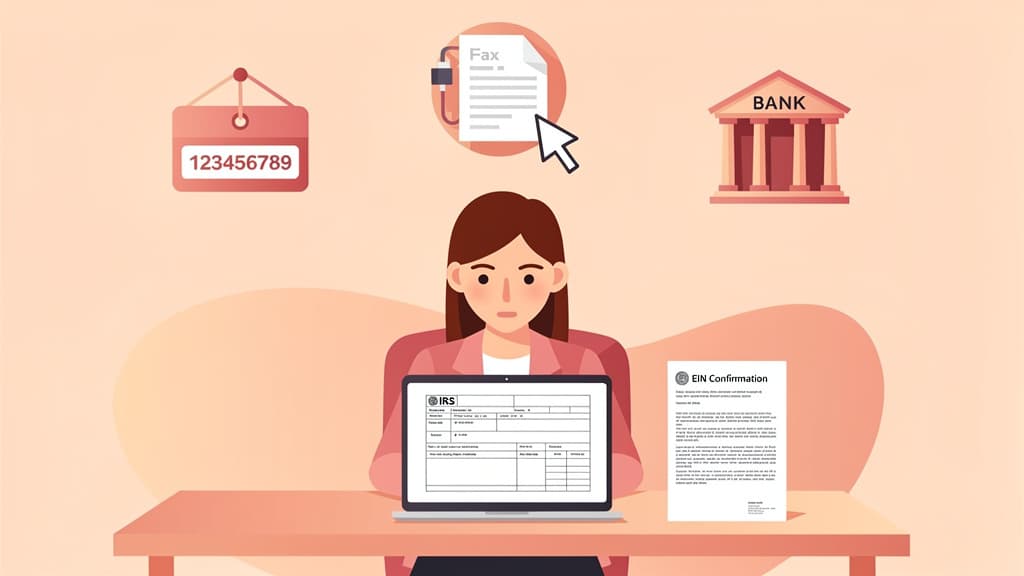
Form SS-4 is the IRS application for an Employer Identification Number (EIN), and in 2026 the fastest way to file it is the IRS online EIN assistant, which issues your number on screen the same session. Fax (855-641-6935) takes about 4 business days, mail takes about 4 weeks, and international applicants without a U.S. presence apply by phone at 267-941-1099. The current paper form is Rev. December 2025, and the trickiest fields are the responsible party (lines 7a-7b) and the entity-type checkbox (line 9a) — this guide walks every line.
Key takeaways:
- Online = same day. U.S. applicants with an SSN or ITIN get the EIN on screen; download the CP 575 confirmation letter immediately and keep it with your formation papers
- Fax: 855-641-6935, about 4 business days with a return fax number; mail: ~4 weeks (EIN Operation, Cincinnati, OH 45999)
- One EIN per responsible party per day — the IRS enforces this across all application methods
- The responsible party must be an individual who controls the entity, not another company; one without an SSN or ITIN writes "foreign" or N/A on line 7b and cannot use the online tool
- An EIN is free directly from the IRS — sites that charge for it are only charging to type the form for you

Save this cheat sheet — the SS-4 numbers and timelines in one image.
Form SS-4, "Application for Employer Identification Number," is the IRS form you use to request an EIN. The current version is Rev. December 2025, and that's the one to use in 2026. The EIN it produces is a permanent nine-digit number, written in the format 12-3456789, that identifies your business to the IRS the same way your SSN identifies you.
You don't always need an EIN. A single-member LLC with no employees can often use the owner's Social Security number. But most businesses end up needing one, and most need it early. You need an EIN if any of the following are true:
- You have employees (now or soon)
- Your business is a corporation or a partnership, including a multi-member LLC
- You file employment, excise, or certain other federal tax returns
- You want to open a business bank account (most banks require an EIN)
- You operate as a Keogh plan, trust, or estate
Even when an EIN isn't strictly required — for a solo freelancer, say — many owners get one anyway. It lets you avoid handing your SSN to every client on a Form W-9, and it's a clean separation between you and the business. If you're still deciding on a structure, our guide on what you need to start an LLC covers where the EIN fits alongside your registered agent and formation paperwork.
One thing worth saying up front: applying for an EIN is free directly from the IRS. There's no filing fee. If a site is charging you to "get your EIN," they're charging for the convenience of typing the form for you — the IRS itself never charges.
Here's a point of confusion the form's name doesn't help with. If you apply for your EIN online, you never physically file Form SS-4 — the IRS online assistant asks you the same questions in a web interview and issues the number on the spot. You only submit the paper Form SS-4 when you apply by fax or mail.
So Form SS-4 plays two roles. As a paper form, it's what you fax or mail. As a worksheet, it's the perfect prep sheet for the online application: fill it out first, then you can move through the online interview in a few minutes with every answer already in front of you. Either way, the fields are identical, so the line-by-line walkthrough below applies no matter which method you choose.
The form fits on one page. Most fields are quick. The ones below are where mistakes happen, so this is where to slow down.
Enter the exact legal name of the entity, as it appears on its formation documents. For an LLC, that's the name on your Articles of Organization. For a corporation, it's the name on your charter. For a sole proprietor with no formal entity, it's your own legal name — your personal name, not your business or "doing business as" name.
Accuracy here matters more than anywhere else. The IRS ties your EIN to whatever you write on Line 1. If it doesn't match your state filing, you can hit problems opening a bank account or filing returns later.
If your business operates under a name different from its legal name — a "doing business as" or trade name — put it here. If you trade under your legal name, enter "N/A" (the instructions say to enter N/A on lines that don't apply). This line doesn't change anything about your EIN; it just records the public-facing name.
Line 4a-4b is your mailing address, where the IRS sends notices. Line 5a-5b is your physical location if it's different from the mailing address. Line 6 is the county and state where your principal business is located. A P.O. box is acceptable for the mailing address but not for the physical location.
This is the line that causes the most rejections, so read it twice. At Anna Money, working with 60,000+ small businesses, this was the field we most often saw new owners get wrong — usually by listing a formation service or a holding company instead of a person.
Line 7a is the full name of the "responsible party." Line 7b is that person's SSN, ITIN, or EIN. The IRS defines the responsible party as the individual who ultimately owns or controls the entity, or who exercises ultimate effective control over it and its funds.
Three rules trip people up:
- It must be a person, not a company. Unless the applicant is a government entity, the responsible party has to be a natural human being. You can't list your holding company or your LLC as its own responsible party.
- Use the right person for your entity. For a corporation, it's a principal officer. For a partnership, it's a general partner. For a single-member LLC, it's the owner. For a trust, it's the grantor or trustor.
- No nominees. A nominee — a person given limited, temporary authority during formation, like a formation service contact — is not allowed to be the responsible party and shouldn't be listed here. If you used a nominee to handle your state filing, identify the real responsible party before you apply.
Whoever you list on Line 7a is the person whose SSN or ITIN goes on Line 7b. That ties the EIN to a real, controllable identity. Foreign responsible parties without an SSN or ITIN can still apply, but not online — they use fax, mail, or the international phone line covered below.
If you're forming an LLC, Line 8a asks you to check "Yes," Line 8b asks for the number of LLC members, and Line 8c asks whether the LLC was organized in the United States. This is also where the IRS starts sorting how your LLC will be taxed by default — a single-member LLC is treated as a disregarded entity, a multi-member LLC as a partnership, unless you elect otherwise.
Check the one box that matches your structure: sole proprietor, partnership, corporation, personal service corporation, estate, trust, or one of the others. For a corporation, you also enter the form number you'll file (1120 for a C corp, 1120-S for an S corp).
LLCs are the common point of confusion here, because "LLC" isn't its own checkbox on Line 9a. An LLC checks the box for how it's taxed: a single-member LLC that stays a disregarded entity checks "Other" and writes "disregarded entity" (a foreign-owned one writes "Foreign-owned U.S. disregarded entity-Form 5472"), a multi-member LLC checks "Partnership," and an LLC that has elected corporate treatment checks "Corporation" and enters the form it will file (1120 or 1120-S). The LLC-specific questions you answered on Line 8 are what tell the IRS you're an LLC.
Check the single reason that best fits. The options include:
- Started a new business
- Hired employees
- Banking purpose
- Changed type of organization
- Purchased a going business
- Created a trust or a pension plan
Most new owners check "Started a new business" and specify the type. If you're getting the EIN mainly to open a business account, "Banking purpose" is a valid choice too.
Line 11 is the date your business started or was acquired. Line 12 is the closing month of your accounting year — almost always December for small businesses. Lines 13-14 ask how many employees you expect in the next 12 months across agricultural, household, and other categories, and whether you expect your annual employment tax to be $1,000 or less (which can let you file Form 944 annually instead of Form 941 quarterly). The Form 944 guide explains who qualifies and how the IRS designation works. If you have no employees, enter 0.
Line 16 asks for your principal business activity — check the closest box from the list (construction, retail, real estate, finance, health care, and so on, or "Other"). Line 17 asks you to describe the specific products or services in a few words: "graphic design services," "online retail of handmade jewelry," "residential plumbing."
This is where the NAICS code comes from. NAICS is the standard government classification of industries, and the IRS uses your Line 16-17 answers to assign or confirm your code. You don't need to memorize a number — describe what you do plainly and the IRS maps it. Pick the box that best reflects how the business earns most of its money.
Line 18 asks whether the entity has ever applied for and received an EIN before. If yes, you list the prior number. The third-party designee section at the bottom lets you authorize someone — an accountant or attorney — to receive the EIN and answer questions on your behalf. They need your signed authorization to do this.
The method you choose decides how fast you get your number. Online is dramatically faster than everything else.
| Method | Who it's for | How fast you get the EIN |
|---|
| Online | U.S.-based applicants with an SSN or ITIN | Immediately, on screen |
| Fax | Anyone; common for those without online eligibility | Generally within 4 business days |
| Mail | Anyone; slowest option | Approximately 4 weeks |
| Phone | International applicants only | During the call |
The IRS online EIN assistant issues your number immediately at the end of the session. To use it, your principal business must be in the U.S. or its territories, you must be the responsible party (or an authorized representative), and you need a valid SSN or ITIN for the responsible party.
A few rules to know:
- One EIN per responsible party per day. The IRS limits each responsible party to a single EIN per day, online or otherwise.
- Finish in one sitting. The session times out after a period of inactivity and doesn't save, so have your Form SS-4 filled out as a worksheet before you start.
- Hours. The assistant runs Monday-Friday 6:00 a.m.-1:00 a.m. ET, Saturday 6:00 a.m.-9:00 p.m. ET, and Sunday 6:00 p.m.-midnight ET.
At the end, the system shows your EIN and lets you download your confirmation letter — the CP 575 EIN confirmation letter. Save and print it immediately. If you lose it, an eligible Business Tax Account user can download a digital CP 575 that substitutes for the original, or you can request a 147C letter.
Fill out the paper Form SS-4, sign it, and fax it to the IRS. Applicants with a principal business, office, or legal residence in a U.S. state use 855-641-6935; applicants with no presence in any state use 855-215-1627 when faxing from inside the United States or 304-707-9471 from outside it. If you include your own fax number, the IRS faxes the EIN back, generally within 4 business days. Fax is the usual route for applicants who can't apply online, such as those whose responsible party has no SSN or ITIN.
Mail the completed, signed Form SS-4 to: Internal Revenue Service, Attn: EIN Operation, Cincinnati, OH 45999. Applicants with no presence in any state use Attn: EIN International Operation at the same Cincinnati, OH 45999 address.
Processing takes approximately 4 weeks, which is why mail is a last resort. Use it only when fax and online aren't options.
If your business is outside the U.S. and you have no legal residence, principal office, or agency in the country, you can get an EIN by phone. Call 267-941-1099 (not a toll-free number), Monday-Friday, 6:00 a.m.-11:00 p.m. ET. The person calling must be authorized to receive the EIN and answer the Form SS-4 questions, so have the completed form in hand.
Here's a quick worked comparison of the timelines, assuming you apply on a Monday:
| Method | Submitted | EIN in hand | Elapsed time |
|---|
| Online | Mon 10:00 | Mon 10:08 | ~8 minutes |
| Fax | Mon 10:00 | Fri (same week) | ~4 business days |
| Mail | Mon | ~4 weeks later | ~28 days |
| Phone | Mon 10:00 | Mon 10:20 | during the call (intl only) |
For a U.S.-based founder, there's rarely a reason to pick anything but online. Once you have the number, learn how to keep a copy handy in our guide on how to find your EIN number — you'll be asked for it constantly.
These are the mistakes I see send applications into a holding pattern. Almost all of them are avoidable in the few minutes before you submit.
Wrong responsible party. Listing a company instead of a person, or naming a nominee or formation-service contact, gets the application rejected or the EIN tied to the wrong person. The responsible party must be a real individual who controls the entity; Line 7b takes that person's SSN or ITIN, or "foreign" or N/A if they don't have and can't get one.
Legal name that doesn't match your state filing. If Line 1 doesn't exactly match your Articles of Organization or corporate charter, your EIN ends up tied to a name that conflicts with your state records. Copy the name character for character.
Checking the wrong entity box for an LLC. Remember, there's no "LLC" box on Line 9a. A single-member LLC that stays disregarded checks "Other" and writes "disregarded entity"; "Sole proprietor" is for individuals. A multi-member LLC checks "Partnership." The LLC questions live on Line 8.
Applying twice in one day. The one-EIN-per-responsible-party-per-day limit means a second attempt the same day is blocked. If your online session fails, wait until the next day rather than retrying repeatedly.
Applying before you actually need it. Your business start date on Line 11 should be real. Getting an EIN you don't use creates an account the IRS expects returns for, which can generate notices down the line.
Losing the confirmation letter. The IRS does not mail a second CP 575. If you lose it, an eligible Business Tax Account user can download a digital CP 575, or you can request a 147C letter, which serves as official verification. Save the CP 575 the moment you receive it.
Getting your EIN is the first step. The harder part is everything that comes after — keeping the business's books clean enough that the EIN actually pays off at tax time. That's what Jupid handles.
Jupid is an AI accountant that lives in WhatsApp and iMessage. Once your business is set up, you connect your bank account and Jupid pulls in every transaction and auto-categorizes it with 95.9% accuracy. Instead of a shoebox of receipts and a frantic April, your income and expenses are sorted in real time, under the business identity your EIN established.
When a transaction is ambiguous — was that software purchase a business expense or personal? — you settle it in a quick chat message, and Jupid remembers your answer. Over time it learns how your business categorizes spending and applies the right treatment automatically. You can read more about that in transaction learning.
Because the categorization stays accurate in the background, you can ask Jupid questions in plain language — "how much have I spent on contractors this quarter?" — and get an answer in seconds, plus real-time financial insights whenever you want them. Jupid also handles automatic tax filing and compliance, so the entity you just registered stays in good standing without you tracking every deadline by hand.
A new EIN is a fresh start. Try Jupid and keep the books behind it clean from day one.
If you use Claude, ChatGPT, or another AI agent to apply for an EIN, our open-source Form SS-4 skill drafts the application with you. It asks who actually owns and controls the entity before filling lines 7a and 7b, picks the line 9a box from the LLC's federal tax classification (Other with "disregarded entity", the Form 5472 wording for a foreign owner, or Corporation with 1120-S ahead of Form 2553), chooses the single line 10 reason, respects the one-EIN-per-responsible-party-per-day limit, and routes you to the online tool, the international phone line, fax, or mail. Review the draft before you file.
→ jupid-tax/jupid-skills on GitHub – forms/form-ss-4/SKILL.md
For Claude Code, clone the repo and run cp -r jupid-skills/forms/form-ss-4 ~/.claude/skills/. For the Anthropic SDK, load SKILL.md into the system prompt and the references/ files on demand. For browser-automation runtimes, filing.md covers the e-file or paper-file workflow.
This guide is for general educational purposes and does not constitute tax, legal, or accounting advice. EIN requirements and Form SS-4 instructions can change, and the right answers depend on your entity type and situation. Verify the current form and instructions on IRS.gov, and consult a qualified accountant or attorney before filing.