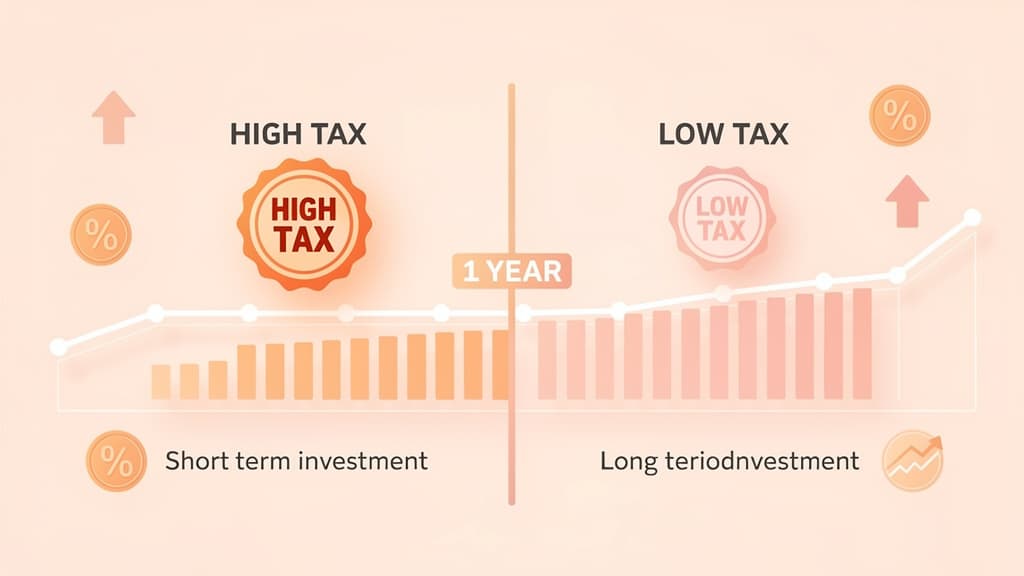
Qualified dividends are taxed at 0%, 15%, or 20% for 2026 — 0% up to $49,450 of taxable income (single) or $98,900 (married filing jointly), 15% up to $545,500 / $613,700, and 20% above that (Rev. Proc. 2025-32). Ordinary (non-qualified) dividends get no preferential rate: they're taxed at your regular bracket, 10%–37%. On a $20,000 dividend payment, the gap between the two treatments can exceed $4,000 — and which one you get often comes down to a 61-day holding period.
Key takeaways:
A dividend is qualified only if a U.S. corporation (or qualified foreign corporation) pays it AND you held the stock more than 60 days during the 121-day window around the ex-dividend date. Sell too early and the same dividend is taxed as ordinary income.
Your 1099-DIV does the sorting: Box 1a is total ordinary dividends, Box 1b is the qualified subset that gets the 0%/15%/20% rates.
High earners pay an extra 3.8% NIIT on dividends — qualified or not — once MAGI passes $200,000 (single) or $250,000 (MFJ). Top combined rates: 23.8% qualified vs. 40.8% ordinary.
S-Corp distributions are not dividends. They're generally tax-free returns of income that was already taxed on your K-1.
Reinvested (DRIP) dividends are taxable in the year they're paid, even though you never see the cash.
Must meet holding period; paid by U.S. corporation or qualified foreign corp
Ordinary (non-qualified) dividends
10%–37% (your regular tax bracket)
Everything else
2026 Qualified Dividend / Long-Term Capital Gains Rate Brackets (Single):
Rate
Taxable Income
0%
Up to $49,450
15%
$49,451–$545,500
20%
Over $545,500
2026 Qualified Dividend / Long-Term Capital Gains Rate Brackets (MFJ):
Rate
Taxable Income
0%
Up to $98,900
15%
$98,901–$613,700
20%
Over $613,700
Net Investment Income Tax (NIIT): Additional 3.8% on investment income (including dividends) if MAGI exceeds $200,000 (single) or $250,000 (MFJ). Not inflation-adjusted.
Maximum effective rate on qualified dividends: 23.8% (20% + 3.8% NIIT)
Maximum effective rate on ordinary dividends: 40.8% (37% + 3.8% NIIT)
A dividend receives the preferential qualified rate if it meets two conditions:
Condition 1: Paid by a qualifying entity
U.S. corporations
Qualified foreign corporations (incorporated in a U.S. possession, eligible for a U.S. tax treaty, or traded on a major U.S. stock exchange)
Condition 2: You meet the holding period
You must have held the stock for more than 60 days during the 121-day period that begins 60 days before the ex-dividend date
For preferred stock, the holding period extends to more than 90 days during a 181-day window
What this means in practice: If you buy a stock on January 15 and sell it on March 1 — a total of 45 days — any dividend received during that window is treated as an ordinary (non-qualified) dividend, taxed at your regular rate.
Legal citation:IRC §1(h)(11) defines qualified dividend income and the applicable rates. The holding period rules are specified in IRC §1(h)(11)(B)(iii).
All dividends that don't meet the qualified criteria are ordinary dividends. They're taxed at your regular income tax rate — the same as wages, freelance income, and interest.
Common sources of ordinary dividends:
REITs (Real Estate Investment Trusts)
Money market funds
Dividends on shares held for less than the required holding period
If your taxable income (after deductions) falls below $49,450 (single) or $98,900 (MFJ), your qualified dividends are taxed at 0%. This is not a typo — you pay zero federal tax on those dividends.
Example: A married couple filing jointly with $85,000 in taxable income receives $8,000 in qualified dividends. Their taxable income including dividends is $93,000, which is below the $98,900 threshold. Tax on those dividends: $0.
This is particularly relevant for self-employed workers who take advantage of business deductions — a lower taxable income means more room in the 0% bracket for investment income.
Use the Dividend Calculator to estimate your tax on dividend income based on your filing status and total taxable income.
What do your dividends cost as qualified vs ordinary?
Enter the dividend amount and your other taxable income — the qualified label is the difference between the 0%/15%/20% schedule and your regular bracket.
$
Box 1a of your 1099-DIV.
$
After deductions — sets which breakpoints the dividends stack into.
Tax if the dividends are qualified
$0
Qualified dividends fill the 0% / 15% / 20% breakpoints sitting above your other taxable income.
Dividends inside the 0% band (tax-free)$8,000
Same amount as ordinary dividends$960
Qualified status saves you$960
Your taxable income keeps the entire dividend inside the 0% qualified band ($98,900 married filing jointly) — $0 federal tax, exactly like the article's $8,000 example. The same dividends as ordinary income would cost $960.
Federal estimate for 2026: the dividends stack on top of your other taxable income, which also stands in for MAGI on the 3.8% NIIT check (NIIT hits qualified and ordinary dividends alike). State tax and the holding-period test aren't modeled — sell inside the 61-day window and the whole amount is ordinary.
The Net Investment Income Tax adds 3.8% on top of your regular tax rate on investment income — but only if your Modified Adjusted Gross Income (MAGI) exceeds certain thresholds.
2026 NIIT Thresholds (unchanged since 2013 — not inflation-adjusted):
For high-income taxpayers, the combined rates on dividends can be:
Dividend Type
Base Rate
+ NIIT
= Total
Qualified (top bracket)
20%
3.8%
23.8%
Ordinary (top bracket)
37%
3.8%
40.8%
The difference between 23.8% and 40.8% on $50,000 in dividends is $8,500. This is why the qualified vs. ordinary distinction matters so much for high earners.
If you own an LLC taxed as an S-Corp or a standalone S-Corporation, you need to understand a fundamental difference: S-Corp distributions are not dividends.
When an S-Corp distributes profits to shareholders, those distributions are generally tax-free — as long as they don't exceed your stock basis.
Here's why: S-Corp income is already taxed on your personal return through the K-1. The income passes through to you and is reported on your Form 1040 whether or not the S-Corp actually distributes the cash. When the distribution happens, it's a return of money that was already taxed.
S-Corp net income:                  $100,000
  → Reported on your K-1:          $100,000 (taxed on your 1040)
  → You already paid tax on it

S-Corp distribution to you:         $80,000
  → Tax-free (return of basis)      $80,000
  → Reduces your stock basis by     $80,000
The key rule: Distributions are tax-free up to your stock basis. If distributions exceed your basis, the excess is treated as a capital gain.
The corporation pays corporate tax on its profits (21% federal rate)
When profits are distributed as dividends, shareholders pay dividend tax on those distributions
C-Corp pre-tax profit:              $100,000
Corporate tax (21%):                −$21,000
After-tax profit:                   $79,000
Distributed as dividend:            $79,000

Shareholder tax on dividend:
  At 15% qualified rate:            −$11,850
  At 20% + 3.8% NIIT:              −$18,802

Net to shareholder:                 $60,198–$67,150
Effective combined rate:             32.9%–39.8%
This double taxation is why most small business owners choose S-Corp or LLC structures instead of C-Corp. For guidance on paying yourself from your LLC, see the How to Pay Yourself from LLC guide.
Like S-Corps, partnership distributions are generally tax-free returns of basis. The income is reported on Schedule K-1 and taxed at the partner level regardless of whether distributions occur.
You'll receive a 1099-DIV from each brokerage, mutual fund, or corporation that pays you $10 or more in dividends during the year. Review these forms carefully — the qualified vs. ordinary split is pre-calculated for you.
1099-DIV, Box 1a (total ordinary dividends) → Form 1040, Line 3b
1099-DIV, Box 1b (qualified dividends)      → Form 1040, Line 3a
The tax is then calculated using the Qualified Dividends and Capital Gain Tax Worksheet (in the Form 1040 instructions) or Schedule D if you also have capital gains.
If your taxable income is near or below $49,450 (single) or $98,900 (MFJ), you can receive qualified dividends tax-free. Self-employed workers who take large business deductions — home office, retirement contributions, health insurance — can sometimes keep their taxable income low enough to benefit.
Freelance net income:               $70,000
− 1/2 SE tax:                       −$4,945
− Self-employed health insurance:   −$7,200
− Solo 401(k) contribution:         −$23,500
= AGI:                              $34,355
− Standard deduction:               −$16,100
− QBI deduction (capped at 20% of
  taxable income before QBI):       −$3,651
= Taxable income:                   $14,604
At a taxable income of $14,604, this freelancer could receive qualified dividends of up to $34,846 ($49,450 − $14,604) at the 0% tax rate.
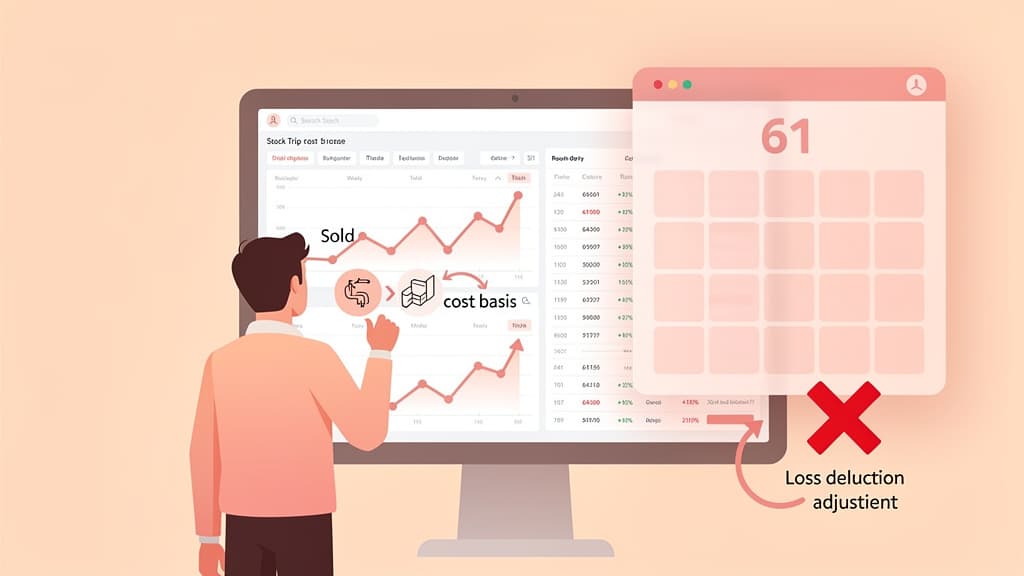
Don't sell dividend-paying stocks before the 61-day holding period. Doing so converts qualified dividends to ordinary dividends, potentially doubling or tripling the tax rate on that income.
If you're actively trading, keep dividend dates in mind. The ex-dividend date is the critical marker — you need to have owned the stock for at least 61 days within the 121-day window surrounding that date.
If you hold investments in both taxable and tax-advantaged accounts:
Taxable accounts: Hold stocks that pay qualified dividends (taxed at 0–20%)
Tax-deferred accounts (Traditional IRA, 401k): Hold investments that produce ordinary income (REITs, bonds, non-qualified dividends) — withdrawals are taxed as ordinary income regardless
Tax-free accounts (Roth IRA, Roth 401k): Hold highest-growth investments — withdrawals are tax-free
If your MAGI is near $200,000 (single) or $250,000 (MFJ), every additional dollar of investment income triggers the 3.8% NIIT. Strategies to stay below include:
Maximizing retirement plan contributions (reduces MAGI)
Timing capital gains realization across tax years
Harvesting capital losses to offset gains
Contributing to an HSA ($4,400 self-only / $8,750 family for 2026, per Rev. Proc. 2025-19)
Use the Capital Gains Tax Calculator to model different scenarios and see how gains and dividends interact with NIIT.
This comparison shows why business structure and income type matter enormously. A dollar earned as self-employment income can be taxed at more than double the rate of a dollar received as a qualified dividend.
A common misconception: if you reinvest your dividends through a DRIP (dividend reinvestment plan) instead of taking cash, you don't owe tax. Wrong. Reinvested dividends are taxable in the year received, just like cash dividends.
Dividend paid:                      $2,000
Automatically reinvested in stock:  $2,000
Taxable income reported:            $2,000 (yes, it's taxable)
The reinvested amount becomes your cost basis in the new shares, which will reduce your capital gain when you eventually sell. But in the year the dividend is paid, you owe tax on it.
Track your reinvested dividends carefully for cost basis purposes. When you sell shares purchased through DRIPs, you need accurate basis records to calculate your gain correctly.
The difference between qualified and ordinary dividends is not trivial. On $20,000 in dividends, a taxpayer in the 32% bracket pays $3,000 at the 15% qualified rate vs. $6,400 at the 32% ordinary rate. Check your 1099-DIV for the split — and understand what makes dividends qualified before you sell shares.
S-Corp distributions are a return of already-taxed income. They are not dividends. Don't report them as dividend income, and don't apply dividend tax rates to them. The income was already taxed when it passed through on your K-1.
If your MAGI is over $200,000 (single) or $250,000 (MFJ), the 3.8% NIIT applies to your dividends on top of the regular rate. Many taxpayers miss this and underpay, resulting in a balance due at filing.
Selling a stock before the 61-day holding period around the ex-dividend date converts what would have been a 0–20% qualified dividend into an ordinary dividend taxed at up to 37%. If you're planning to sell near a dividend date, run the numbers first.
Reinvested dividends are taxable income. If you're in a DRIP, you owe tax on the dividends even though you never saw the cash. Plan for this in your estimated tax payments.
When you're self-employed and also earning investment income, your tax picture has multiple moving parts: Schedule C profit, self-employment tax, estimated payments, dividends, capital gains, and potentially the NIIT. Keeping it all straight manually is time-consuming and error-prone.
Jupid connects to your bank accounts and automatically categorizes your business transactions with 95.9% accuracy. Your business income and expenses are tracked in real time, giving you an accurate net profit figure at any point during the year. That net profit, combined with your investment income from 1099-DIVs, determines your total AGI and NIIT exposure.
With Jupid, you always know where you stand:
Real-time net income so you can estimate your tax bracket for dividend planning
Automatic expense categorization so your Schedule C deductions are maximized
Estimated tax tracking that accounts for both business and investment income
Ask questions anytime through WhatsApp or iMessage:
Not all income is taxed equally, and dividends are a clear example. The spread between a 0% qualified rate and a 40.8% ordinary rate on the same dollar amount is enormous. Knowing the rules — holding periods, qualified vs. ordinary treatment, NIIT thresholds, and the S-Corp distribution distinction — puts you in a position to keep more of what you earn.
Disclaimer: This article is for informational purposes only and does not constitute tax, legal, or financial advice. Tax laws change frequently. Consult a qualified tax professional for advice specific to your situation. Jupid provides AI-powered bookkeeping and tax assistance but is not a substitute for professional tax counsel.
Fintech CEO with 10+ years building accounting and financial technology products. Previously co-founded and scaled an AI-powered accounting platform to $30M revenue and 100K+ business users, achieving 30,000 customers per accountant through automation — recognized by CNBC as a top fintech company. Holds a Master's in Management Information Systems. At Jupid, he leads the development of AI-native bookkeeping, tax, and compliance tools designed for freelancers and small business owners.