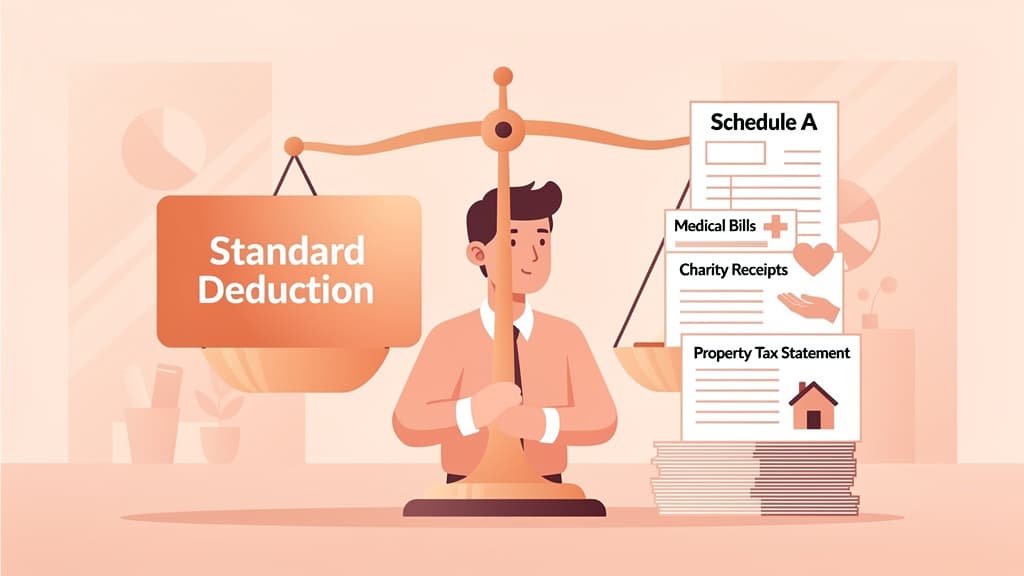
One of the most common misconceptions among self-employed business owners is that they need to itemize deductions to write off business expenses. I heard it constantly at Anna Money, where we worked with 60,000+ SMEs, and I hear it just as often from Jupid users: "Should I itemize to deduct my home office?"
The answer is almost always no — because business deductions go on Schedule C, not Schedule A. Itemizing is a completely separate decision that has nothing to do with your business expenses. But understanding when itemizing does make sense can save you thousands of dollars, especially after the SALT deduction cap changes under the One Big Beautiful Bill Act.
For 2026, the standard deduction is $16,100 (single) or $32,200 (married filing jointly). These are the numbers you need to beat. If your Schedule A deductions add up to more than your standard deduction, you itemize. If they don't, you take the standard deduction.
The wrinkle for 2026: the SALT deduction cap has increased to $40,400 (up from $10,000 under the original TCJA), which means more taxpayers — particularly those in high-tax states — may benefit from itemizing for the first time in years.
This guide breaks down every category of itemized deductions, explains how they interact with your self-employment deductions, and helps you determine which approach saves you more.
What are itemized deductions? Personal deductions you list individually on Schedule A (Form 1040) instead of claiming the standard deduction. You choose whichever gives you a larger deduction.
Enter your three biggest Schedule A categories to see which side of the line you're on.
$
State income (or sales) tax + property tax.
$
$
Your better option
Itemize
Your $30,200 on Schedule A beats the $16,100 standard deduction (single) by $14,100.
Itemized total (SALT capped)$30,200
Standard deduction$16,100
Margin$14,100
Uses the article's 2026 figures: $16,100 single / $32,200 MFJ / $24,150 HoH standard deduction (Rev. Proc. 2025-32) and the $40,400 SALT cap (phases down above $505,000 MAGI). Medical expenses over the 7.5% AGI floor and disaster casualty losses aren't included — add them if they apply.
Health insurance premiums not paid with pre-tax dollars (important: if you pay premiums through an employer's cafeteria plan, they're already excluded from income)
Dental work, vision care, hearing aids
Mental health treatment and therapy
Long-term care insurance premiums (limited by age)
Medical equipment and supplies
Travel to medical appointments (mileage rate: 20.5 cents/mile for miles driven January 1–June 30, 2026; 23.5 cents/mile from July 1, per IRS Announcement 2026-11)
What doesn't qualify:
Cosmetic surgery (unless medically necessary)
General health items (gym memberships, vitamins, supplements)
Over-the-counter medications (unless prescribed)
The 7.5% AGI floor makes this deduction hard to reach. If your AGI is $80,000, you'd need more than $6,000 in unreimbursed medical expenses before you can deduct a single dollar. Most healthy working-age adults won't hit this threshold in a typical year.
Self-employed note: If you're self-employed and pay your own health insurance premiums, you likely claim the self-employed health insurance deduction on Schedule 1 (Line 17) — which is an "above-the-line" deduction, not an itemized deduction. This is generally more beneficial because it reduces your AGI, and you don't need to itemize to claim it.
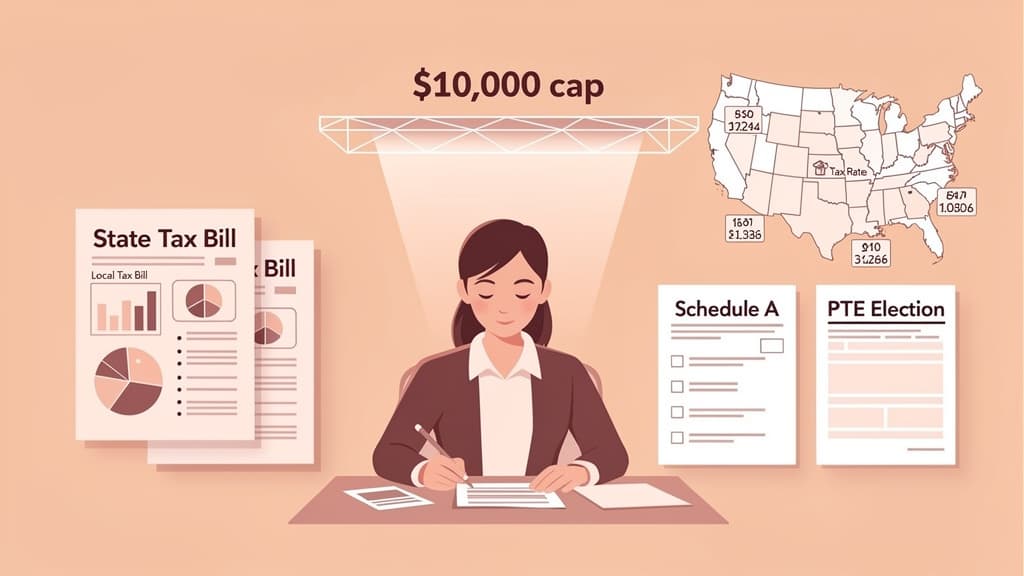
The SALT deduction is the most impactful change for 2026 itemizers. Under the One Big Beautiful Bill Act (OBBBA), the cap increased from $10,000 to $40,000 starting in 2025, with annual 1% increases through 2029.
2026 SALT cap: $40,400
What you can deduct (choose one):
State and local income taxes paid during the year, OR
State and local sales taxes paid during the year (most people choose income taxes unless they live in a state with no income tax)
Plus:
Real estate taxes on your primary home and other personal property
Personal property taxes (e.g., vehicle registration fees based on value)
The new phase-out for high earners:
The $40,400 cap begins phasing out at $505,000 MAGI ($252,500 for married filing separately). The cap is reduced by 30% of the amount by which your MAGI exceeds the threshold. At approximately $640,000 MAGI, the cap effectively returns to $10,000.
Example: Single filer, MAGI of $555,000

SALT cap: $40,400
Excess MAGI: $555,000 - $505,000 = $50,000
Reduction: $50,000 × 30% = $15,000
Adjusted SALT cap: $40,400 - $15,000 = $25,400
Self-employed note: State income taxes you pay on your business income are part of your personal SALT deduction on Schedule A. However, if you have an LLC taxed as an S Corp, the entity-level state tax (in states that offer a pass-through entity tax election) may be deductible as a business expense, bypassing the SALT cap entirely. This strategy is worth discussing with your tax professional.
Interest on mortgage debt up to $750,000 (for mortgages taken out after December 15, 2017)
Interest on mortgage debt up to $1,000,000 (for mortgages taken out on or before December 15, 2017)
Points paid on a home purchase (deductible in the year paid)
Points paid on a refinance (deducted over the life of the loan)
What you can't deduct:
Home equity loan interest (unless the loan was used to buy, build, or substantially improve the home that secures the loan)
Mortgage insurance premiums (this deduction expired and has not been extended for 2026)
Self-employed note: If you claim the home office deduction, the business portion of your mortgage interest goes on Schedule C (or Form 8829), not Schedule A. Only the personal portion goes on Schedule A. You don't need to itemize to claim the home office deduction — it's a business deduction.
Cash donations to qualified 501(c)(3) organizations
Property donations (at fair market value)
Mileage driven for charitable purposes (14 cents/mile for 2026)
Out-of-pocket expenses while volunteering (supplies, uniforms, etc.)
Limits:
Cash contributions: Up to 60% of AGI (for most public charities)
Appreciated property: Up to 30% of AGI
Private foundations: Up to 30% of AGI (cash) or 20% of AGI (property)
Excess contributions carry forward for up to 5 years
Documentation requirements:
Under $250: Receipt or bank record
$250-$500: Written acknowledgment from the charity
Over $500: Form 8283 required
Over $5,000: Qualified appraisal required (for non-cash property)
Important 2026 change: Starting with tax year 2026, OBBBA created a permanent charitable deduction for non-itemizers under IRC §170(p): up to $1,000 (single) or $2,000 (married filing jointly) in cash gifts to qualifying public charities. Contributions to donor-advised funds and supporting organizations don't count, and property donations still require Schedule A. For itemizers, 2026 also adds a floor: only charitable contributions above 0.5% of AGI are deductible.
For 2026, casualty and theft losses are deductible only if attributable to a federally declared disaster. This limitation was established by the Tax Cuts and Jobs Act and extended through 2025 by OBBBA.
How it works:
Each loss is reduced by $100
Total losses are reduced by 10% of AGI
Only losses in federally declared disaster areas qualify
This deduction is rarely applicable for most taxpayers but can be significant for those affected by hurricanes, wildfires, floods, or other declared disasters.
Under TCJA, these "miscellaneous itemized deductions subject to the 2% AGI floor" were suspended. OBBBA extended this suspension. These deductions are not available for 2026.
The math typically works in your favor when you have at least two of these:
Deduction Source
Common Range
SALT (income tax + property tax)
$5,000–$40,400
Mortgage interest
$5,000–$25,000
Charitable contributions
$1,000–$10,000+
Medical expenses (above 7.5% AGI)
Varies widely
The new SALT cap changes the math. Before OBBBA, the $10,000 SALT cap made it hard for many people to exceed the standard deduction with SALT alone. Now, with a $40,400 cap, taxpayers in high-tax states (New York, California, New Jersey, Connecticut, Massachusetts) may find that SALT alone pushes them past the standard deduction threshold.
Example: Single filer in New York City
Deduction
Amount
NY state income tax
$8,500
NYC local income tax
$3,200
Property tax
$9,000
Total SALT
$20,700
Mortgage interest
$7,500
Charitable giving
$2,000
Total itemized
$30,200
This filer clearly benefits from itemizing ($30,200 vs. $16,100 standard deduction — a $14,100 margin). Under the old $10,000 SALT cap, their total would have been only $19,500 — still worth itemizing, but the new cap adds $10,700 in additional deductions.
This is the most critical distinction for self-employed taxpayers. Your business deductions go on Schedule C, not Schedule A:
Schedule C (Business Deductions)
Schedule A (Itemized Deductions)
Office supplies
State income taxes
Business travel
Property taxes
Vehicle expenses (business use)
Mortgage interest
Home office deduction
Charitable contributions
Professional development
Medical expenses (above 7.5% AGI)
Software and subscriptions
Casualty losses (disaster only)
Marketing and advertising
Professional services
Business insurance
You claim Schedule C deductions regardless of whether you itemize or take the standard deduction. A freelance graphic designer who deducts $15,000 in business expenses on Schedule C can also take the $16,100 standard deduction. These are separate calculations.
The Qualified Business Income (QBI) deduction under IRC §199A is another common source of confusion. The QBI deduction — up to 20% of qualified business income — is claimed on Form 8995 or Form 8995-A and deducted on your 1040. It is:
Not an itemized deduction
Not a Schedule C deduction
Available whether you itemize or take the standard deduction
Here's the complete flow for a self-employed person:
Gross business income
- Schedule C deductions (business expenses)
= Net business profit (Schedule C, Line 31)

Net business profit flows to:
→ Schedule SE (self-employment tax: 15.3% on 92.35% of net profit)
→ Schedule 1, Line 3 (added to total income)

Total income
- Above-the-line deductions (half of SE tax, SEP IRA, health insurance)
= Adjusted Gross Income (AGI)

AGI
- GREATER OF: Standard deduction OR Itemized deductions (Schedule A)
- QBI deduction (Form 8995)
= Taxable income
Your business deductions reduce your income before the standard-vs-itemized decision even comes into play.
Instead of spreading deductions evenly across two years, you "bunch" them into one year to exceed the standard deduction, then take the standard deduction in the alternate year.
Example: Single filer with $12,000 in annual SALT and $5,000 in annual charitable giving
Without bunching (2 years):
Year
SALT
Charitable
Total
Deduction Used
Amount
2026
$12,000
$5,000
$17,000
Itemized
$17,000
2027
$12,000
$5,000
$17,000
Itemized
$17,000
Total deductions
$34,000
With bunching (2 years):
Year
SALT
Charitable
Total
Deduction Used
Amount
2026
$12,000
$10,000
$22,000
Itemized
$22,000
2027
$12,000
$0
$12,000
Standard
$16,100
Total deductions
$38,100
By doubling charitable contributions in 2026 (giving two years' worth) and giving nothing in 2027, the filer gains an extra $4,100 in total deductions across the two-year period. (The table uses the 2026 standard deduction of $16,100 for 2027 as a conservative stand-in — the actual 2027 amount will be inflation-adjusted upward.)
Charitable contributions: Donate two years' worth in one year. Consider using a Donor-Advised Fund (DAF) to take the tax deduction now while distributing grants over multiple years.
Medical procedures: If you have elective medical work, schedule it in a year when you'll itemize. Getting dental work, eye surgery, or other planned procedures in the same year as other medical expenses helps clear the 7.5% AGI floor.
Property taxes: Some states allow prepayment of property taxes. Pay two installments in one calendar year.
SALT (income taxes): You can't easily control when state income taxes are due. However, if you make state estimated tax payments, you can time the January payment to fall in December instead, shifting it into the earlier tax year.
Mortgage interest: Fixed by your payment schedule. You can make an extra payment in December, but the benefit is marginal.
Your Schedule C deductions (office supplies, business travel, software, home office) are completely separate from Schedule A itemized deductions. You claim business deductions regardless of whether you itemize. This is the single most common misconception among self-employed taxpayers.
If you took the standard deduction every year since 2018 because the $10,000 SALT cap made itemizing pointless, recalculate for 2026. The $40,400 cap may push your SALT alone past the standard deduction threshold — especially if you live in a high-tax state and own property.
If your itemized deductions are within a few thousand dollars of the standard deduction, you're leaving money on the table by not bunching. Concentrate charitable giving, medical procedures, and elective expenses into alternating years.
If you claim the home office deduction on Schedule C (or Form 8829), the business portion of your mortgage interest, property tax, and utilities is already deducted as a business expense. Don't also include that same portion on Schedule A. Only the personal-use portion of mortgage interest and property tax goes on Schedule A.
The IRS requires specific documentation for itemized deductions — especially charitable contributions over $250 (written acknowledgment required) and non-cash donations over $500 (Form 8283 required). Missing documentation can result in the entire deduction being disallowed on audit.
For self-employed individuals, the real tax savings come from Schedule C — your business deductions. Every dollar of business expense you track reduces both your income tax and your 15.3% self-employment tax. Missing a $1,000 deduction doesn't just cost you $220 in income tax (22% bracket) — it costs you an additional $141 in SE tax, for a total of $361.
Jupid connects to your bank accounts and categorizes business transactions automatically with 95.9% accuracy. Instead of sorting through 12 months of bank statements at tax time, your expenses are categorized as they happen — office supplies, software subscriptions, business meals, vehicle expenses, and everything else that belongs on Schedule C.
Through Jupid's WhatsApp and iMessage AI accountant, you can ask questions in plain language: "What are my total business deductions this year?" or "Am I better off taking the standard deduction?" Jupid pulls the numbers instantly from your categorized transactions.
The self-employed tax decision isn't really about standard vs. itemized — it's about making sure every legitimate business expense is captured on Schedule C. Itemizing on Schedule A is a separate question that depends on your personal deductions. Jupid makes sure the business side is covered.
For most self-employed individuals, the biggest tax savings come from Schedule C business deductions — not Schedule A itemized deductions. But the two work together: Schedule C reduces your net profit, and then you choose between the standard deduction and itemizing to further reduce your taxable income.
With the 2026 SALT cap at $40,400, more taxpayers will benefit from itemizing than at any point since 2017. Run the numbers for your specific situation, and consider the bunching strategy if you're on the fence.
Disclaimer
This article provides general information about itemized deductions and should not be considered tax advice. The SALT deduction cap, standard deduction amounts, and other figures are based on current law (OBBBA 2025) and are subject to annual inflation adjustments. Your actual tax benefit from itemizing depends on your complete financial situation. For advice specific to your situation, consult with a qualified tax professional.
Fintech CEO with 10+ years building accounting and financial technology products. Previously co-founded and scaled an AI-powered accounting platform to $30M revenue and 100K+ business users, achieving 30,000 customers per accountant through automation — recognized by CNBC as a top fintech company. Holds a Master's in Management Information Systems. At Jupid, he leads the development of AI-native bookkeeping, tax, and compliance tools designed for freelancers and small business owners.