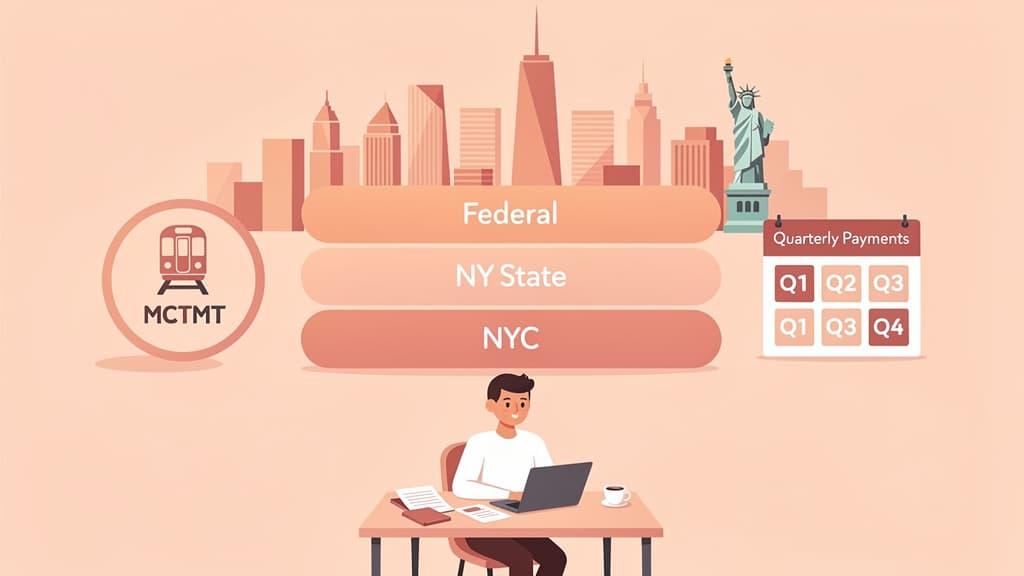
The next New York estimated tax deadline is September 15, 2026 — the Q3 payment for New York State, New York City, and MCTMT. The final payment for tax year 2026 is due January 15, 2027. The April 15 (Q1) and June 15 (Q2) deadlines have passed: if you missed one, pay the shortfall now through your Online Services account at tax.ny.gov, because the underpayment penalty accrues day by day (9.5% annual rate for July through September 2026) and is calculated per quarter on Form IT-2105.9.
Key takeaways:
You must pay New York estimated tax if you expect to owe $300 or more of New York State, New York City, or Yonkers income tax after withholding and credits. Each tax has its own $300 trigger, far below the federal $1,000 threshold
Safe harbor: pay 90% of your 2026 tax or 100% of your 2025 tax (110% if your 2025 New York AGI exceeded $150,000; $75,000 if married filing separately)
The MCTMT changed for 2026: the self-employment threshold jumped from $50,000 to $150,000 of net earnings per zone, and the Zone 1 (NYC) rate rose to 0.60% (Zone 2 stays 0.34%)
New York cut its bottom five tax rates for 2026: brackets now run 3.9% to 10.9%
Pay online (free ACH debit through Online Services) or mail Form IT-2105, the 2026 estimated tax payment voucher that covers state, city, Yonkers, and MCTMT amounts on one form
As of July 2026, two payment deadlines remain for tax year 2026: September 15, 2026 (Q3) and January 15, 2027 (Q4). Earlier dates are shown for reference and penalty catch-up.
Deadline
What's Due
Who It Applies To
Sep 15, 2026 — next
NY State / NYC / MCTMT Q3 payment
Individuals expecting $300+ NYS, NYC, or Yonkers tax
Jan 15, 2027
NY State / NYC / MCTMT Q4 payment
Same as Q3
Apr 15, 2026 (passed)
NY State / NYC Q1 estimated tax
Same as Q3
Apr 15, 2026 (passed)
MCTMT Q1 payment
Self-employed in the MCTD (net SE earnings >$150K per zone)
Apr 15, 2026 (passed)
NY individual return (IT-201/IT-203)
NY residents / nonresidents with NY income
Jun 15, 2026 (passed)
NY State / NYC / MCTMT Q2 payment
Same as Q3
Mar 16, 2026 (passed)
NY S-Corp (CT-3-S) / Partnership (IT-204)
S-Corps and partnerships (extended: Sep 15, 2026)
Apr 15, 2026 (passed)
NY C-Corp (CT-3)
Calendar-year C-Corps
Legal basis: NY Tax Law §685, NYC Admin Code §11-1785
Yes, if you expect to owe $300 or more of New York State, New York City, or Yonkers income tax for 2026 after subtracting withholding and credits. Each of the three taxes carries its own $300 trigger, and the trigger is far lower than the federal $1,000 threshold — a detail many New York taxpayers miss. Self-employed individuals with net earnings allocated to the Metropolitan Commuter Transportation District must also make estimated MCTMT payments (covered below).
This applies to:
Self-employed individuals and freelancers
Partners and S-Corp shareholders with pass-through income
Individuals with significant investment income not subject to withholding
Missed Q1 or Q2? Pay the shortfall as soon as possible rather than waiting for September 15. The underpayment penalty runs from each missed due date until the day you pay, so a July catch-up payment costs less than a September one (details in the penalty section).
Enter your 2025 New York tax and your 2026 estimate — the smaller safe harbor sets the payment that keeps the IT-2105.9 penalty off your return.
$
Total NY State + NYC + Yonkers tax from your 2025 return.
$
State + city tax before withholding and credits.
Your quarterly payment
$2,750
Locked in by the prior-year safe harbor — no penalty even if 2026 income comes in higher than planned.
Prior-year safe harbor (100% × $11,000)$11,000
Current-year option (90% of expected tax)$11,268
Left to pay at filing if your estimate holds — penalty-free$1,520
Remaining 2026 due datesSep 15 + Jan 15, 2027
Four equal installments; NY withholding counts as paid evenly across the year. Remaining 2026 due dates: September 15, 2026 and January 15, 2027 — missed Q1/Q2 amounts accrue penalty at 9.5% (Jul–Sep 2026 rate, compounded daily) until paid. Include NYC and Yonkers amounts in both inputs; MCTMT rides on the same IT-2105 voucher on top. Prior-year option requires a filed, full-12-month 2025 NY return.
The fastest way to pay is through an Online Services account with the New York State Department of Taxation and Finance: log in, open the Services menu, choose Payments, bills and notices, then Make a payment. The direct debit from your checking or savings account is free, you can save your bank details, and you can schedule all remaining 2026 installments in advance.
Your three payment options:
Online Services at tax.ny.gov — free bank transfer (ACH debit), with scheduling
Form IT-2105 — the 2026 Estimated Tax Payment Voucher for Individuals, if paying by check or money order through the mail; one voucher per quarter, and the same voucher carries your New York State, NYC, Yonkers, and MCTMT amounts
Credit card — through the state's third-party processor (convenience fees apply)
New York cut the rates in its bottom five brackets by 0.1 percentage point for tax year 2026, with another 0.1-point cut scheduled for 2027, so a 2025 rate table slightly overstates your 2026 bill. The 2026 brackets for single filers, from the official Form IT-2105-I rate schedule:
Taxable Income (Single)
Rate
Up to $8,500
3.90%
$8,500 – $11,700
4.40%
$11,700 – $13,900
5.15%
$13,900 – $80,650
5.40%
$80,650 – $215,400
5.90%
$215,400 – $1,077,550
6.85%
$1,077,550 – $5,000,000
9.65%
$5,000,000 – $25,000,000
10.30%
Over $25,000,000
10.90%
2026 brackets for married filing jointly:
Taxable Income (MFJ)
Rate
Up to $17,150
3.90%
$17,150 – $23,600
4.40%
$23,600 – $27,900
5.15%
$27,900 – $161,550
5.40%
$161,550 – $323,200
5.90%
$323,200 – $2,155,350
6.85%
$2,155,350 – $5,000,000
9.65%
$5,000,000 – $25,000,000
10.30%
Over $25,000,000
10.90%
The 2026 New York standard deduction is $8,000 for single filers (who cannot be claimed as a dependent), $16,050 for married filing jointly, and $11,200 for head of household. Note for higher earners: if your New York AGI exceeds $107,650, a supplemental "tax benefit recapture" worksheet phases out the benefit of the lower brackets, so your effective rate lands near your top bracket rate.
If you are a resident of New York City, you owe NYC income tax in addition to New York State income tax. NYC has its own $300 trigger: you must make estimated payments if you expect to owe $300 or more of city income tax after withholding and credits, even if your state liability alone falls under $300.
NYC income tax applies only to residents of the five boroughs. If you live outside NYC, you do not owe city income tax (though you may owe MCTMT — see below).
NYC estimated tax payments follow the same quarterly schedule as New York State:
April 15, 2026 — Q1 (passed)
June 15, 2026 — Q2 (passed)
September 15, 2026 — Q3
January 15, 2027 — Q4
NYC estimated taxes are paid together with your New York State estimated taxes on Form IT-2105. You do not file a separate NYC payment voucher — the single form covers state, city, Yonkers, and MCTMT.
The Metropolitan Commuter Transportation Mobility Tax (MCTMT) is a New York tax that funds the Metropolitan Transportation Authority (MTA). The rules changed substantially for 2026: self-employed individuals now owe MCTMT only if net earnings from self-employment allocated to a zone of the Metropolitan Commuter Transportation District (MCTD) exceed $150,000 for the tax year. Through 2025 the threshold was $50,000, so many freelancers who paid MCTMT last year owe nothing this year.
The 2026 MCTMT rates for self-employed individuals, per tax.ny.gov:
Zone 1 (the five NYC boroughs): 0.60% of net self-employment earnings allocated to the zone
You owe MCTMT for 2026 if both of these conditions are met:
You are self-employed (or a partner or LLC member treated as a partner) carrying on a trade or business within the MCTD
Your net earnings from self-employment allocated to Zone 1 or Zone 2 exceed $150,000 in that zone for the tax year. The threshold is tested per zone and per individual, even if you file a joint return
Zone 1 counties: New York (Manhattan), Bronx, Kings (Brooklyn), Queens, Richmond (Staten Island)
Zone 2 counties: Rockland, Nassau, Suffolk, Orange, Putnam, Dutchess, Westchester
MCTMT = net earnings from self-employment allocated to the zone × the zone rate (0.60% or 0.34%)
Net earnings from self-employment is the figure from federal Schedule SE, Part 1, line 6, which is roughly 92.35% of your Schedule C profit, not the profit itself.
Example: a Manhattan-based consultant with $200,000 of net Schedule C profit in 2026:
Net earnings from self-employment = $200,000 × 92.35% = $184,700
$184,700 exceeds the $150,000 Zone 1 threshold, so the tax applies
MCTMT = $184,700 × 0.60% = $1,108 per year, or about $277 per quarter
The $150,000 threshold is a cliff, not an exclusion. Once you cross it, the rate applies to your entire net earnings in that zone. Below it, you owe nothing: a freelancer with $150,000 of Schedule C profit has net earnings of only $138,525 and owes zero MCTMT for 2026, even though the same earnings triggered the tax under 2025 rules.
MCTMT quarterly payments follow the same schedule: April 15 and June 15 (both passed), September 15, 2026, and January 15, 2027. Estimated MCTMT is paid together with your state and city amounts on Form IT-2105 (its instructions include separate Zone 1 and Zone 2 worksheets), and the annual amount is reconciled on your Form IT-201 or IT-203. The old standalone Form MTA-6 was discontinued years ago; everything now runs through IT-2105 and your personal return.
Form: CT-3-S (New York S Corporation Franchise Tax Return), with Form CT-34-SH (the shareholders' information schedule) attached
Original deadline: March 16, 2026 (March 15 was a Sunday) — passedExtended deadline: September 15, 2026
New York S-Corps are subject to a fixed dollar minimum tax based on New York receipts, ranging from $25 to $4,500. S-Corp shareholders report their share of income on their personal New York returns (IT-201 or IT-203).
Form: CT-3 (General Business Corporation Franchise Tax Return)
Original deadline: Varies by fiscal year. Calendar-year C-Corps filed by April 15, 2026.
Extended deadline: Six months from the original due date (October 15, 2026 for calendar-year filers)
New York C-Corps are subject to franchise tax calculated under three bases — the business income base, the capital base, and the fixed dollar minimum — and pay whichever produces the highest tax.
New York LLC filing depends on federal tax treatment: single-member LLCs report on IT-201, multi-member LLCs file IT-204, S-Corp-electing LLCs file CT-3-S, and C-Corp-electing LLCs file CT-3.
All New York LLCs also owe an annual filing fee based on New York-source gross income, ranging from $25 (income under $100,000) to $4,500 (income of $25 million or more). This is separate from income tax.
New York's Pass-Through Entity Tax is an optional election that allows partnerships, S-Corps, and LLCs taxed as partnerships or S-Corps to pay state income tax at the entity level. This was created as a workaround to the federal $10,000 SALT deduction cap — the entity-level tax is deductible as a business expense on the federal return, effectively bypassing the SALT cap for pass-through owners.
PTET runs on its own calendar, not the individual estimated tax schedule:
Election deadline: March 15 of the tax year, made annually online through the entity's Business Online Services account. The 2026 election window closed on March 16, 2026; the window for tax year 2027 opens January 1, 2027
Estimated payments: Due March 15, June 15, September 15, and December 15 of the tax year (a December date, not the individual January 15 installment). Payments must be made through the online PTET Web File application by ACH debit; checks are not accepted
Annual return: Due March 15 of the following year
Partners and shareholders receive a refundable credit on their personal New York returns for their share of PTET paid.
If you fail to pay enough estimated tax by any quarterly due date, New York imposes a penalty based on the underpayment amount, the applicable interest rate (set quarterly by the Department of Taxation and Finance), and the number of days outstanding. For July 1 through September 30, 2026, the underpayment rate for personal income tax is 9.5%, compounded daily. The penalty is calculated separately for each quarter — overpaying in a later quarter does not eliminate a prior-quarter penalty.
Pay the missed amount now; you cannot erase a Q1 or Q2 underpayment, but the penalty stops accruing on the day the money arrives, so paying in July costs meaningfully less than paying at the September 15 deadline. Make the catch-up payment through Online Services or with a Form IT-2105 voucher, then compute the penalty on Form IT-2105.9 when you file your 2026 return.
One repair tool exists if you also have a W-2 job: New York, like the IRS, treats withholding as paid evenly across all four quarters by default. Raising your NY withholding for the rest of 2026 can therefore retroactively cover the Q1 and Q2 shortfalls in a way a late estimated payment cannot.
If you owe an underpayment penalty, you calculate it on Form IT-2105.9 (Underpayment of Estimated Tax by Individuals and Fiduciaries) and file it with your annual return. The federal penalty runs on parallel rules with its own form (Form 2210); see our Estimated Tax Penalty Guide for that side.
To illustrate the total estimated tax burden, here's an example for a single, self-employed NYC resident with $150,000 in net Schedule C income and no other income sources. The federal layer follows standard self-employment tax rules.
This example uses 2026 rates and standard deductions. Your actual amounts will vary based on deductions, credits, filing status, and other income. Use the Quarterly Tax Calculator to estimate your specific payments. For a full breakdown of federal quarterly obligations, see our Quarterly Estimated Taxes Guide.
The effective total tax rate on $150,000 of self-employment income in this example is approximately 33.4% — before accounting for any business deductions beyond the standard deduction and QBI. Note what changed from 2025: this taxpayer no longer owes MCTMT (the threshold tripled to $150,000 of net SE earnings) and pays slightly less state tax under the reduced 2026 brackets.
If you requested an extension by April 15, 2026 (federal Form 4868 or New York Form IT-370), your New York return (IT-201 or IT-203) deadline moved to October 15, 2026.
An extension does not extend the deadline to pay. Payment was due April 15 with Form IT-370, and interest accrues from April 15 on any unpaid balance, so if you extended but still owe, pay now rather than waiting for October. Quarterly estimated payment due dates remain unchanged regardless of filing extensions.
New York City residents owe both state and city estimated taxes. Some taxpayers calculate their New York State obligation and forget that NYC adds another 3.078%–3.876% on top. For a self-employed NYC resident earning $150,000, that oversight could mean underpaying by roughly $5,000 for the year.
The MCTMT rules changed for 2026, and both directions of the mistake are expensive. Freelancers still budgeting for MCTMT on earnings between $50,000 and $150,000 are overpaying: the threshold is now $150,000 of net SE earnings per zone. High earners in the five boroughs applying the old 0.34% rate are underpaying: the Zone 1 rate is now 0.60%. Check your zone and 2026 net earnings before the September 15 payment.
The federal estimated tax threshold is $1,000 — you must make estimated payments if you expect to owe $1,000 or more after withholding and credits. New York's threshold is only $300. Taxpayers who calculate their estimated obligation at $500 and assume they're below the threshold (using the federal number) still owe New York estimated payments and will face an underpayment penalty.
Filing Form 4868 gives you more time to file both your federal and New York returns. But it does not give you more time to pay. New York estimated tax payments — including any balance due on your annual return — must still be paid by April 15. Taxpayers who file extensions and assume they can pay later face interest charges from the original due date.
Managing estimated tax payments is harder when you're paying at multiple levels — federal, New York State, New York City, and MCTMT. Each has its own calculations, thresholds, and safe harbor rules. Jupid tracks all of these obligations in one place.
When you connect your bank accounts, Jupid automatically categorizes your income and expenses with 95.9% accuracy. The AI calculates your estimated tax liability across all levels — federal self-employment tax, New York State, NYC (if applicable), and MCTMT — based on your actual year-to-date earnings.
Instead of maintaining separate spreadsheets for federal and state estimated payments, you get a unified picture. Jupid flags when your quarterly payments are due and shows you the amount for each level. If your income changes mid-year, the calculations update automatically so you can adjust your remaining quarterly payments and avoid an underpayment penalty.
Jupid works through a web interface and via WhatsApp and iMessage — ask your AI accountant "What are my Q3 estimated payments?" and get a breakdown by jurisdiction based on your real bank transactions.
New York adds real complexity to estimated tax payments. Between state income tax, city income tax, and MCTMT, you may be making estimated payments to three taxing authorities on the same quarterly schedule — on top of federal.
The good news is that the individual quarterly dates align: April 15, June 15, September 15, and January 15, with two payments still ahead for 2026. Batch your payments on the same day each quarter. Know the thresholds ($300 for NY vs. $1,000 federal), apply the right safe harbor, and re-check your MCTMT position under the new $150,000 threshold before September 15. The penalties are avoidable — but only if you plan ahead.
Disclaimer
This article provides general information about New York estimated tax payments for the 2026 tax year and should not be considered tax advice. Tax rates, thresholds, and deadlines are subject to legislative change. NYC income tax applies only to NYC residents. MCTMT applies to self-employed individuals in the MCTD only above the $150,000 net-earnings threshold (2026). Consult a qualified tax professional or refer to the NY Department of Taxation and Finance at tax.ny.gov for advice specific to your situation.
Fintech CEO with 10+ years building accounting and financial technology products. Previously co-founded and scaled an AI-powered accounting platform to $30M revenue and 100K+ business users, achieving 30,000 customers per accountant through automation — recognized by CNBC as a top fintech company. Holds a Master's in Management Information Systems. At Jupid, he leads the development of AI-native bookkeeping, tax, and compliance tools designed for freelancers and small business owners.