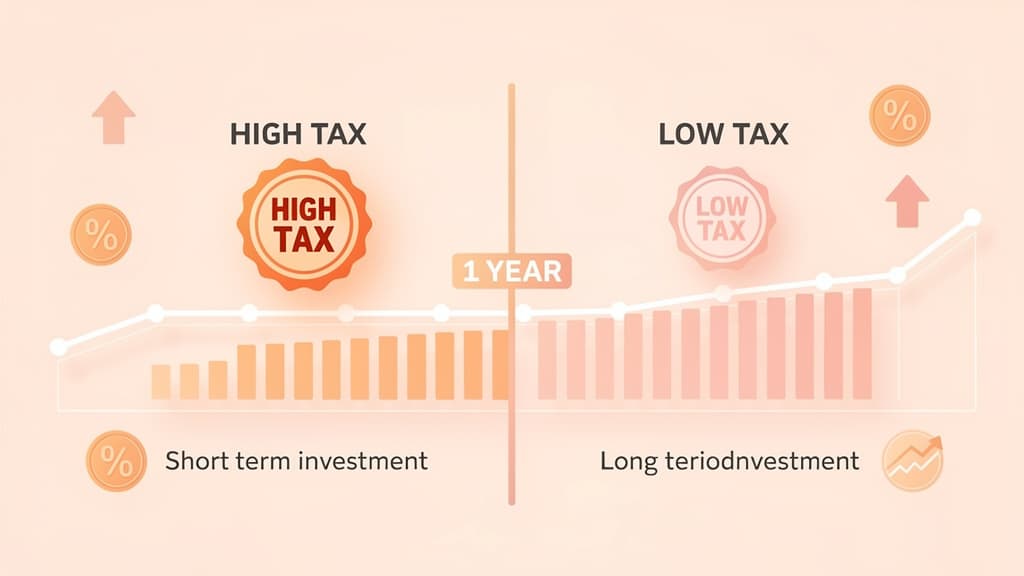
The 2026 capital gains tax rate depends on how long you held the asset. Long-term capital gains (assets held more than one year) are taxed at 0%, 15%, or 20%: a single filer pays 0% on taxable income up to $49,450, 15% from $49,451 to $545,500, and 20% above that, per IRS Revenue Procedure 2025-32. Short-term gains (assets held one year or less) get no special rate; they are taxed as ordinary income at 10% to 37%. High earners add the 3.8% Net Investment Income Tax on top.
Key takeaways:
- Held more than one year = long-term (0%/15%/20%); held one year or less = short-term (ordinary rates up to 37%)
- 2026 long-term brackets, single filer: 0% up to $49,450, 15% to $545,500, 20% above (Revenue Procedure 2025-32)
- 2026 long-term brackets, married filing jointly: 0% up to $98,900, 15% to $613,700, 20% above
- The NIIT adds 3.8% above $200,000 MAGI (single) / $250,000 (MFJ), making the maximum effective rates 40.8% short-term vs 23.8% long-term
- Net capital losses deduct up to $3,000 per year against ordinary income; the rest carries forward indefinitely
2026 Long-Term Capital Gains Rates:
| Filing Status | 0% Rate | 15% Rate | 20% Rate |
|---|
| Single | Up to $49,450 | $49,451–$545,500 | Over $545,500 |
| Married Filing Jointly | Up to $98,900 | $98,901–$613,700 | Over $613,700 |
| Head of Household | Up to $66,200 | $66,201–$579,600 | Over $579,600 |
2026 Short-Term Capital Gains Rates (Same as Ordinary Income, Single):
| Taxable Income (Single) | Tax Rate |
|---|
| $0–$12,400 | 10% |
| $12,401–$50,400 | 12% |
| $50,401–$105,700 | 22% |
| $105,701–$201,775 | 24% |
| $201,776–$256,225 | 32% |
| $256,226–$640,600 | 35% |
| Over $640,600 | 37% |
Legal basis: IRC §1(h) (capital gains rates), IRC §1222 (definitions), IRC §1231 (business property), IRC §1411 (NIIT), IRS Publication 544, Schedule D, Form 8949

The holding period determines everything. When you sell a capital asset, you calculate the time between two dates:
- Start date: The day after you acquire the asset
- End date: The day you sell or dispose of the asset
If the holding period is one year or less, the gain is short-term. If it is more than one year, the gain is long-term.
Example: You buy 100 shares of stock on March 15, 2025. Your holding period starts March 16, 2025.
- Sell on March 15, 2026 = short-term (exactly one year, not more than one year)
- Sell on March 16, 2026 = long-term (one year and one day)
That one-day difference can change your tax rate from 24% to 15%. At Anna Money, which served 60,000+ small businesses, we regularly saw owners sell appreciated assets in December without checking the purchase date, when one more month of holding would have cut their rate by half or more.
Not all assets follow the standard acquisition date:
| Situation | Holding Period Starts |
|---|
| Inherited property | Automatically treated as long-term, regardless of actual holding period |
| Gifted property | Donor's holding period carries over (tacks on) |
| Stock splits | Original purchase date applies |
| Reinvested dividends | Each reinvestment has its own purchase date |
| Wash sale replacement shares | Includes holding period of the original disallowed shares |
| Short sales | Begins when replacement shares are delivered |
Legal citation: IRC §1222 defines short-term and long-term capital gains. IRC §1223 provides rules for determining holding periods. For inherited property, IRC §1014 and §1223(9) establish automatic long-term treatment.
Short-term capital gains are added to your other ordinary income — wages, freelance income, interest — and taxed at the same rates. These are the same seven brackets that apply to your paycheck; our 2026 Tax Brackets Guide covers them for every filing status.
| Taxable Income | Marginal Rate |
|---|
| $0–$12,400 | 10% |
| $12,401–$50,400 | 12% |
| $50,401–$105,700 | 22% |
| $105,701–$201,775 | 24% |
| $201,776–$256,225 | 32% |
| $256,226–$640,600 | 35% |
| Over $640,600 | 37% |
| Taxable Income | Marginal Rate |
|---|
| $0–$24,800 | 10% |
| $24,801–$100,800 | 12% |
| $100,801–$211,400 | 22% |
| $211,401–$403,550 | 24% |
| $403,551–$512,450 | 32% |
| $512,451–$768,700 | 35% |
| Over $768,700 | 37% |
Here is a concrete comparison. Suppose you are a single freelancer with $80,000 in net self-employment income and you sell stock for a $20,000 gain.
| Short-term gain | Long-term gain |
|---|
| Freelance income | $80,000 | $80,000 |
| Capital gain | $20,000 (ordinary income) | $20,000 (preferential rate) |
| Standard deduction | -$16,100 | -$16,100 |
| Taxable income | $83,900 | $83,900 ($63,900 ordinary + $20,000 LTCG) |
| Rate on the gain | 22% bracket | 15% LTCG rate |
| Federal tax on the gain | ~$4,400 | $3,000 |
Difference: $1,400. The gap widens significantly at higher income levels.
Legal citation: IRC §1(a)–(d) establishes the ordinary income tax brackets. Short-term capital gains are defined under IRC §1222(1) and are not eligible for the preferential rates of IRC §1(h).
Long-term capital gains receive one of three preferential rates based on your taxable income:
Single Filers:
| Taxable Income | LTCG Rate |
|---|
| $0–$49,450 | 0% |
| $49,451–$545,500 | 15% |
| Over $545,500 | 20% |
Married Filing Jointly:
| Taxable Income | LTCG Rate |
|---|
| $0–$98,900 | 0% |
| $98,901–$613,700 | 15% |
| Over $613,700 | 20% |
Head of Household:
| Taxable Income | LTCG Rate |
|---|
| $0–$66,200 | 0% |
| $66,201–$579,600 | 15% |
| Over $579,600 | 20% |
Married Filing Separately:
| Taxable Income | LTCG Rate |
|---|
| $0–$49,450 | 0% |
| $49,451–$306,850 | 15% |
| Over $306,850 | 20% |
Source: IRS Revenue Procedure 2025-32 (2026 inflation-adjusted thresholds), as amended by the One Big Beautiful Bill Act (OBBBA)
If your taxable income (after deductions) is below the 0% threshold, your long-term capital gains are taxed at zero. This applies to total taxable income including the gains.
Example: A single freelancer has $35,000 in net business income after deductions and $10,000 in long-term capital gains. Total taxable income: $45,000. Since $45,000 is below the $49,450 threshold, the entire $10,000 gain is taxed at 0%.
But the 0% rate also works for gains that partially fall within the bracket:
Example: The same freelancer has $45,000 in ordinary taxable income and $10,000 in long-term gains. The first $4,450 of gains fills up the 0% bracket ($49,450 − $45,000). The remaining $5,550 is taxed at 15%. Total tax on the gains: $832.50.
This is particularly valuable for self-employed people who maximize business deductions — lower taxable income means more room in the 0% bracket.
Use the Capital Gains Tax Calculator to estimate your tax based on your filing status, income, and holding period.
Legal citation: IRC §1(h) establishes the preferential rates for net capital gain. The income thresholds are adjusted annually for inflation under IRC §1(f).
The NIIT adds 3.8% to your tax on investment income, but only if your Modified Adjusted Gross Income (MAGI) exceeds certain thresholds. These thresholds have not been adjusted for inflation since the tax was created in 2013.
2026 NIIT Thresholds:
| Filing Status | MAGI Threshold |
|---|
| Single | $200,000 |
| Married Filing Jointly | $250,000 |
| Married Filing Separately | $125,000 |
| Head of Household | $200,000 |
The 3.8% applies to the lesser of:
- Your net investment income, or
- The amount by which your MAGI exceeds the threshold
Example (single filer with $260,000 MAGI):
| Item | Amount |
|---|
| MAGI | $260,000 |
| NIIT threshold | $200,000 |
| Excess over threshold | $60,000 |
| Short-term capital gains | $15,000 |
| Long-term capital gains | $30,000 |
| Dividends | $5,000 |
| Total net investment income | $50,000 |
NIIT = 3.8% × the lesser of $60,000 or $50,000 = 3.8% × $50,000 = $1,900
Subject to NIIT:
- Capital gains (both short-term and long-term)
- Dividends and interest
- Rental income and royalties
- Passive activity income
NOT subject to NIIT:
- Self-employment income (subject to SE tax instead)
- Distributions from qualified retirement plans
- Tax-exempt municipal bond interest
Legal citation: IRC §1411 established the NIIT. The thresholds are statutory and not indexed for inflation.
With NIIT, the maximum federal rates on capital gains become:
| Type | Base Rate | + NIIT | Effective Maximum |
|---|
| Short-term | 37% | 3.8% | 40.8% |
| Long-term | 20% | 3.8% | 23.8% |
The difference between maximum rates is 17 percentage points — a significant incentive to hold assets for more than a year.
When you have multiple transactions in a year, the IRS requires a specific netting process. This is not optional; the order matters.
All capital gains and losses are first sorted into two buckets:
- Short-term: Assets held one year or less
- Long-term: Assets held more than one year
| Short-Term | Long-Term |
|---|
| Gains: +$8,000 | Gains: +$12,000 |
| Losses: -$3,000 | Losses: -$5,000 |
| Net: +$5,000 | Net: +$7,000 |
Each is taxed at its respective rate. In the example above, $5,000 is taxed as ordinary income and $7,000 at long-term rates. This is the simplest scenario.
The net loss offsets the net gain in the other category:
| Scenario | Short-Term | Long-Term | Result |
|---|
| A | Net gain: +$5,000 | Net loss: -$3,000 | +$2,000 short-term gain |
| B | Net loss: -$4,000 | Net gain: +$10,000 | +$6,000 long-term gain |
| C | Net loss: -$2,000 | Net loss: -$4,000 | -$6,000 total net loss |
In Scenario B, the netting preserves the favorable long-term rate — your remaining $6,000 gain is still taxed at the lower long-term rate, not reclassified as short-term.
If your total net capital losses exceed total net capital gains, you can deduct up to $3,000 per year ($1,500 if married filing separately) against ordinary income. Any remaining loss carries forward to future years indefinitely.
Example: You have $2,000 in net short-term losses and $5,000 in net long-term losses. Your total net capital loss is $7,000. You deduct $3,000 this year. The remaining $4,000 carries forward to 2027, retaining its short-term or long-term character.
Legal citation: The netting process is governed by IRC §1(h) and explained in detail in Schedule D instructions. The $3,000 capital loss limitation is established in IRC §1211(b). Carryforward rules are in IRC §1212(b).
If you sell business property held for more than one year — equipment, vehicles, real property used in your business — these gains may qualify for Section 1231 treatment.
Section 1231 gives you the best of both worlds:
- Net Section 1231 gains are treated as long-term capital gains (lower rates)
- Net Section 1231 losses are treated as ordinary losses (fully deductible, no $3,000 cap)
There is a catch. If you claimed ordinary loss treatment on Section 1231 losses in any of the five preceding tax years, an equivalent amount of your current Section 1231 gain is "recaptured" and taxed as ordinary income.
Example: In 2024, you had a $10,000 Section 1231 loss that you deducted as an ordinary loss. In 2026, you sell business equipment for a $15,000 Section 1231 gain. The first $10,000 is recaptured as ordinary income. Only the remaining $5,000 receives long-term capital gains treatment.
If you sell depreciable business property at a gain, you may also face depreciation recapture under Sections 1245 and 1250:
- Section 1245 (equipment, vehicles): All prior depreciation is recaptured as ordinary income, up to the amount of gain
- Section 1250 (real property): Unrecaptured Section 1250 gain is taxed at a maximum rate of 25%
For a detailed breakdown of depreciation recapture rules, see our Depreciation Recapture Guide.
Legal citation: IRC §1231 (business property gains and losses), IRC §1245 (depreciation recapture for personal property), IRC §1250 (depreciation recapture for real property), IRS Publication 544
Long-term gains on collectibles are taxed at a maximum rate of 28% — higher than the standard 20% maximum for other long-term gains. Collectibles include:
- Art and antiques
- Precious metals (gold, silver, platinum)
- Gems and jewelry
- Stamps and coins
- Rare wines
- Certain ETFs backed by precious metals
Important: If your ordinary income rate is below 28%, you pay your ordinary rate instead. The 28% is a cap, not a flat rate.
If you sell stock in a qualified small business (C corporation with gross assets under $50 million at issuance), you may exclude up to 100% of the gain from federal income tax. The maximum exclusion is the greater of $10 million or 10 times your basis in the stock.
Requirements:
- Must be a C corporation (not S-Corp, LLC, or partnership)
- Stock must be acquired at original issuance
- Must hold for more than 5 years
- Corporation must be in an active trade or business
Legal citation: IRC §1(h)(4) sets the 28% rate for collectibles. IRC §1202 provides the QSBS exclusion. IRS Publication 550 covers investment income reporting.
Form 8949 (Sales and Other Dispositions of Capital Assets):
- Lists every individual transaction
- Separated into Part I (short-term) and Part II (long-term)
- Requires: date acquired, date sold, proceeds, cost basis, gain or loss
Schedule D (Capital Gains and Losses):
- Summarizes totals from Form 8949
- Calculates net short-term and long-term gains/losses
- Applies the netting rules
- Determines your tax using the Schedule D Tax Worksheet
Your brokerage sends Form 1099-B with transaction details. Since 2011, brokers are required to report cost basis for most securities. Check the "basis reported to IRS" indicator — if basis was reported, your Form 8949 filing is simpler.
When you own shares purchased at different prices, the method you use to determine cost basis matters:
| Method | How It Works | Default For |
|---|
| FIFO (First In, First Out) | Oldest shares sold first | Most brokerages |
| Specific Identification | You choose which shares to sell | Available if you designate at sale |
| Average Cost | Total cost ÷ number of shares | Mutual funds only |
Tax planning tip: Specific identification gives you the most control. If you have shares purchased at $50 and $30, selling the $50 shares first reduces your gain.
Legal citation: Form 8949 and Schedule D are required by IRC §1001 (recognition of gain or loss). Cost basis reporting rules are in IRC §6045(g).
The simplest strategy. If you are considering selling an appreciated asset, check your purchase date. If selling now produces a short-term gain, waiting until you cross the one-year mark can cut your rate from up to 37% to 15% (or even 0%).
Sell losing positions to offset gains. A $10,000 loss offsets a $10,000 gain, dollar for dollar. Just watch out for the wash sale rule — if you buy a substantially identical security within 30 days before or after the sale, the loss is disallowed.
If your taxable income is below $49,450 (single) or $98,900 (MFJ), plan to realize long-term gains in years when your income is lower. This is especially relevant for freelancers whose income fluctuates year to year.
Self-employed people have a unique advantage: business deductions reduce your taxable income, which can push your capital gains into lower rate brackets. Maximizing deductions for your home office, business vehicle, and retirement contributions directly affects which capital gains bracket you fall into.
If you donate long-term appreciated securities to a qualified charity, you can:
- Deduct the full fair market value as a charitable contribution
- Avoid paying capital gains tax on the appreciation
This is more tax-efficient than selling the asset, paying capital gains tax, and donating the cash.
If you sell a business asset or real property, an installment sale (IRC §453) spreads the gain over multiple years. This can keep you in a lower tax bracket in each year rather than recognizing the full gain at once.
Investing capital gains into a Qualified Opportunity Zone fund (IRC §1400Z-2) allows you to defer and potentially reduce capital gains tax. The deferral lasts until December 31, 2026 or until you sell the investment, whichever comes first. Investments held for 10 or more years may qualify for a permanent exclusion of gain on the QOZ investment itself.
The holding period must be more than one year for long-term treatment. Exactly 365 days is short-term. This is the most common and most expensive mistake.
Some taxpayers assume all gains are taxed at the same rate. They're not. Short-term and long-term gains are netted separately first, and the order affects your total tax.
Selling a stock at a loss and buying it back within 30 days disallows the loss. The rule applies even if you buy the replacement in a different account — including your spouse's account or your IRA. Read our full Wash Sale Rule Guide.
If you cannot prove your cost basis, the IRS may treat your entire sale price as gain. Keep records of every purchase, especially for assets acquired before brokers were required to track basis (pre-2011 stocks, cryptocurrency, real property).
Taxpayers often calculate their capital gains tax using only the 0%/15%/20% rates and forget about the 3.8% NIIT. If your MAGI exceeds $200,000 (single), the effective rate on long-term gains jumps from 15% to 18.8% or from 20% to 23.8%.
Crypto-to-crypto transactions are taxable events. Trading Bitcoin for Ethereum triggers a capital gain or loss on the Bitcoin. Many crypto investors fail to track the holding period for each individual transaction, resulting in short-term treatment when long-term would have applied.
Federal rates are only part of the picture. States like California (up to 13.3%), New York (up to 10.9%), and New Jersey (up to 10.75%) tax capital gains as ordinary income. Meanwhile, nine states — including Florida, Texas, and Wyoming — have no state income tax at all. See our states with no capital gains tax guide for the state-by-state rates, and the States With No Income Tax Guide for the broader picture.
Capital gains planning comes down to knowing your taxable income before you sell, because that number decides whether you land in the 0%, 15%, or 20% bracket. Jupid is an AI accountant that connects to your bank accounts, categorizes business transactions with 95.9% accuracy, and keeps your Schedule C picture current all year, so you know how much room is left in a lower bracket before you realize a gain. Ask in WhatsApp or iMessage whether selling now or in January changes your estimated taxes, and get an answer built on your real numbers. Try Jupid
- IRC §1(h): Preferential tax rates for net capital gain (law.cornell.edu)
- IRC §1222: Definitions of short-term and long-term capital gain and loss (law.cornell.edu)
- IRC §1211(b): $3,000 capital loss limitation for individuals (law.cornell.edu)
- IRC §1212(b): Capital loss carryforward rules (law.cornell.edu)
- IRC §1231: Business property gains and losses (law.cornell.edu)
- IRC §1411: Net Investment Income Tax (law.cornell.edu)
- IRS Publication 544: Sales and Other Dispositions of Assets (irs.gov)
- IRS Publication 550: Investment Income and Expenses (irs.gov)
- Schedule D Instructions: Capital Gains and Losses (irs.gov)
- Form 8949 Instructions: Sales and Other Dispositions of Capital Assets (irs.gov)
- IRS Revenue Procedure 2025-32: 2026 inflation-adjusted thresholds (irs.gov)
Capital gains taxation rewards patience. The one-year holding period is the single most impactful factor — waiting just one extra day can drop your rate from 37% to 15%, or from 24% to 0%. That is not a rounding error; it is thousands of dollars on any meaningful gain.
For self-employed people, the interaction between business income and investment income makes planning even more important. Your business deductions directly affect which capital gains bracket you land in. A well-timed retirement contribution or equipment purchase can push your taxable income below the 0% threshold, making your long-term gains tax-free.
Track your holding periods, document your cost basis, understand the netting rules, and plan your sales with the calendar in mind. The tax code rewards those who do.
Disclaimer: This article is for informational purposes only and does not constitute tax, legal, or financial advice. Tax laws change frequently, and individual circumstances vary. Consult a qualified tax professional before making decisions based on this content. The 2026 figures cited are based on IRS Revenue Procedure 2025-32 and current law as of the last update.