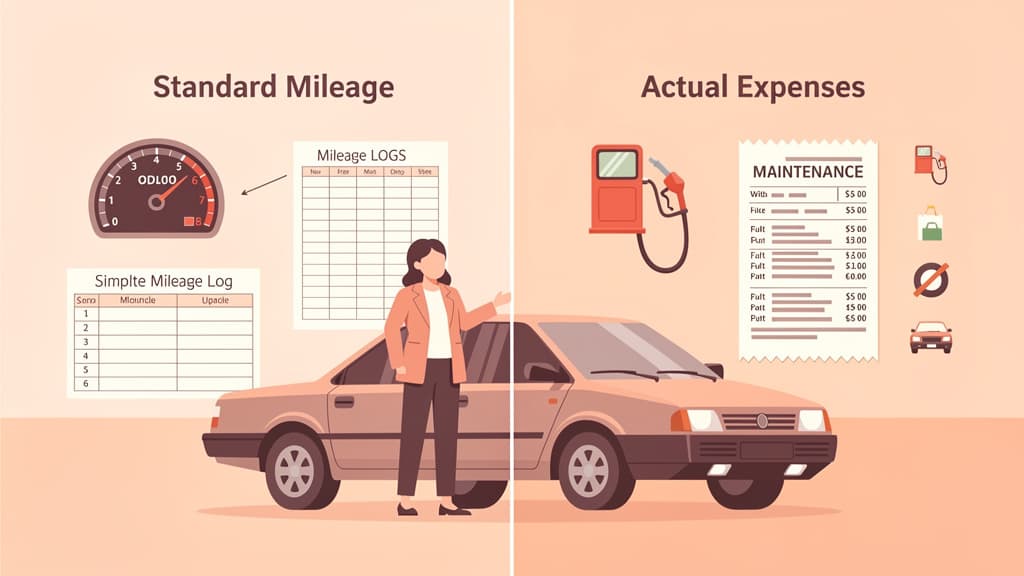
The 2026 IRS standard mileage rate is 72.5 cents per business mile for miles driven January 1–June 30, 2026, and 76 cents from July 1 (Notice 2026-10; Announcement 2026-11), and it bundles gas, insurance, repairs, and depreciation into that single number. Use standard mileage when you drive many business miles in an inexpensive car. Switch to the actual-expense method when you own a costly vehicle or a heavy SUV over 6,000 lbs GVWR, where Section 179 and 100% bonus depreciation write off far more in year one. Run both calculations before you file: the method you pick in a vehicle's first year is often locked in for as long as you own it.
Key takeaways:
2026 standard mileage rate: 72.5¢/mile (Jan 1–Jun 30) and 76¢/mile (Jul 1–Dec 31) (IRS Notice 2026-10; Announcement 2026-11). 15,000 business miles at the 76¢ second-half rate equals an $11,400 deduction.
Actual-expense method deducts real costs (gas, insurance, repairs, car wash, registration, depreciation) times your business-use percentage.
Heavy SUV or truck (6,001–14,000 lbs GVWR): up to $32,000 of Section 179 in year one, then 100% bonus depreciation on the remaining cost (IRC §179(b)(6)).
Passenger car (6,000 lbs or less): first-year depreciation is capped at $20,300 with bonus (Section 280F, Rev. Proc. 2026-15). You cannot write off a $50,000 sedan in one year.
Commuting miles are never deductible. A qualifying home office turns trips from home into deductible business miles.
Primary source: IRS Publication 463, Travel, Gift, and Car Expenses.
The standard mileage rate is simpler and usually wins for high-mileage, low-cost cars. The actual-expense method usually wins for expensive vehicles, heavy SUVs, and cars with high operating costs. Here is the side-by-side.
Factor
Standard Mileage Rate
Actual Expense Method
2026 rate/basis
72.5¢ (Jan–Jun) / 76¢ (Jul–Dec) per mile
Actual costs × business-use %
What's included
Gas, insurance, repairs, depreciation, all bundled
The standard mileage rate bundles all vehicle operating costs — gas, oil, insurance, repairs, tires, registration, and depreciation — into a single per-mile rate set by the IRS each year.
2026 rate: 72.5 cents per business mile for miles driven January 1–June 30, and 76 cents for miles driven July 1–December 31 (IRS Notice 2026-10; Announcement 2026-11)
This rate applies equally to gasoline, diesel, hybrid, and fully electric vehicles.
Example: 18,000 business miles × $0.76 (the rate for miles driven July 1–December 31, 2026) = $13,680 deduction. Miles driven before July 1 count at $0.725 instead.
First-Year Election Rule: If you own the vehicle, you must choose the standard mileage rate in the first year you use the vehicle for business. After the first year, you can switch to actual expenses. But if you start with actual expenses using accelerated depreciation, Section 179, or bonus depreciation, you're locked out of the standard mileage rate for that vehicle permanently.
Additional restrictions:
You cannot operate five or more vehicles simultaneously for business (fleet rule)
Leased vehicles: If you choose standard mileage, you must use it for the entire lease period
The vehicle must be used for business — personal use miles don't count
Yes, car washes count. IRS Publication 463 treats washing and waxing as an ordinary operating cost of a business vehicle, so it is deductible under the actual-expense method (times your business-use percentage). It is not a separate write-off if you use the standard mileage rate, because the per-mile rate already bundles every operating cost.
Plus depreciation: the annual deduction for the vehicle's declining value, subject to Section 280F limits for passenger vehicles.
At 70% business use, the deductible amount is $13,575 × 0.70 = $9,503.
For the same vehicle driven 12,000 business miles, the standard mileage rate at the 76¢ second-half 2026 rate gives 12,000 × $0.76 = $9,120 (miles driven before July 1 count at 72.5¢). The actual-expense method ($9,503) wins here by $383.
Your business use percentage is business miles divided by total miles driven. With 12,000 business miles and 6,000 personal miles (18,000 total), business use is 12,000 ÷ 18,000 = 66.7%.
Every deductible expense is multiplied by this percentage. If your business use drops below 50%, you lose access to accelerated depreciation methods, Section 179, and bonus depreciation.
Source: IRC §280F(b)(3) — recapture rules for business use below 50%
Section 280F of the Internal Revenue Code caps how much depreciation you can claim each year on passenger vehicles weighing 6,000 lbs or less (GVWR). The IRS calls these "luxury auto limits," though they apply to virtually every sedan and light truck — not just actual luxury cars.
2026 Depreciation Limits (Rev. Proc. 2026-15):
Year
With Bonus Depreciation
Without Bonus Depreciation
Year 1
$20,300
$12,300
Year 2
$19,800
$19,800
Year 3
$11,900
$11,900
Each succeeding year
$7,160
$7,160
The bonus-depreciation column adds $8,000 to the first-year cap. The IRS adjusts these amounts annually for inflation; the 2025 figures were $20,200 and $12,200 under Rev. Proc. 2025-16.
Even with 100% bonus depreciation restored by the OBBBA, the 280F cap still applies to passenger vehicles under 6,000 lbs. You cannot write off the entire cost of a $50,000 sedan in year one. The most you claim with bonus is $20,300.
Example: $45,000 sedan, 100% business use. Year 1 (with bonus) is $20,300, Year 2 is $19,800, and Year 3 covers the remaining $4,900. The $45,000 basis is fully recovered in three years, because each annual cap exceeds the balance left.
Example: $65,000 sedan, 100% business use. Year 1 $20,300, Year 2 $19,800, Year 3 $11,900, Year 4 $7,160, and Year 5 the remaining $5,840. The full $65,000 is depreciated in about five years.
Section 179 allows businesses to deduct the full purchase price of qualifying equipment — including vehicles — in the year of purchase instead of depreciating over time. For vehicles, the rules depend on weight.
2026 Section 179 Vehicle Limits:
Vehicle Category
GVWR
Section 179 Limit
Passenger vehicles (cars, light trucks)
Under 6,000 lbs
Subject to 280F limits ($12,300 without bonus, $20,300 with)
For SUVs, trucks, and vans with a GVWR over 6,000 lbs but under 14,001 lbs, you can deduct up to $32,000 under Section 179 in the first year. The remaining cost qualifies for 100% bonus depreciation under the OBBBA.
Example: $72,000 SUV (GVWR 6,500 lbs), 100% business use. Section 179 covers $32,000, and 100% bonus depreciation covers the remaining $40,000, for a $72,000 year-one deduction.
Compare that to a $72,000 sedan (under 6,000 lbs): the 280F cap holds year-one depreciation to $20,300, leaving $51,700 to recover over the following years. The heavy SUV deducts $51,700 more in year one, which is why trucks and full-size SUVs are popular business-vehicle choices.
Under the original TCJA phase-down schedule, bonus depreciation was dropping 20 percentage points per year — reaching just 20% in 2026. The One Big Beautiful Bill Act (OBBBA), signed July 4, 2025, restored 100% bonus depreciation for qualified property acquired and placed in service after January 19, 2025.
What this means for vehicles placed in service in 2026:
Vehicle Type
Bonus Depreciation Treatment
Passenger vehicle (under 6,000 lbs)
100%, but capped by 280F limits ($20,300 in year 1)
This is the most commonly misunderstood rule in vehicle deductions. Your daily commute between home and your regular place of business is a personal expense — never deductible.
If your home office qualifies as your principal place of business under IRS Publication 587, every trip from home becomes a deductible business trip. This single rule can add thousands of dollars in deductions.
Example: 30 miles round-trip to client meetings × 240 working days = 7,200 annual business miles. With a qualifying home office, that deducts 7,200 × $0.76 (the July 1–December 31, 2026 rate; earlier miles count at $0.725) = $5,472. Without the home office, the same driving is commuting and deducts $0.
When you lease, your deductible expense is the business portion of your lease payments — not depreciation. However, the IRS requires a "lease inclusion amount" adjustment for expensive vehicles to prevent taxpayers from avoiding the 280F limits by leasing instead of buying.
Advantages of leasing:
Lower monthly payments = better cash flow
No depreciation calculations needed
Consistent deduction each year
Deduct the full business portion of lease payments
Disadvantages:
Lease inclusion amount reduces deduction on expensive vehicles
No Section 179 or bonus depreciation
Must use standard mileage for entire lease if you choose that method
Under IRC §274(d), the IRS requires "adequate records" or "sufficient evidence" for vehicle deductions. In practice, this means you need a written mileage log kept at or near the time of each trip.
Keep your mileage logs and vehicle expense records for at least 3 years after filing the return. If you claim depreciation, keep records for 3 years after the final depreciation year.
Apps that use GPS to automatically log trips are accepted by the IRS, as long as you review and categorize each trip. Popular options include MileIQ, Everlance, and Stride.
If you claim Section 179 or bonus depreciation in year one, then your business use drops below 50% in a later year, the IRS requires you to recapture the excess depreciation. This means reporting it as ordinary income on your tax return.
Example: You claim $32,000 of Section 179 on a heavy SUV at 80% business use in Year 1. In Year 2, business use drops to 40%. You must recapture the difference between the Section 179 you claimed and the straight-line depreciation you would otherwise have been allowed.
This recapture is reported on Form 4797 and is taxed as ordinary income.
The IRS has disallowed vehicle deductions in countless Tax Court cases where the taxpayer had no mileage log. Estimating at year-end is not sufficient. Start tracking from day one.
Unless your vehicle is a commercial truck that never leaves a job site, claiming 100% business use invites scrutiny. Be honest about personal use — even driving to lunch counts.
A freelancer driving 20,000 business miles in a $15,000 Honda Civic should use the standard mileage rate. A contractor driving 8,000 miles in a $75,000 truck should use actual expenses. Run both calculations before choosing.
Your regular commute is never deductible, even if you make business calls during the drive, carry business materials in your car, or have your company logo on the vehicle.
Setting up a qualified home office converts every business trip from home into a deductible trip. This can be worth $3,000–$8,000+ per year in additional deductions.
If you plan to ever use the standard mileage rate for a vehicle, you must elect it in the first year of business use. Using actual expenses with accelerated depreciation in year one permanently locks you out.
Business owners buying a $70,000 heavy SUV often don't realize they can deduct the entire cost in year one using Section 179 ($32,000) plus bonus depreciation ($38,000). They depreciate it over five years unnecessarily.
Every business mile (72.5¢ January–June, 76¢ July–December 2026) and every gas, insurance, and repair charge is a deduction, but only if it is tracked and categorized correctly. Jupid is an AI accountant that connects to your bank account and automatically categorizes transactions with 95.9% accuracy, flagging gas stations, repair shops, insurance, parking, and tolls as vehicle expenses. Ask a question like "standard mileage or actual expenses for my truck?" over WhatsApp or iMessage and get an answer based on your real numbers instead of generic advice.
Business vehicle deductions are one of the largest tax savings available to self-employed individuals, but they require deliberate planning. The choice between the standard mileage rate (72.5¢/mile January–June, 76¢ July–December 2026) and the actual expense method can mean a difference of thousands of dollars — and that difference changes based on your vehicle, your driving patterns, and your operating costs.
Run the numbers for both methods before committing. Track every mile from day one. And if you're buying a vehicle for business, understand the weight-based rules: heavy SUVs and trucks over 6,000 lbs get dramatically better tax treatment than passenger cars.
The recordkeeping requirement is non-negotiable. The IRS has disallowed vehicle deductions in case after case where taxpayers couldn't produce a contemporaneous mileage log. An app that takes 10 seconds per trip can protect deductions worth $10,000 or more.
Disclaimer
This article provides general information about business vehicle tax deductions and should not be considered tax advice. Vehicle deduction rules, depreciation limits, and mileage rates are subject to annual changes. The Section 280F depreciation limits referenced are from Rev. Proc. 2026-15; the Section 179 limits are from Rev. Proc. 2025-32. Your actual deduction depends on your vehicle type, business use percentage, and overall tax situation. For advice specific to your circumstances, consult with a qualified tax professional.
Fintech CEO with 10+ years building accounting and financial technology products. Previously co-founded and scaled an AI-powered accounting platform to $30M revenue and 100K+ business users, achieving 30,000 customers per accountant through automation — recognized by CNBC as a top fintech company. Holds a Master's in Management Information Systems. At Jupid, he leads the development of AI-native bookkeeping, tax, and compliance tools designed for freelancers and small business owners.