The extended Form 1041 deadline for calendar-year trusts and estates is September 30, 2026. The original April 15, 2026 due date has passed, and the Form 7004 extension runs 5½ months, not the six months individuals get. The next date on the fiduciary calendar is September 15, 2026, when Q3 estimated payments (Form 1041-ES) are due. Fiscal-year estates follow their own rule: Form 1041 is due the 15th day of the 4th month after the estate's tax year ends.
Key takeaways:
Extended Form 1041 is due September 30, 2026 for calendar-year trusts and estates that filed Form 7004 (5½-month extension, not October 15)
Missed April 15 without an extension? File now: the late-filing penalty is 5% of unpaid tax per month, up to 25%, with a $525 minimum once the return is more than 60 days late
Q3 estimated payment (Form 1041-ES) is due September 15, 2026. Estates skip estimated payments for their first two tax years; trusts don't
Trusts hit the top 37% rate at just $16,000 of 2026 taxable income (Rev. Proc. 2025-32), so distribution planning matters
The 2026 federal estate tax exemption is $15 million per person under the One Big Beautiful Bill Act; Form 706 is due 9 months after death
Form 1041, U.S. Income Tax Return for Estates and Trusts, is required for:
Trusts with gross income of $600 or more for the tax year, or any amount of taxable income, or a beneficiary who is a nonresident alien
Estates with gross income of $600 or more for the tax year, or a beneficiary who is a nonresident alien
This applies regardless of whether the trust or estate actually owes tax. A trust that earns $700 in interest but distributes all of it to beneficiaries still files Form 1041; the income just passes through via Schedule K-1.
Grantor trusts (where the grantor retains control) report income on the grantor's individual return, but may still need to file an informational Form 1041 under Treasury Regulation §1.671-4.
Three tests decide it — gross income, taxable income, and who the beneficiaries are.
$
All income before deductions — interest, dividends, rents, capital gains, business income.
Yes — Form 1041 is required
The 2025 return was due April 15, 2026; with a Form 7004 extension it is due September 30, 2026 (5½ months, not the six individuals get). Distributing every dollar doesn't change the answer — income passes through on Schedule K-1, but the return still gets filed.
Missed April 15 with no extension? File now — Form 7004 can't be filed retroactively. The late-filing penalty runs 5% of unpaid tax per month up to 25%, with a $525 minimum once the return is more than 60 days late, plus a 0.5%-per-month late-payment penalty and 7% interest (Q3 2026). If no tax is due there's generally no penalty, but beneficiaries still need their K-1s.
Filing tests from the Form 1041 instructions and IRC §6012(a)(4); deadlines and penalty figures are for the 2025 return filed in 2026. State fiduciary returns are separate.
This is one of the most important distinctions between trusts and estates, and one of the most common mistakes.
Trusts must use the calendar year. That means the tax year runs January 1 through December 31, and the return is due April 15 of the following year. There are no exceptions for simple or complex trusts. The only trusts that may use a fiscal year are tax-exempt trusts (such as charitable remainder trusts under IRC §664).
Estates can choose a fiscal year. An estate's first tax year begins on the date of the decedent's death, and the executor can select any month-end within 12 months as the fiscal year-end. For example, if someone dies on March 20, 2026, the executor could choose a fiscal year ending on any month-end from March 31, 2026, through February 28, 2027.
This fiscal year flexibility is a real planning tool. It can defer income, shift deductions, and delay K-1 reporting to beneficiaries. But it also means the filing deadline isn't always April 15.
Form 1041 for the 2025 tax year was due April 15, 2026 for calendar-year trusts and estates, together with Schedule K-1 for each beneficiary. The next original deadline for calendar-year filers is April 15, 2027, covering the 2026 tax year.
With an extension, the Form 1041 due date is September 30, 2026 for calendar-year trusts and estates that filed Form 7004 by April 15. The extension for trusts and estates is 5½ months, not 6 months like individual returns. This is a detail many people miss: Form 7004 gives you until September 30, not October 15.
Form 7004 cannot be filed retroactively, so the fix is to file Form 1041 and pay as soon as possible. Three costs accumulate until you do:
Late-filing penalty: 5% of the unpaid tax per month, up to 25%. A return filed more than 60 days late (after June 14, 2026, for calendar-year filers) owes a minimum of $525 or 100% of the tax due, whichever is smaller
Late-payment penalty: 0.5% of the unpaid tax per month, up to 25%
Interest: 7% annually for Q3 2026, compounded daily, on top of both penalties
If the trust or estate owes no tax, there is generally no penalty for the late return itself, but K-1s still need to reach beneficiaries.
Original deadline: 15th day of the 4th month after the fiscal year ends
Extended deadline: 5.5 months after the original deadline (file Form 7004)
For example, an estate with a fiscal year ending June 30, 2026, would have an original deadline of October 15, 2026, and an extended deadline of March 31, 2027.
Form 1041 reports the trust or estate's income (interest, dividends, rents, capital gains, business income), deductions (trustee fees, attorney fees, accounting fees, charitable contributions), distributions to beneficiaries, the DNI calculation, and a Schedule K-1 for each beneficiary.
Every beneficiary who receives a distribution — or is entitled to receive one — gets a Schedule K-1 from the trust or estate. The K-1 reports the beneficiary's share of income, deductions, and credits.
K-1 deadline: The K-1 must be provided to beneficiaries by the Form 1041 filing deadline. For calendar-year filers that date was April 15, 2026; for trusts and estates on extension, K-1s go out with the return by September 30, 2026. Fiscal-year estates use their own filing date.
The extension creates a problem: beneficiaries need K-1 information to file their own individual returns (due April 15). Beneficiaries of a trust still on extension in July 2026 who filed Form 4868 have until October 15, 2026 to file their own returns, so K-1s should go out well before the September 30 deadline.
Trusts are subject to the same estimated tax payment rules as individuals. If a trust expects to owe $1,000 or more in tax for the year (after subtracting credits and withholding), it must make quarterly estimated payments using Form 1041-ES, either with the payment vouchers or electronically through EFTPS.
As of July 2026, the Q1 and Q2 payments have passed. The next Form 1041-ES payment is Q3, due September 15, 2026.
Quarter
Income Period
Payment Due Date
Q1
Jan 1 – Mar 31, 2026
April 15, 2026 (passed)
Q2
Apr 1 – May 31, 2026
June 15, 2026 (passed)
Q3
Jun 1 – Aug 31, 2026
September 15, 2026
Q4
Sep 1 – Dec 31, 2026
January 15, 2027
A trust that skipped Q1 or Q2 should pay the shortfall with the Q3 installment; the underpayment penalty accrues at the IRS interest rate (7% in Q3 2026) only until the missed amount is paid in. View the full tax deadline calendar for all 2026 dates.
Trusts with uneven income throughout the year can use the annualized income installment method (Form 2210, Schedule AI) to calculate required payments based on actual income received in each period, rather than dividing the annual estimate into four equal payments. This is particularly useful for trusts that receive large, irregular distributions from investments.
Form 1041-T, the election under IRC §643(g) to allocate a trust's estimated tax payments to its beneficiaries, is due by the 65th day after the close of the tax year. For a 2025 calendar-year trust or estate, that date was March 6, 2026, so the window for 2025 payments is closed. For the 2026 tax year, the 65-day window runs into early March 2027. Only trusts (or estates in their final year) can make this election, and it moves credit for the payments onto the beneficiaries' K-1s.
The separate 65-day election under IRC §663(b), which treats distributions made in the first 65 days of 2026 as 2025 distributions, shared the same March 6, 2026 deadline.
Here's where estates differ significantly from trusts. Under IRC §6654(l), estates are exempt from estimated tax payments for their first two tax years. This rule exists because executors often don't know the estate's income during the administration period, and the income can be unpredictable.
After the first two tax years (which is uncommon — most estates close within that window), the estate must begin making estimated payments under the same rules as trusts.
The Form 1041 tax rates for 2026 reach 37% at just $16,000 of taxable income (Rev. Proc. 2025-32). The 2025-year return you may be finishing on extension uses slightly lower breakpoints, with 37% starting at $15,650 (Rev. Proc. 2024-40). Both schedules:
Tax Rate
2025 Taxable Income (return due in 2026)
2026 Taxable Income (2026 planning and estimates)
10%
$0 – $3,150
$0 – $3,300
24%
$3,150 – $11,450
$3,300 – $11,700
35%
$11,450 – $15,650
$11,700 – $16,000
37%
Over $15,650
Over $16,000
Compare this to individual filers, where the 37% rate doesn't apply in 2026 until taxable income exceeds $640,600 (single) or $768,700 (married filing jointly).
The practical implication: income retained in a trust is taxed at much higher effective rates than income distributed to beneficiaries. A trust that retains $50,000 of ordinary income in 2026 pays $16,431 in federal tax ($3,851 plus 37% of the $34,000 above the top breakpoint). If that same $50,000 is distributed to a beneficiary in the 22% bracket, the federal tax is about $11,000, roughly $5,400 less.
This makes distribution planning, the decision of how much income to distribute versus retain, one of the most important tax strategies for trusts.
DNI, defined in IRC §643(a), determines how income is split between the trust and its beneficiaries. It serves two functions:
It caps the distribution deduction. The trust can only deduct distributions up to DNI. If a trust has $40,000 of DNI and distributes $60,000, the deduction is limited to $40,000. The remaining $20,000 is a return of corpus (principal) — generally not taxable to the beneficiary.
It preserves income character. Interest stays interest, capital gains stay capital gains on the beneficiary's return. Different types are taxed at different rates.
For simple trusts (required to distribute all income annually), all DNI flows to beneficiaries. For complex trusts, the trustee decides how much to distribute.
The federal estate tax exemption for deaths in 2026 is $15 million per individual, raised from $13.99 million (2025 deaths) by the One Big Beautiful Bill Act and indexed for inflation starting in 2027. Married couples can effectively shield $30 million through portability of the unused exemption.
Estates below the exemption amount do not owe estate tax and generally don't need to file Form 706 — unless the executor wants to elect portability (transferring the unused exemption to the surviving spouse). That portability election requires filing Form 706 even if no tax is due.
The GST tax applies to transfers that skip a generation — for example, a grandparent leaving assets directly to a grandchild when the parent is still living. The GST tax exemption for 2026 matches the estate tax exemption at $15 million, and the tax rate is also 40%.
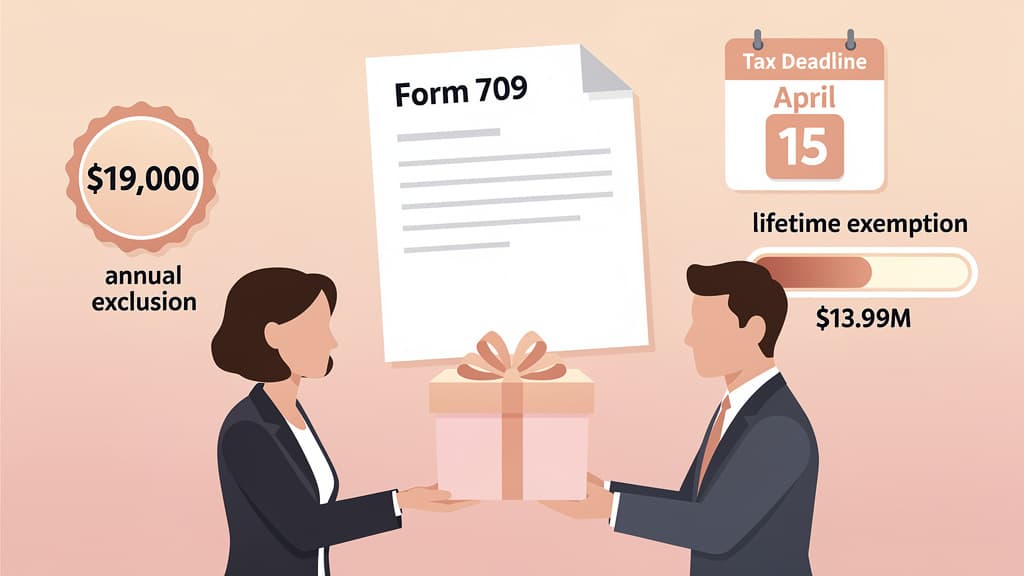
GST tax is reported on Form 706 (at death) or Form 709 (lifetime transfers).
Before the estate files its first Form 1041, there's another return to consider: the decedent's final individual income tax return (Form 1040).
Deadline: April 15 of the year after death. If the decedent dies in 2026, the final Form 1040 is due April 15, 2027.
The final 1040 covers income from January 1 through the date of death. Income earned after the date of death belongs to the estate and goes on Form 1041.
If the decedent was married, the surviving spouse can file a joint return for the year of death. The surviving spouse (or executor, if one has been appointed) signs the return.
If you need more time, file a tax extension using Form 4868 for an automatic 6-month extension to October 15.
An ESBT can hold stock in one or more S-Corporations. The S-Corp income is taxed at the trust level at the highest individual rate of 37%, not passed through to beneficiaries. The election must be made within 2 months and 15 days of the trust receiving S-Corp stock.
A QSST holds stock in only one S-Corporation, distributes all income to a single beneficiary, and the S-Corp income is taxed to that beneficiary. The QSST election must also be made within 2 months and 15 days.
For both types, missing the election deadline means the trust isn't a qualified S-Corp shareholder — which can terminate the corporation's S election entirely.
This is one of the most frequent errors. Estates can choose a fiscal year-end. Trusts cannot; they must use the calendar year (January 1 through December 31). A new trustee who files using a fiscal year will receive a rejection from the IRS.
Because estates are exempt from estimated tax payments for their first two years, trustees sometimes assume the same rule applies to trusts. It doesn't. Trusts must make estimated payments from the first year they have sufficient income, using the same quarterly schedule as individuals.
With the 37% rate kicking in at just $16,000 of 2026 taxable income, retaining income in a trust is one of the most expensive tax positions available. Unless there's a specific reason to accumulate income (asset protection, beneficiary management, legal restrictions), distributing income to beneficiaries in lower brackets saves real money.
The estate tax return is due 9 months after the date of death — not 12 months, not at the next April 15. Executors who are focused on grieving and settling the estate's practical affairs sometimes overlook this deadline. The late-filing penalty for Form 706 is 5% of the unpaid tax per month, up to 25%. On a large estate, that's a significant amount. File Form 4768 for a 6-month extension if you need more time.
Managing trust or estate finances means separating income by type (interest, dividends, capital gains, rental income) and tracking what gets distributed to beneficiaries versus what stays in the trust. That separation determines how much tax is owed and by whom.
Jupid connects to bank accounts associated with trusts and estates and automatically categorizes transactions with 95.9% accuracy. When income arrives, Jupid identifies the type and amount. When distributions go out to beneficiaries, Jupid tracks those separately. At the end of the year, you have a clear picture of retained income versus distributed income: the exact split you need for Form 1041 and Schedule K-1 preparation.
The WhatsApp and iMessage AI accountant means trustees and executors can check balances, review categorizations, or ask about income breakdowns without logging into a dashboard. Ask "How much dividend income has the trust received this year?" and get an answer based on actual bank data.
Jupid works through the web interface, Claude Code, and other AI tools. A professional fiduciary managing multiple trusts and a first-time trustee get the same workflow.
Trust and estate tax filing has its own rhythm, separate from individual and business returns. The deadlines are different, the brackets are compressed, and the rules around estimated payments, fiscal years, and distribution planning can catch first-time trustees and executors off guard.
The key takeaways: trusts use a calendar year and owe estimated payments immediately. Estates can choose a fiscal year and get a two-year estimated payment exemption. Income retained in a trust hits 37% at just $16,000 in 2026; distributing to lower-bracket beneficiaries almost always saves tax. And the estate tax return (Form 706) operates on its own timeline, due 9 months after death, completely independent of the income tax calendar.
For the rest of 2026, that means two dates: September 15 for the Q3 estimated payment and September 30 for the extended Form 1041. Get those right, plan distributions before year-end, and the fiduciary calendar takes care of itself.
Disclaimer
This article provides general information about 2026 trust and estate tax deadlines and should not be considered tax, legal, or financial advice. Trust and estate taxation involves rules that vary by trust type, state law, and individual circumstances. Tax brackets and exemption amounts reflect Rev. Proc. 2025-32 and the One Big Beautiful Bill Act. For advice specific to your situation, consult a qualified tax professional or estate planning attorney. Refer to IRS Publication 559 and the Form 1041 instructions for official guidance.
Fintech CEO with 10+ years building accounting and financial technology products. Previously co-founded and scaled an AI-powered accounting platform to $30M revenue and 100K+ business users, achieving 30,000 customers per accountant through automation — recognized by CNBC as a top fintech company. Holds a Master's in Management Information Systems. At Jupid, he leads the development of AI-native bookkeeping, tax, and compliance tools designed for freelancers and small business owners.