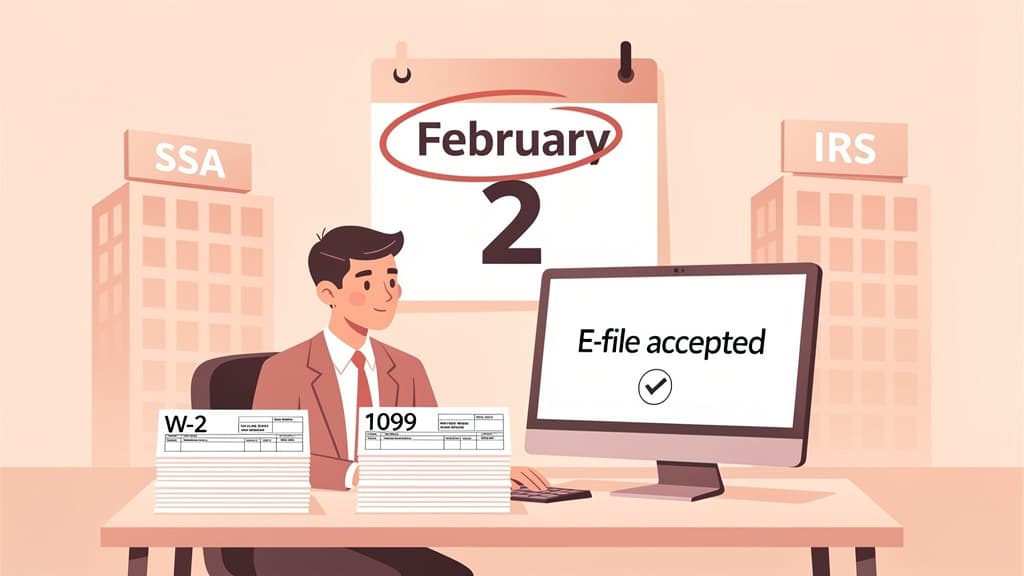
The employer filing deadline for both W-2s and 1099-NECs in 2026 is February 2, 2026: W-2 copies to employees and the Social Security Administration, and 1099-NEC copies to both contractors and the IRS, all on the same day (the statutory January 31 date falls on a Saturday). The remaining 1099s (MISC, K, INT, DIV) are due to recipients by February 2 but not to the IRS until March 2, 2026 on paper or March 31, 2026 e-filed.
Key takeaways:
- February 2, 2026: W-2s to employees and the SSA, plus 1099-NECs to contractors and the IRS; neither form has an automatic extension
- March 2, 2026 (paper) or March 31, 2026 (e-file): IRS copies of 1099-MISC, 1099-K, 1099-INT, and 1099-DIV
- $2,000 is the 1099-NEC reporting threshold for payments made in 2026 (OBBBA); forms filed in early 2026 for 2025 payments still used $600
- 10 or more information returns of all types combined means e-filing is mandatory
- Late filing costs $60–$340 per form, assessed separately for the IRS copy and the recipient copy
All information return deadlines for 2026:
| Form | To Recipient | To IRS/SSA (Paper) | To IRS/SSA (E-File) |
|---|
| W-2 (to employees) | Feb 2, 2026* | n/a | n/a |
| W-2 (to SSA) | n/a | Feb 2, 2026* | Feb 2, 2026* |
| W-3 (transmittal to SSA) | n/a | Feb 2, 2026* | Feb 2, 2026* |
| 1099-NEC (to recipients) | Feb 2, 2026* | n/a | n/a |
| 1099-NEC (to IRS) | n/a | Feb 2, 2026* | Feb 2, 2026* |
| 1099-MISC (to recipients) | Feb 2, 2026* | n/a | n/a |
| 1099-MISC (to IRS) | n/a | Mar 2, 2026** | Mar 31, 2026 |
| 1099-K (to recipients) | Feb 2, 2026* | n/a | n/a |
| 1099-K (to IRS) | n/a | Mar 2, 2026** | Mar 31, 2026 |
| 1099-INT (to recipients) | Feb 2, 2026* | n/a | n/a |
| 1099-INT (to IRS) | n/a | Mar 2, 2026** | Mar 31, 2026 |
| 1099-DIV (to recipients) | Feb 2, 2026* | n/a | n/a |
| 1099-DIV (to IRS) | n/a | Mar 2, 2026** | Mar 31, 2026 |
*January 31 falls on a Saturday in 2026, so all January 31 deadlines shift to Monday, February 2, 2026.
**February 28 also falls on a Saturday in 2026, so the paper deadline shifts to Monday, March 2, 2026.
This guide owns the employer-side calendar: who files what, where, and by when. For the penalty tiers in depth, plus extensions, corrections, and how to get penalties waived, see the companion 1099 filing deadlines and penalties guide.

Every employer who paid wages to an employee during the tax year must issue a Form W-2. There is no minimum threshold: if you withheld income tax, Social Security tax, or Medicare tax from any employee's pay, you file a W-2. This includes:
- Full-time and part-time employees
- Seasonal and temporary workers
- Officers of a corporation who received compensation
- Employees who worked only part of the year
Form W-2 reports total wages paid, federal and state income tax withheld, Social Security and Medicare wages and tax withheld, and various other compensation items (retirement plan contributions, health insurance premiums for S-Corp shareholders, dependent care benefits, etc.). There are six copies of each W-2:
- Copy A: to the Social Security Administration
- Copy 1: to the state/local tax authority
- Copy B: to the employee (for federal filing)
- Copy C: to the employee (for their records)
- Copy 2: to the employee (for state/local filing)
- Copy D: employer's records
The deadline for employers to send W-2s to employees in 2026 is February 2, and the SSA copy is due the same day. For 2026, the statutory January 31 deadline falls on a Saturday, so all W-2 deadlines shift to Monday, February 2.
| Requirement | Deadline |
|---|
| Copy B, C, 2 to employees | February 2, 2026 |
| Copy A to SSA (paper or e-file) | February 2, 2026 |
| Extension available? | Yes: Form 8809 (30-day extension, not automatic; must show cause) |
When you submit W-2s to the Social Security Administration, you must include Form W-3 as a transmittal summary. The W-3 totals up all W-2s and accompanies the batch filing. It's due the same date: February 2, 2026.
If you e-file through the SSA's Business Services Online (BSO) system, the W-3 is generated automatically as part of the electronic submission.
Starting with the 2024 tax year, any employer filing 10 or more information returns (counting all types together: W-2s, 1099s, etc.) must e-file. This was reduced from the previous 250-form threshold. If you have 8 employees and issue 3 1099-NECs, that's 11 forms total, so you must e-file.
You must file Form 1099-NEC for each person to whom you paid $2,000 or more during the tax year for services performed in your trade or business, if that person is not your employee. This threshold was raised from $600 to $2,000 by the One Big Beautiful Bill Act (OBBBA), effective for payments made starting January 1, 2026.
Common recipients:
- Independent contractors and freelancers
- Attorneys (for legal services, regardless of entity type)
- Consultants and professional service providers
- Subcontractors
You do not issue a 1099-NEC for:
- Payments to C-Corporations or S-Corporations (with the exception of attorneys and medical/health care payments)
- Payments made through third-party payment networks like PayPal, Venmo, or Stripe (those are reported on 1099-K by the payment processor)
- Payments for merchandise, freight, or storage
- Payments to employees (those go on W-2s)
For a deeper comparison of the two worker classifications, see our guide on employees vs. contractors; the worker-side tax math is in the 1099 vs. W-2 guide.
The 1099-NEC is the strictest information return. Both the recipient copy and the IRS copy are due on the same date, and there is no automatic extension available. The IRS does not distinguish between paper and e-file deadlines for the 1099-NEC: everything is due February 2.
| Requirement | Deadline |
|---|
| Copy B to recipient | February 2, 2026 |
| Copy A to IRS (paper) | February 2, 2026 |
| Copy A to IRS (e-file) | February 2, 2026 |
| Extension available? | No (only hardship extensions via Form 8809, rarely granted) |
This is the key difference from the 1099-MISC. Business owners who previously filed 1099-MISC for contractor payments (before the IRS reintroduced the 1099-NEC in 2020) sometimes assume they have until March to file with the IRS. They don't. The 1099-NEC has a single, same-day deadline of February 2 for both copies.
For complete details on 1099 penalty structures, see our 1099 Filing Deadlines and Penalties Guide.
For tax year 2026 (forms filed in early 2027), the reporting threshold is $2,000 per payee. For forms you filed in early 2026 (covering tax year 2025), the old $600 threshold still applied.
This means if you pay a contractor $1,800 in 2026, you are not required to file a 1099-NEC for that contractor. Under the old rules, you would have been. Many businesses paying small amounts to occasional contractors (a graphic designer for a one-time project, a photographer for an event) will no longer need to file.
However, the contractor still owes income tax on that $1,800 regardless of whether you file a 1099-NEC. The threshold is a reporting obligation, not a tax exemption.
Form 1099-MISC covers several types of payments that don't belong on the 1099-NEC. You must file a 1099-MISC if you paid $600 or more (this threshold was NOT changed by OBBBA) for:
- Rent (office space, equipment, land)
- Royalties ($10 or more)
- Prizes and awards
- Medical and health care payments
- Crop insurance proceeds
- Attorney fees (for settlements or judgments, separate from services reported on 1099-NEC)
- Fishing boat proceeds
Unlike the 1099-NEC, the 1099-MISC has different deadlines for the recipient copy and the IRS copy:
| Requirement | Deadline |
|---|
| Copy B to recipient | February 2, 2026 |
| Copy A to IRS (paper) | March 2, 2026 (February 28 is a Saturday) |
| Copy A to IRS (e-file) | March 31, 2026 |
| Extension available? | Yes: Form 8809 (automatic 30-day extension for IRS filing) |
This split is important. You must get the recipient their copy by February 2, but you have additional time to compile and submit your IRS filing, especially if you e-file, which gives you until the end of March.
Form 1099-K is different from the other 1099s in a key way: you typically don't issue it yourself. Payment processors (Stripe, Square, PayPal, Venmo for Business, Amazon, Etsy) are responsible for issuing 1099-Ks to the sellers and service providers who use their platforms.
The OBBBA reverted the 1099-K reporting threshold to the pre-American Rescue Plan Act level: $20,000 in gross payments AND more than 200 transactions. Both conditions must be met. The IRS's prior attempts to lower this threshold to $600 (and then $5,000 as a transition) have been superseded by the OBBBA.
This means most small sellers on platforms like eBay, Etsy, or Depop won't receive a 1099-K unless they're doing significant volume. How recipients report the form is covered in the 1099-K guide.
| Requirement | Deadline |
|---|
| Copy B to recipient | February 2, 2026 |
| Copy A to IRS (paper) | March 2, 2026 (February 28 is a Saturday) |
| Copy A to IRS (e-file) | March 31, 2026 |
Several other 1099 variants follow the same deadline pattern as the 1099-MISC.
Filed by banks and financial institutions for anyone who earned $10 or more in interest during the tax year. Also filed by businesses that paid $600 or more in interest to non-corporate payees in the course of their trade or business.
Filed by corporations, mutual funds, and brokerages for anyone who received $10 or more in dividends or distributions.
Filed by plan administrators for distributions of $10 or more from retirement accounts.
| Requirement | Deadline |
|---|
| Copy B to recipients | February 2, 2026 |
| Copy A to IRS (paper) | March 2, 2026 (February 28 is a Saturday) |
| Copy A to IRS (e-file) | March 31, 2026 |
The IRS imposes penalties under IRC §6721 (failure to file correct information returns with the IRS) and IRC §6722 (failure to furnish correct payee statements). The penalties are assessed per form and increase based on how late you correct the problem.
Amounts below apply to returns required to be filed in 2026, per Rev. Proc. 2024-40:
| Correction Timeline | Penalty Per Form | Small Business Max* | Large Business Max |
|---|
| Filed within 30 days of due date | $60 | $239,000 | $683,000 |
| Filed after 30 days but by August 1 | $130 | $683,000 | $2,049,000 |
| Filed after August 1 or not at all | $340 | $1,366,000 | $4,098,500 |
| Intentional disregard | $680+ | No maximum | No maximum |
*Small business = average annual gross receipts of $5 million or less for the 3 most recent tax years.
The same tiered structure applies to the recipient side. If you file with the IRS on time but fail to send the payee their copy, the penalties mirror §6721.
These are per-form penalties. If you have 15 employees and 10 contractors, that's 25 information returns. Filing all 25 after August 1 means 25 × $340 = $8,500 in penalties, just for the IRS filing side. Add the recipient-side penalties and it doubles.
For intentional disregard, where the IRS determines you deliberately didn't file, the penalty jumps to at least $680 per form with no maximum cap. The IRS applies this when it finds a pattern of non-compliance, not for honest mistakes. Worked penalty examples by tier, plus reasonable-cause waivers and First Time Abate, are in the 1099 penalties guide.
- File as soon as possible. Even if you've missed the deadline, filing within 30 days limits your penalty to $60/form.
- Correct errors promptly. An incorrect TIN, wrong amount, or missing information triggers the same penalties as a late filing. File corrected returns quickly.
- Reasonable cause exception. If you can demonstrate reasonable cause (not willful neglect), the IRS may waive penalties. You must show you acted responsibly before and after the failure. File Form 8508 or include a reasonable cause statement.
If you discover an error on a W-2 after filing, you must file Form W-2c (Corrected Wage and Tax Statement) along with Form W-3c (Transmittal of Corrected Wage and Tax Statements). Common reasons for corrections:
- Incorrect Social Security number
- Wrong wage or tax amounts
- Employee name misspelled
- Wrong tax year
File the W-2c with the SSA as soon as you discover the error. Provide the corrected copy to the employee. There is no specific deadline for W-2c, but filing promptly reduces the chance of penalty.
To correct a 1099, you file a new 1099 with the "CORRECTED" box checked at the top. There are two types of corrections:
Type 1 (wrong amount or code): File a new 1099 with the correct information. The IRS matches it to the original using the payer and payee TINs.
Type 2 (wrong payee TIN or name): File two forms: one to zero out the incorrect return, and another with the correct payee information.
For e-filed returns, corrections are submitted through the same system (IRS FIRE or IRIS) used for the original filing.
Beginning with returns filed for the 2024 tax year and continuing for 2025 and 2026, businesses that file 10 or more information returns must e-file. This threshold applies in aggregate: you count all W-2s, 1099-NECs, 1099-MISCs, 1099-Ks, and every other information return type together.
If you have:
- 6 employees (6 W-2s)
- 5 contractors (5 1099-NECs)
- 1 landlord you pay rent to (1 1099-MISC)
That's 12 information returns total. You must e-file all of them.
- W-2s: Through the SSA's Business Services Online (BSO) at ssa.gov/bso
- 1099s: Through the IRS's Information Returns Intake System (IRIS) at irs.gov/iris or the legacy FIRE system
- Third-party software: Most payroll and accounting software (QuickBooks, Gusto, ADP) handles e-filing directly
If you're required to e-file but submit paper forms instead, the IRS can treat your returns as not filed and assess the standard late-filing penalties under IRC §6721.
Many states require their own copies of information returns. The IRS's Combined Federal/State Filing (CF/SF) program simplifies this by forwarding your federal 1099 filings to participating states automatically.
When you e-file 1099s through the IRS FIRE or IRIS system, you can elect to participate in CF/SF. The IRS then sends the relevant data to each participating state based on the payee's address. No separate state filing is required for participating states.
Most states participate in CF/SF, but not all. As of 2026, notable non-participants include certain states that require separate filings or additional state-specific information. Check your state's revenue department website for current participation status.
Some states that participate in CF/SF still have additional requirements:
- Earlier deadlines than the federal dates
- Lower reporting thresholds (some states still use $600 for 1099-NEC even though the federal threshold is now $2,000)
- Additional forms (state-specific wage reports, reconciliation forms)
Always verify your specific state's requirements. The CF/SF program handles the basic forwarding, but it doesn't override state-specific rules.
The OBBBA raised the 1099-NEC reporting threshold from $600 to $2,000 for payments made in 2026. If your payroll or accounting system still flags every contractor paid $600+ for a 1099-NEC, you'll over-file. That's not a penalty situation (the IRS won't fine you for filing a 1099-NEC you didn't technically need to), but it creates unnecessary paperwork and potential confusion for your contractors.
Update your systems and internal processes now. The $2,000 threshold applies to payments made starting January 1, 2026 (reported on forms filed in early 2027).
This is the mistake that costs money. The 1099-MISC gives you until March 2 (paper) or March 31 (e-file) to submit to the IRS. The 1099-NEC does not. Both copies of the 1099-NEC (recipient and IRS) are due February 2. There is no paper vs. e-file split, and there is no automatic extension.
Business owners who previously filed contractor payments on 1099-MISC (before the 1099-NEC was reintroduced in 2020) sometimes carry over the old March deadline assumption. That assumption will cost you $60–$340 per form.
You need each contractor's taxpayer identification number (TIN) to file a 1099-NEC. If you don't collect a W-9 from contractors when you start working with them, you'll be scrambling in January to get TINs from people who may not respond quickly.
Best practice: require a completed W-9 before making any payment to a new contractor. Many businesses include this in their onboarding process or vendor setup.
The e-filing threshold dropped from 250 to 10 forms starting with the 2024 tax year. Many small businesses that previously filed on paper now must e-file. If you have a combination of employees and contractors that totals 10+ information returns, paper filing is no longer an option. The IRS can treat paper-filed returns as unfiled and assess penalties accordingly.
The hard part of employer filing season is not the forms; it's knowing who you paid and how much, across twelve months of bank activity. Jupid connects to your business bank accounts, categorizes every transaction automatically at 95.9% accuracy, and keeps a running total per payee, so payments that cross the $2,000 1099-NEC threshold are flagged as they happen. In January, ask the AI accountant in WhatsApp or iMessage "how much did I pay each contractor last year?" and get your filing list from real bank data instead of a spreadsheet reconstruction.
Try Jupid
See the full tax deadline calendar for all 2026 business tax dates.
- IRS Publication 15-A — Employer's Supplemental Tax Guide (worker classification, W-2 requirements)
- General Instructions for Forms W-2 and W-3 — Filing procedures, deadlines, and correction instructions
- General Instructions for Certain Information Returns (1099 series) — Covers all 1099 forms, thresholds, and e-filing rules
- IRS Publication 1220 — Specifications for Electronic Filing of Forms 1097, 1098, 1099, 3921, 3922, 5498, and W-2G
- IRS IRIS (Information Returns Intake System) — Free e-filing portal for 1099s
- IRC §6051 — Receipts for employees (W-2 filing requirement)
- IRC §6041 — Information at source (general reporting requirement for $600+ payments)
- IRC §6721 — Failure to file correct information returns (IRS-side penalties)
- IRC §6722 — Failure to furnish correct payee statements (recipient-side penalties)
- IRC §6724 — Waiver of penalties for reasonable cause
- IRC §6011(e) — E-filing requirement for information returns
| Item | 2026 Amount |
|---|
| 1099-NEC reporting threshold | $2,000 (raised from $600 by OBBBA) |
| 1099-MISC reporting threshold | $600 (unchanged) |
| 1099-K threshold | $20,000 + 200 transactions (reverted by OBBBA) |
| E-filing mandate | 10+ information returns (aggregate) |
| W-2 / 1099-NEC deadline | February 2 (Jan 31 is Saturday) |
| 1099-MISC IRS deadline (paper) | March 2 (Feb 28 is Saturday) |
| 1099-MISC IRS deadline (e-file) | March 31 |
| Penalty: within 30 days late | $60/form |
| Penalty: 31 days – Aug 1 | $130/form |
| Penalty: after Aug 1 | $340/form |
| Penalty: intentional disregard | $680+/form (no max) |
Use the Payroll Tax Calculator to estimate your total employer tax obligations for 2026.
Information return filing is a mechanical process: collect the data, fill in the forms, submit by the deadline. The penalties exist because the IRS depends on these forms to match income reported by taxpayers. When employers don't file, the IRS can't verify, and the entire system breaks down.
The good news for 2026: the raised $2,000 threshold for 1099-NEC means fewer forms for many small businesses. The bad news: the per-form penalties continue to increase, and the 10-form e-file mandate means paper filing is no longer an option for most employers.
Mark February 2 on your calendar. That single date covers W-2s to employees, W-2s to the SSA, 1099-NECs to recipients, and 1099-NECs to the IRS. Miss it, and the penalties start at $60 per form and go up from there.
Free download: Get the printable 2026 Tax Deadline Calendar (PDF): every federal due date for all entity types on a single page. Planning ahead? The 2027 calendar (PDF) is also available, and an interactive version with calendar exports is at jupid.com/tax-deadline-calendar.
Disclaimer
This article provides general information about 2026 W-2 and 1099 employer filing deadlines and should not be considered tax advice. Specific deadlines may differ based on your state, filing method, or business circumstances. Penalty amounts are subject to annual inflation adjustments and may differ from the figures shown here. For advice specific to your situation, consult with a qualified tax professional or refer to the official IRS instructions for Forms W-2 and 1099.
Tax Year: 2026
Last Updated: July 7, 2026