

AI & AccountingJun 29, 2026
Private AI for Accountants: The Complete 2026 Guide
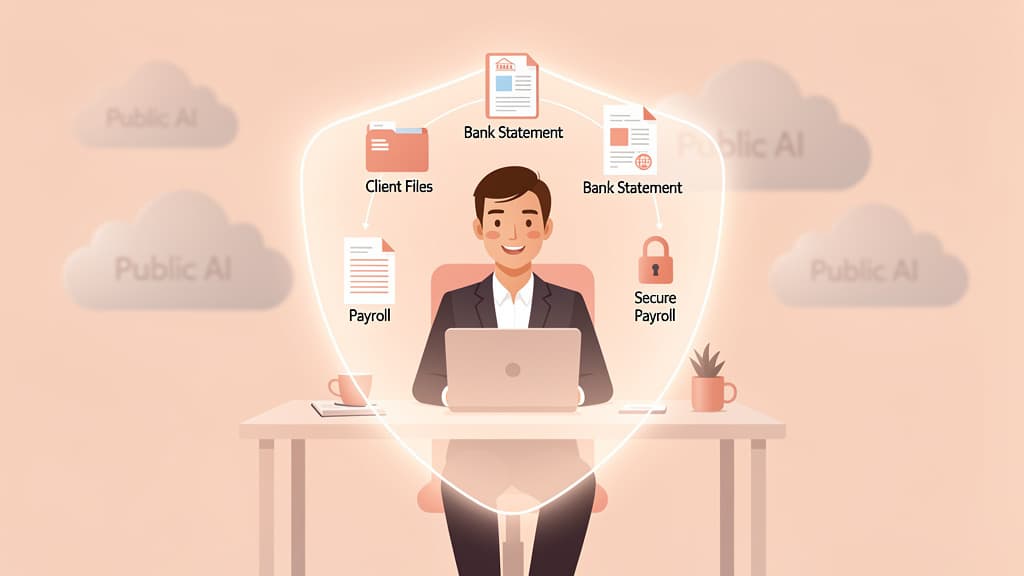
Private AI lets accounting firms use AI on client data without sending it to ChatGPT or Copilot. The complete 2026 guide to what it is and how to choose.
Read more
Fact-checked by Jupid experts
Reviewed by our in-house tax team before publishing. Every figure is validated against:
Last reviewed: June 29, 2026
Published: June 29, 2026
I'm Slava, founder of Jupid. Before this, I built Anna Money, where we worked with more than 60,000 small businesses and grew to $40M ARR. I now spend my days building AI for accounting and tax work, which means I talk to a lot of CPAs, enrolled agents, and bookkeepers. Lately almost every one of them asks me a version of the same question: "Can I just use ChatGPT for this?"
The honest answer is yes — and also no. Yes, ChatGPT and tools like it are genuinely useful for an accountant. No, you cannot paste a client's tax return information into a public AI chatbot and treat it as a private workspace. That second half is where careers and licenses are on the line, because the rule that governs it, Internal Revenue Code Section 7216, is a criminal statute.
This is the part most "AI for accountants" articles skip. They talk about productivity and prompt tricks, and never mention that typing a client's name, income, and Social Security number into a consumer chatbot is a disclosure to a third party under federal law. A 2026 federal court ruling, United States v. Heppner, made the confidentiality problem concrete in a way that should get every firm's attention.
I'll walk through exactly what §7216 says, why pasting client data into ChatGPT triggers it, what the Heppner decision did and did not establish, and the three ways an accountant can actually use AI without breaking the rules. I run an AI company, and I'll still tell you plainly: the safe path is rarely "paste the client file into ChatGPT."

Yes, accountants can use ChatGPT. You can use it to draft a client email, outline a memo, explain a tax concept, summarize a public IRS notice, or rewrite a paragraph in plain English. None of that requires a client's identity.
What you cannot do, without either valid consent or a clear regulatory exception, is enter client-identifiable tax return information into ChatGPT, Claude, Gemini, or any other public AI tool. That act is a disclosure to a third party under IRC §7216, and §7216 is enforced with criminal and civil penalties.
There are three safe routes, and the rest of this guide covers each one:
Most accountants have heard of §7216 as "the consent rule." Fewer realize it is a criminal statute first and a consent rule second.
Here is the operative language, straight from the Treasury regulation. Under 26 CFR §301.7216-1(a): "Section 7216(a) prescribes a criminal penalty for tax return preparers who knowingly or recklessly disclose or use tax return information for a purpose other than preparing a tax return. A violation of section 7216 is a misdemeanor, with a maximum penalty of up to one year imprisonment or a fine of not more than $1,000, or both, together with the costs of prosecution."
On top of that criminal penalty sits a separate civil one. IRC §6713 imposes a penalty of "$250 for each prohibited disclosure or use, not to exceed a total of $10,000 for a calendar year." The civil penalty applies per disclosure and does not require the "knowing or reckless" mental state that the crime does.
| What applies | Source | Penalty |
|---|---|---|
| Criminal penalty (§7216) | 26 CFR §301.7216-1(a) | Misdemeanor: up to $1,000 fine and/or up to 1 year imprisonment per violation, plus costs of prosecution |
| Civil penalty (§6713) | 26 CFR §301.7216-1(a) | $250 per prohibited disclosure or use, capped at $10,000 per calendar year |
Two definitions decide how far this reaches, and both are deliberately broad.
"Tax return preparer" is wider than the person who signs the return. The regulation covers anyone in the business of preparing or assisting in preparing returns, anyone who develops software used to prepare returns, and — importantly — every employee who handles return information as part of their job. In the IRS's own example, a firm's preparer, the assistant who types data into the computer, and the staffer who e-files are all "tax return preparers" for §7216 purposes. If you prepare returns for compensation, this is you.
"Tax return information" is broader still. Under 26 CFR §301.7216-1(b)(3), it means "any information, including, but not limited to, a taxpayer's name, address, or identifying number, which is furnished in any form or manner for, or in connection with, the preparation of a tax return." A W-2, a brokerage statement, a prior-year return, the client's email describing their side business — all of it qualifies. So does information you derive from that data while preparing the return.
And "disclosure"? The regulation defines it as "the act of making tax return information known to any person in any manner whatever." There is no carve-out for "I only pasted it into a chatbot." A third-party AI provider is a person, and the act of sending them the data is the disclosure.
Yes. When you paste a client's tax return information into ChatGPT, that information leaves your control and enters the systems of a third-party company — OpenAI, Anthropic, Google, or whoever runs the model. The statute is technology-neutral. It does not care whether the recipient is a person, a service bureau, or a large language model; it cares that tax return information became known to someone outside the engagement without authorization.
The natural follow-up: isn't there an exception? Section 7216 has a long list of permitted disclosures that do not require consent, and the one people reach for is the auxiliary-services exception in 26 CFR §301.7216-2(d). It lets a preparer disclose return information "to another tax return preparer ... located in the United States ... for the purpose of preparing or assisting in preparing a tax return, or obtaining or providing auxiliary services in connection with the preparation of any tax return, so long as the services provided are not substantive determinations or advice affecting the tax liability reported by taxpayers."
Read that carefully and the fit problem appears. The exception is built for disclosure to another tax return preparer or auxiliary service provider — a US-located entity in the business of helping prepare returns. A general-purpose public chatbot is not holding itself out as a tax return preparer or as a provider of return-preparation auxiliary services, and there is no IRS guidance treating it as one. Tax commentators who have studied this, including Tom Gorczynski in his "AI and 7216" analysis, conclude the auxiliary-services exception is unlikely to cover general public AI tools. I have not found any IRS authority that says otherwise as of June 2026.
That gap matters because the IRS has said almost nothing here. The agency's own Section 7216 Information Center still points to materials from 2009 through 2013 — revenue rulings, Rev. Proc. 2013-14, and the final regulations effective at the end of 2012. There is no IRS guidance that specifically addresses generative AI and §7216. Practitioners are working from a 2008-era rulebook and filling the gaps with AICPA guidance and commentary. (Thomson Reuters has reported that the IRS Office of Professional Responsibility issued a 2026 alert reminding practitioners that Circular 230 duties still apply and warning against uploading sensitive client data to unsecured or public AI platforms — useful context, though it is general practice guidance, not §7216-specific interpretation.)
Here is a working rule of thumb until clearer guidance exists:
| Generally safe to put in public AI | Not safe without consent or a real exception |
|---|---|
| A general tax question with no client facts | A client's W-2, 1099, or brokerage statement |
| Rewriting or summarizing a public IRS notice | A client's name, address, or SSN/EIN |
| Drafting a generic client-education email | A prior-year return or its figures |
| Explaining a concept to a staff member | Client income, deductions, or balances tied to identity |
| Outlining a memo with placeholders, not real names | Any data the client gave you to prepare their return |
The line is identity. The moment the prompt could be tied back to a specific taxpayer, you are in §7216 territory.
In February 2026, Judge Jed S. Rakoff of the U.S. District Court for the Southern District of New York ruled from the bench in United States v. Heppner, No. 25-cr-503 (JSR). It is the first decision of its kind, and it reframes the confidentiality question for everyone who uses AI in professional work.
The facts: Bradley Heppner, a financial-services executive charged with securities and wire fraud, used a consumer version of Anthropic's Claude to research questions about the government's investigation after he had received a grand jury subpoena and hired counsel. He generated 31 documents of prompts and responses, then sent them to his lawyers. The FBI later seized those documents, and his attorneys claimed attorney-client privilege and work-product protection. Judge Rakoff rejected both.
The court's reasoning, as summarized by the law firm Jones Walker, rested on a few points: an AI tool is not a lawyer and cannot form an attorney-client relationship; the documents were not confidential because the provider's policy permitted using and disclosing the data, including to government authorities; and the chats were not created for the purpose of getting legal advice from a lawyer. The work-product claim failed for a separate reason — defense counsel conceded they "did not direct" Heppner to run the AI searches, and he created the documents "of his own volition." Without attorney direction, no work-product protection attached.
A detail worth underlining for accountants who assume a paid plan buys privacy: the court treated a consumer subscription as exactly that — consumer. The provider's standard terms allowed broad data use and disclosure. Paying twenty dollars a month does not create a confidential relationship.
Now the honest part, because this ruling is easy to overstate. Heppner is one district-court decision, and the law is not settled. A different federal court reached close to the opposite conclusion on work product around the same time. In Warner v. Gilbarco, Inc. (E.D. Mich.), a magistrate judge treated AI as a "tool, not a person" and found that a litigant's use of ChatGPT did not waive work-product protection. Commentators have flagged the split — a Kirkland & Ellis alert covered both cases as "diverging paths" — and Lawfare called Heppner's reasoning "flawed," agreeing with the outcome on the facts but warning the opinion reached further than it needed to. So the safe takeaway is not "a court has ruled AI chats are always discoverable." It is "courts are actively split, the outcomes are fact-specific, and you cannot assume your AI chats are protected."
The point that matters most for accountants is one Heppner does not even reach. Heppner is about attorney-client privilege. Accountants do not have a general accountant-client privilege. The only federal privilege available to a tax practitioner is the narrow one in IRC §7525, and it is narrow by design.
Section 7525 extends "the same common law protections of confidentiality which apply to a communication between a taxpayer and an attorney" to communications with a "federally authorized tax practitioner" — but only "with respect to tax advice," and only in two settings: "any noncriminal tax matter before the Internal Revenue Service" and "any noncriminal tax proceeding in Federal court brought by or against the United States." It does not apply to criminal matters. It does not apply to return preparation, because preparing a return is not "tax advice." It does not apply outside federal tax disputes at all.
Put those pieces together. Client data you feed into a public AI tool is broadly discoverable, and for an accountant there is no privilege standing behind it the way attorney-client privilege might (or, post-Heppner, might not) stand behind a lawyer's file. Heppner is a warning shot for lawyers. For accountants, the confidentiality exposure was already wider.
Federal law is not the only rulebook. CPAs are also bound by the AICPA Code of Professional Conduct, specifically the Confidential Client Information Rule at ET §1.700.001, which prohibits disclosing confidential client information without the client's consent. Many state boards adopt the same standard or a stricter one — California, for example, has its own granular consent requirements and misdemeanor exposure for improper disclosure.
The AICPA also publishes §7216 guidance and sample consent forms. They predate widespread generative AI, so they do not name ChatGPT, but the structure they require is the structure you still need: consent that is specific, written, and informed. A line in your engagement letter that says "we may use AI tools" does not satisfy §7216. The consent rules are more demanding than that, as the next section explains.
Three paths. Pick the one that fits the work in front of you.
1. De-identify the data first. If you strip out everything that ties the information to a specific taxpayer — name, address, SSN or EIN, account numbers, and any unusual figures that could re-identify the person — then what is left is no longer "tax return information" in the §7216 sense, and you can use it freely. This works well for "how do I handle this kind of transaction" questions. Be genuinely careful, though: de-identification is harder than deleting a name. A combination of city, profession, and an unusual income figure can re-identify someone. If in doubt, generalize the numbers too.
2. Get a compliant §7216 consent. Consent has to be knowing, voluntary, and in writing, and the taxpayer has to give it before you disclose. For Form 1040-series clients, the consent must follow the IRS format rules in Rev. Proc. 2013-14, including specific mandatory language, and it must identify the recipient by name. Commentators reading these rules conclude you should name the actual AI vendor ("OpenAI" or "Anthropic"), not a vague phrase like "various AI tools," and that switching providers requires a fresh consent. This path is real but heavy, and it does not fit every workflow.
3. Use a private AI that never discloses to a third party. The cleanest answer to a §7216 disclosure problem is to not make a disclosure. If the AI runs inside an environment where client data stays within your firm's control and is not sent to OpenAI, Anthropic, or Google as a third party, the §7216 disclosure question largely falls away. This is why so much of the profession is moving toward private or enterprise-tier AI for any work that touches real client records. I cover the trade-offs in depth in Private AI for accountants: the complete 2026 guide and compare a common enterprise option in Microsoft Copilot vs. private AI for accountants.
Assuming a paid plan equals confidentiality. This is the Heppner lesson. Standard consumer and individual paid plans generally allow the provider broad rights to use and disclose your data. A subscription is not a confidentiality agreement.
Treating an engagement-letter mention as consent. "We use AI" buried in your engagement letter does not meet the §7216 consent requirements. Compliant consent is a specific, standalone act that names the recipient and follows the format rules.
Believing accountants have a privilege. There is no general accountant-client privilege. IRC §7525 is limited to noncriminal federal tax matters and to tax advice, not return preparation. Do not rely on it as a confidentiality backstop for AI use.
Underestimating de-identification. Removing the name is not enough if the remaining facts still point to one person. Generalize the identifying details, not just the obvious ones.
Confusing "no enforcement headlines" with "no risk." There are no widely reported §7216 enforcement actions tied specifically to AI use yet. "Yet" is doing a lot of work in that sentence. The statute is on the books, the penalties are real, and the absence of a headline is not a safe harbor.
I build Jupid Private AI for accountants, so treat this as the part where I tell you what we do — and where we don't fit.
Jupid Private AI is a private AI workspace for accounting firms that works with client records — bookkeeping, tax prep, payroll, and client accounting services — without sending invoices, tax documents, payroll files, or client emails to Copilot, ChatGPT, Claude, Gemini, or any outside AI system. It builds a per-client "private context window," turns statements, invoices, payroll reports, and prior filings into client-ready working notes, matches records to the books, and drafts personalized client follow-ups in your firm's tone.
I see it as a complement to public AI, not a replacement for it. Use ChatGPT or Claude for general productivity — drafting, explaining, brainstorming with no client identity attached. Use Jupid for the work that involves real client data, where a §7216 disclosure is the thing you are trying to avoid in the first place. It is set up done-for-you, so a firm is not stitching together infrastructure to get there.
One honest caveat: Jupid Private AI is in Beta. I would rather you know that than oversell it. If you want to see whether it fits your firm's workflow, start at Jupid Private AI for accountants. And whatever tool you choose, the rule underneath all of this stays the same: client-identifiable tax return information does not belong in a public chatbot.
This article is general information, not legal or tax advice. Section 7216 outcomes and AI privilege questions are fact-specific and still developing — United States v. Heppner is one district-court ruling, courts are split, and there is no IRS guidance specifically addressing AI and §7216 as of this writing. Before relying on any AI tool with client information, consult qualified legal counsel and a tax professional about your firm's specific facts and your state's rules.
Tax Year: 2026 Last Updated: June 29, 2026

CEO & Co-Founder
Fintech CEO with 10+ years building accounting and financial technology products. Previously co-founded and scaled an AI-powered accounting platform to $30M revenue and 100K+ business users, achieving 30,000 customers per accountant through automation — recognized by CNBC as a top fintech company. Holds a Master's in Management Information Systems. At Jupid, he leads the development of AI-native bookkeeping, tax, and compliance tools designed for freelancers and small business owners.
Private AI lets accounting firms use AI on client data without sending it to ChatGPT or Copilot. The complete 2026 guide to what it is and how to choose.
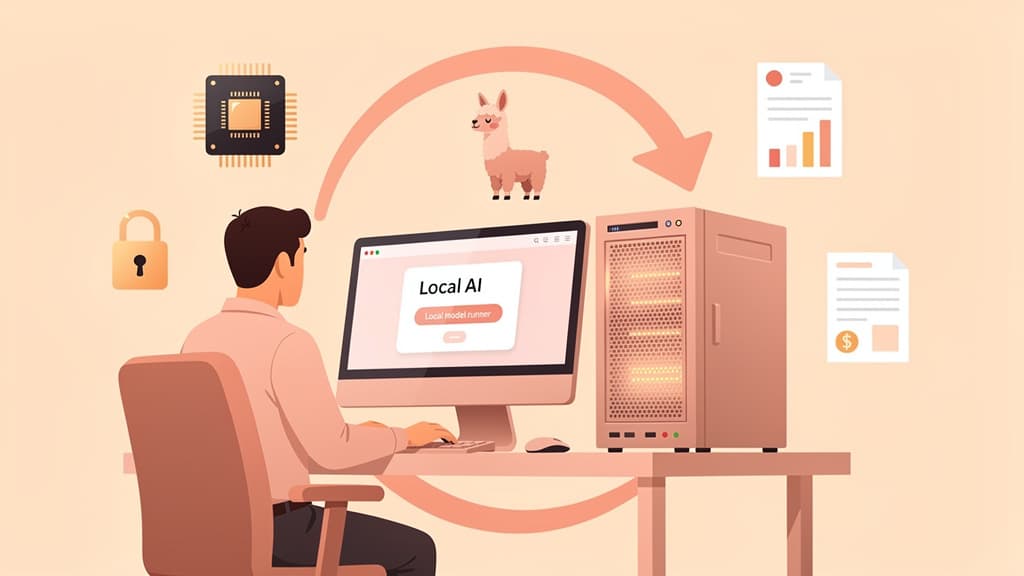
Run AI on your own hardware so client data never leaves the office. A 2026 guide to local LLMs for accountants: tools, models, hardware, and limits.
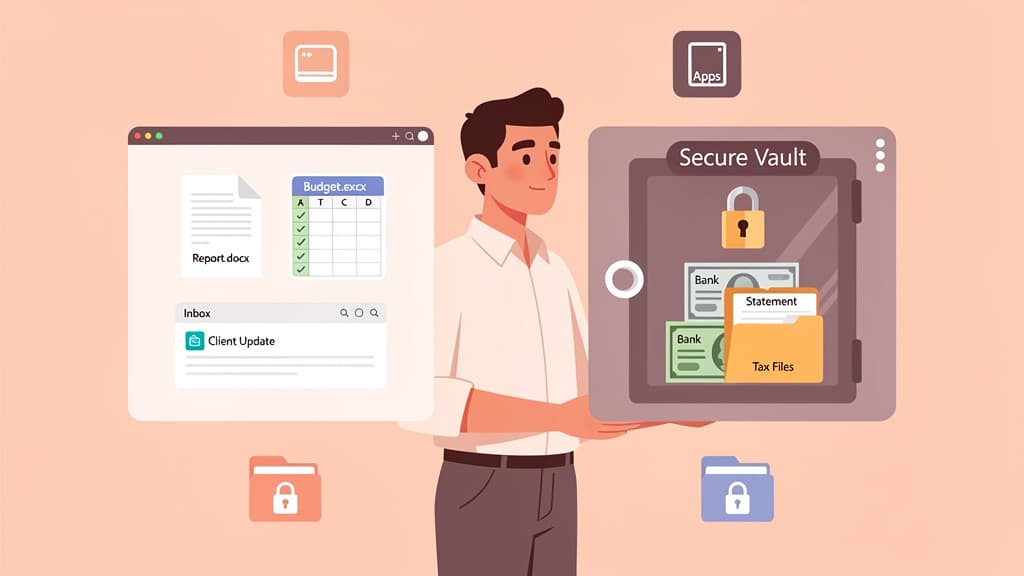
Microsoft 365 Copilot has real enterprise protections, but it's a productivity layer, not a client-file workspace. Here's where it fits for accountants.
Set up in minutes. Cancel anytime.
Join 1,000+ businesses using Jupid to save time and money. Start simplifying your finances today.
30-day money-back guarantee