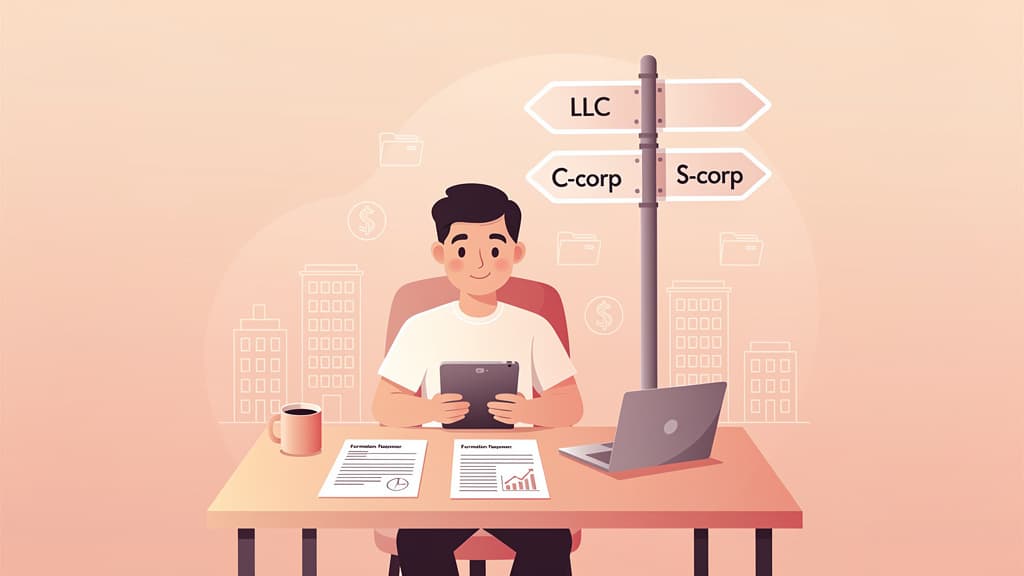
Form 8832, the Entity Classification Election, is the IRS form an eligible entity (usually an LLC) files to change its federal tax classification, most often to elect C-corporation treatment. It is not the S-corp form: for S-corporation status you file Form 2553 instead, and a timely Form 2553 on its own counts as a deemed classification election. The effective date you pick on Line 8 can be at most 75 days before or 12 months after the day you file.
Key takeaways:
- Form 8832 → C corporation (or back to partnership/disregarded status); Form 2553 → S corporation. Never file Form 8832 to become an S corp
- Effective-date window (Line 8): up to 75 days back, up to 12 months forward from the filing date
- A change election locks the entity in for 60 months; an initial election by a newly formed entity does not start the clock
- Every owner at the time of filing signs the Consent Statement (or an authorized officer, manager, or member signs for the entity)
- Mail the form to Kansas City, MO or Ogden, UT (assigned by state) and attach a copy to that year's federal return
- The current revision is December 2013, still active as of the 2026 filing season
Official IRS resources: Form 8832 (PDF) · About Form 8832 · Where to File Form 8832
An entity tax classification is the federal tax status the IRS assigns a business: disregarded entity, partnership, or corporation. The classification determines which return the business files (owner's Form 1040, Form 1065, or Form 1120) and how its profit is taxed. An LLC is a legal form created under state law, not a tax classification, which is why the IRS needs a rule for how to tax it.
The "check-the-box" regulations supply that rule: most unincorporated businesses may choose their federal tax treatment instead of having it dictated by their legal form. Left alone, every LLC falls into a default bucket. Form 8832 is how you opt out of that default.
What Form 8832 does not do: it does not make you an S corporation. That's the single most common misunderstanding. We cover the 8832-vs-2553 split in detail below.
Legal Basis: Treas. Reg. §301.7701-3 (the check-the-box regulations) governs entity classification. The underlying authority is IRC §7701, which defines the terms "corporation," "partnership," and related entities for the entire Internal Revenue Code.
Every domestic LLC starts with a default classification. Form 8832 lets you change it. Here's the full map.
| Entity | Default tax status | Election options via Form 8832 |
|---|
| Single-member LLC | Disregarded entity (taxed on owner's Schedule C / return) | Elect to be an association taxable as a C corporation |
| Multi-member LLC | Partnership (Form 1065) | Elect to be an association taxable as a C corporation |
| LLC already taxed as a corporation | Corporation (by prior election) | Elect back to disregarded entity or partnership (subject to the 60-month rule) |
Two things to read off this table. First, the only "new" status Form 8832 adds for a default LLC is C-corporation treatment. Second, S-corp status is not on this list: that comes from a separate form (Form 2553).
| Item | 2026 Rule |
|---|
| Current form revision | December 2013 (verified current against the IRS PDF, July 2026) |
| Effective date (earliest) | Up to 75 days before the date you file |
| Effective date (latest) | Up to 12 months after the date you file |
| Change-again lock-in | 60 months from the effective date of an election to change classification |
| Who signs | Each owner/member at the time of filing, OR an authorized officer, manager, or member |
| Where to file | Kansas City, MO or Ogden, UT service center (by state); also attach a copy to the return |
| Late election relief | Rev. Proc. 2009-41 (explain on Part II, Line 11 of the form) |
| EIN | Required before filing |
Legal Basis: Treas. Reg. §301.7701-3(b)(1) (default classifications), §301.7701-3(c)(1)(iii) (effective date window), §301.7701-3(c)(1)(iv) (60-month limitation), IRC §7701 (entity definitions).

The check-the-box rules assign a default the moment your LLC exists, so you're never in limbo.
A domestic eligible entity with a single owner is disregarded as an entity separate from its owner — the IRS looks straight through it to the owner. A solo founder reports the business on Schedule C of their personal Form 1040. (Read our Schedule C line-by-line guide for how that works.)
A domestic eligible entity with two or more members is a partnership by default and files Form 1065, issuing each member a Schedule K-1.
The regulation states it plainly: "a domestic eligible entity is—(i) A partnership if it has two or more members; or (ii) Disregarded as an entity separate from its owner if it has a single owner."
For most founders, the default is the right answer. Pass-through taxation avoids the double tax that hits C corporations, and a default LLC carries no extra federal filing burden beyond the owner's normal return (single-member) or one partnership return (multi-member). You only reach for Form 8832 when the default no longer serves you.
Legal Basis: Treas. Reg. §301.7701-3(b)(1).
File Form 8832 to have your LLC taxed as a C corporation; file Form 2553 to have it taxed as an S corporation. If your goal is S-corp status, skip Form 8832 entirely: a timely, valid Form 2553 includes a deemed classification election, so one form does both jobs.
| Form 8832 | Form 2553 |
|---|
| Official name | Entity Classification Election | Election by a Small Business Corporation |
| What it elects | C-corporation, partnership, or disregarded-entity treatment | S-corporation treatment |
| Return filed afterward | Form 1120 (C corp), Form 1065, or owner's Form 1040 | Form 1120-S |
| Deadline | None; constrained only by the 75-day-back / 12-month-forward effective-date window | 2 months and 15 days after the start of the tax year it takes effect, or anytime the prior year |
| Eligibility limits | Any eligible entity (LLCs, partnerships) | 100 or fewer eligible shareholders, one class of stock, no nonresident-alien or entity shareholders (IRC §1361) |
| Who signs | Each owner, or an authorized officer/manager/member | All shareholders consent |
| Lock-in after electing | 60 months after a change election | After revocation or termination, generally a 5-year wait to re-elect (IRC §1362(g)) |
| Late relief | Rev. Proc. 2009-41 | Rev. Proc. 2013-30 |
The two forms do related-but-different jobs, and the path depends on which tax status you actually want.
If your default LLC (disregarded or partnership) wants to be taxed as a C corporation (its own taxpaying entity that files Form 1120 and pays corporate tax on its profits), Form 8832 is the form. You check "association taxable as a corporation." That's it. No second form is required for C-corp status.
If you want S-corporation treatment (pass-through taxation with the self-employment-tax savings that come from splitting salary and distributions), you generally file Form 2553, "Election by a Small Business Corporation," not Form 8832.
Here's the mechanism that trips people up. To be an S corp, an entity must first be eligible to be taxed as a corporation. An LLC could file Form 8832 (elect association/corporation status) and then file Form 2553 (elect S status). But the IRS lets you skip the first step: a timely, valid Form 2553 is treated as a deemed election to be classified as an association under the check-the-box rules. You file 2553 alone, and the entity becomes a corporation and an S corporation in one filing.
The regulation makes this explicit — when an eligible entity makes a timely, valid S election under IRC §1362(a), "it is treated as having made an election under this section to be classified as an association." So you do not file Form 8832 to get to S-corp status. File 2553.
One important caveat: if your S election turns out to be invalid (you blew an eligibility rule under IRC §1361), the entity is treated as a C corporation only if a valid Form 8832 was on file. Otherwise it drops back to its default classification. Full mechanics of the S election (eligibility, the reasonable-salary requirement, late relief) live in our Form 2553 S-corp election guide.
| You want your LLC taxed as... | File |
|---|
| C corporation | Form 8832 (check association/corporation) |
| S corporation | Form 2553 (deemed 8832 election included) |
| Back to disregarded/partnership from corporate status | Form 8832 (subject to the 60-month rule) |
Legal Basis: Treas. Reg. §301.7701-3(c)(1)(v)(C) (S election deemed an association election); IRC §1361–§1362 (S-corp rules).
The form is three pages: the Part I election section and the consent statement on pages 1 and 2, and Part II (late election relief) on page 3. Most of it is identification; three lines carry the weight.
Name, address, EIN. Enter the entity's legal name and current mailing address. The EIN is required: apply at IRS.gov/EIN before you file if the LLC doesn't have one yet.
Line 1: Type of election. Check 1a for an initial classification (a newly formed entity choosing its first classification) or 1b for a change in current classification (an existing entity switching). The choice affects the 60-month analysis below.
Line 2a: Prior election in the last 60 months? Asks whether the entity previously filed an entity election with an effective date within the last 60 months. Line 2b asks whether that prior election was an initial classification by a newly formed entity effective on its formation date. These two questions screen for the 60-month lock-in. Answering "Yes" to 2a and "No" to 2b generally means you can't make this election yet.
Line 3: More than one owner? "Yes" routes you toward partnership-or-corporation options; "No" routes you toward disregarded-or-corporation options.
Lines 4–5: Owner / parent identification. If single-owner (Line 3 "No"), Line 4 captures the owner's name and identifying number. Line 5 captures a parent corporation's name and EIN where the electing entity is owned by one.
Line 6: The classification you're electing. Six options:
- a. Domestic eligible entity electing to be an association taxable as a corporation
- b. Domestic eligible entity electing to be a partnership
- c. Domestic eligible entity with a single owner electing to be disregarded as a separate entity
- d–f. The three foreign equivalents
For a U.S. LLC moving to C-corp tax treatment, you check 6a.
Line 7: Foreign country of organization (foreign entities only; domestic LLCs skip it).
Line 8: Effective date of the election. The most important field on the form. This is the date you want the new classification to begin, and it's bounded by the 75-day / 12-month window covered in the next section. Get this date wrong and you either miss the year you wanted or trigger a short tax year you didn't plan for.
Lines 9-10: Contact person. Line 9 asks for the name and title of a contact person the IRS may call about the election; Line 10 is that person's phone number.
Part II: Late election relief (Line 11). If you missed the 75-day backdating window, Rev. Proc. 2009-41 lets an entity request late-election relief up to 3 years and 75 days after the intended effective date. You explain the reasonable cause on Line 11 and check the "late classification relief sought under Revenue Procedure 2009-41" box at the top of the form. Entities that don't qualify must request a private letter ruling.
Below the election, the Consent Statement must be signed by each person who is an owner/member at the time the election is filed, or by an officer, manager, or member authorized to make the election on the entity's behalf. For a multi-member LLC, the cleanest approach is to have every member sign. A missing required consent can invalidate the election.
The IRS instruction is explicit: also attach a copy of Form 8832 to the entity's federal income tax return for the tax year of the election. If the entity isn't required to file a return that year, each owner attaches the copy to their own return.
Two timing rules do most of the damage on this form. Both come straight from the regulation.
The date on Line 8 isn't a free choice. Per Treas. Reg. §301.7701-3(c)(1)(iii): "The effective date specified on Form 8832 can not be more than 75 days prior to the date on which the election is filed and can not be more than 12 months after the date on which the election is filed."
In plain terms:
- You can backdate the election up to 75 days before you file. File on March 15, and the earliest effective date you can choose is roughly December 31 of the prior year.
- You can postdate it up to 12 months ahead. File on March 15, and the latest effective date is the following March 15.
- If you leave Line 8 blank, the election takes effect on the filing date.
This is why founders who decide in late winter to be a C corp "for this year" file early — they want a January 1 effective date, which the 75-day backdating window allows only if they file by mid-March.
Once an eligible entity elects to change its classification, it generally cannot change again for 60 months. The regulation: after a change election, "the entity cannot change its classification by election again during the sixty months succeeding the effective date of the election."
There's one critical carve-out. An initial classification by a newly formed entity, effective on its formation date, does not count as a change. The regulation: "An election by a newly formed eligible entity that is effective on the date of formation is not considered a change for purposes of this paragraph (c)(1)(iv)."
So a brand-new LLC that elects C-corp status on day one (Line 1a, effective on formation) is not locked out: it hasn't "changed" anything. But an existing partnership-taxed LLC that elects into C-corp status (Line 1b) starts a five-year clock before it can elect back out. Treat the C-corp election as a five-year commitment unless you qualify for one of the narrow IRS exceptions.
Legal Basis: Treas. Reg. §301.7701-3(c)(1)(iii) (effective-date window); §301.7701-3(c)(1)(iv) (60-month limitation and the newly-formed exception).
Form 8832 is mailed (not e-filed independently) to one of two IRS service centers, based on the entity's principal business location. As of the 2026 filing season:
Kansas City: Department of the Treasury, Internal Revenue Service, Kansas City, MO 64999. Used by entities in: CT, DE, DC, GA, IL, IN, KY, ME, MD, MA, MI, NH, NJ, NY, NC, OH, PA, RI, SC, VT, VA, WV, WI.
Ogden: Department of the Treasury, Internal Revenue Service, Ogden, UT 84201. Used by entities in: AL, AK, AZ, AR, CA, CO, FL, HI, ID, IA, KS, LA, MN, MS, MO, MT, NE, NV, NM, ND, OK, OR, SD, TN, TX, UT, WA, WY.
Foreign / U.S. possessions: Department of the Treasury, Internal Revenue Service, Ogden, UT 84201-0023.
Confirm your service center against the current IRS "Where to File Form 8832" page before mailing; the IRS reassigns service centers periodically. Use certified mail with return receipt so you have proof of the filing date, which establishes timely filing under IRC §7502. The service center should notify you whether the election is accepted within 60 days. If nothing arrives, the Form 8832 instructions say to call 800-829-0115 or write the service center. If the IRS later questions whether you filed, acceptable proof includes the certified-mail receipt, a copy of the form with a stamped IRS received date, or an IRS letter stating the election was accepted.
Northwind Labs LLC is a two-member software company in Washington state. The members are building toward an institutional fundraise, and their lead investor wants to invest through a C corporation structure for its own tax reasons. By default, Northwind is taxed as a partnership (Form 1065). The members decide to elect C-corporation tax treatment via Form 8832.
Northwind Labs LLC has 2 members, a default partnership classification (Form 1065), and wants to be an association taxable as a C corporation (Form 1120). Its Form 8832 looks like this:
| Form 8832 entry | Northwind's answer |
|---|
| Line 1 | 1b (change in current classification) |
| Line 2a | No (no election in the last 60 months) |
| Line 3 | Yes (more than one owner) |
| Line 6 | 6a (domestic association taxable as a corporation) |
| Line 8 | January 1, 2026 (effective date) |
| Consent Statement | Both members sign |
To get the January 1, 2026 effective date, the members must file within the 75-day backdating window, by mid-March 2026 at the latest. They file by certified mail in early February and attach a copy of Form 8832 to Northwind's first Form 1120.
- Double taxation enters the picture. As a C corp, Northwind pays the 21% corporate rate on its profits; distributions are then taxed again as dividends. For a venture-backed company reinvesting into growth, that's often acceptable, and the structure investors expect.
- The 60-month clock starts. Because this is a change election (Line 1b), Northwind generally cannot elect back to partnership treatment until January 1, 2031.
- No Form 2553. Northwind wants C-corp, not S-corp, treatment, so Form 8832 alone does the job.
Had Northwind wanted S-corp treatment instead (pass-through plus self-employment-tax savings), it would not file Form 8832. It would file Form 2553, which carries a deemed association election with it, after confirming S-corp eligibility under IRC §1361 (100 or fewer eligible shareholders, one class of stock, no ineligible owners; see our Form 2553 guide). Same company, different goal, completely different form.
Problem: A founder checks "association taxable as a corporation" on Form 8832 believing it elects S-corp status.
Impact: It elects C-corp status: a separate taxpaying entity with double taxation, not the pass-through S corp they wanted. They've signed up for corporate-level tax and a five-year lock-in by mistake.
Solution: For S-corp treatment, file Form 2553. A timely, valid 2553 includes the deemed association election, so no Form 8832 is needed.
Problem: Filer enters a date more than 75 days before filing (trying to backdate to last year) or simply enters the day they're filling out the form when they wanted January 1.
Impact: An out-of-window date isn't rejected; it is moved to the edge of the window (75 days before the filing date, or 12 months after it), which is usually not the date you wanted. And a mid-year effective date forces a short tax year: part of the year on the old classification, part on the new one.
Solution: For a January 1 effective date, file within the 75-day window (by roughly mid-March). For a future start, stay within 12 months. When in doubt, the filing date itself is the safe default.
Problem: An LLC elects C-corp status, the situation changes a year later, and the owners try to elect back to partnership.
Impact: The election is generally barred for 60 months from the effective date of the change. The entity is stuck as a C corp.
Solution: Treat any change election as a five-year commitment. Remember the exception: an initial election by a newly formed entity effective on its formation date doesn't count as a change and doesn't start the clock.
Problem: A multi-member LLC files Form 8832 with only one member's signature on the Consent Statement.
Impact: The election can be invalid. The entity may keep filing under a classification it never validly elected, inviting back taxes and penalties when the IRS catches it.
Solution: Have every owner at the time of filing sign the Consent Statement, or use a properly authorized officer/manager/member. Verify against the operating agreement's membership schedule.
Problem: The election is mailed to the service center, but no copy is attached to the entity's tax return for the election year.
Impact: A processing mismatch that can delay IRS acknowledgment of the new classification.
Solution: Attach a copy of Form 8832 to the federal income tax return for the year the election takes effect (or to each owner's return if the entity files none that year).
Whether C-corp treatment beats your LLC's default comes down to your actual numbers, not a rule of thumb. Jupid is an AI accountant that lives in WhatsApp and iMessage: connect your bank account and it categorizes every transaction with 95.9% accuracy, so you always know the year-to-date profit a classification decision should rest on. Ask "do I file 8832 or 2553?" in chat and get a sourced answer in plain language. And once the election is made, your books are already clean for whichever return the new status requires. Try Jupid
- IRC §7701: Definitions of corporation, partnership, and related entities
- Treas. Reg. §301.7701-3(b)(1): Default classification of eligible entities
- Treas. Reg. §301.7701-3(c)(1)(iii): 75-day-prior / 12-month-after effective-date window
- Treas. Reg. §301.7701-3(c)(1)(iv): 60-month limitation and the newly-formed-entity exception
- Treas. Reg. §301.7701-3(c)(1)(v)(C): S election treated as a deemed association election
- IRC §1361–§1362: S-corporation eligibility and election
Form 8832 is a small form that makes a big decision: it changes how the IRS taxes your business. For most LLC owners, the default — disregarded entity or partnership — is exactly right, and they never file it. The two situations that send you to Form 8832 are wanting C-corporation treatment (often investor-driven) or unwinding a prior corporate election once the 60-month clock allows.
Keep the one rule that matters straight: Form 8832 gets you to C-corp; Form 2553 gets you to S-corp. From there, mind the 75-day / 12-month effective-date window, respect the 60-month lock-in on change elections, collect every consent signature, and attach a copy to the return. Run the decision past a CPA or tax attorney before you commit — it has long-term consequences across federal tax, state tax, and your fundraising structure.
If you use Claude, ChatGPT, or another AI agent to prepare Form 8832, our open-source skill gives it the rules from this guide. It checks that your entity is eligible to elect, works out the effective-date window (up to 75 days back or 12 months forward), tests the 60-month limit, prepares the late-election relief statement when you need one, and tells you when Form 2553 alone covers an S corporation election. Review the package before you mail it.
→ jupid-tax/jupid-skills on GitHub – forms/form-8832/SKILL.md
For Claude Code, clone the repo and run cp -r jupid-skills/forms/form-8832 ~/.claude/skills/. For the Anthropic SDK, load SKILL.md into the system prompt and the references/ files on demand. For browser-automation runtimes, filing.md covers the e-file or paper-file workflow.
Disclaimer
This article provides general information about entity classification and Form 8832 and should not be considered tax or legal advice. The choice between disregarded-entity, partnership, S-corporation, and C-corporation treatment carries lasting consequences across federal tax, state tax, and corporate structure, and the rules are fact-specific. For advice specific to your situation, consult with a qualified CPA or tax attorney before filing.
Tax Year: 2026
Last Updated: July 7, 2026