Published: March 20, 2026
Tax Year: 2026
LLCs are the most popular business structure in America, and for good reason — they combine liability protection with tax flexibility. But that flexibility creates a problem most new LLC owners don't expect: your tax deadlines depend entirely on how your LLC is classified for tax purposes.
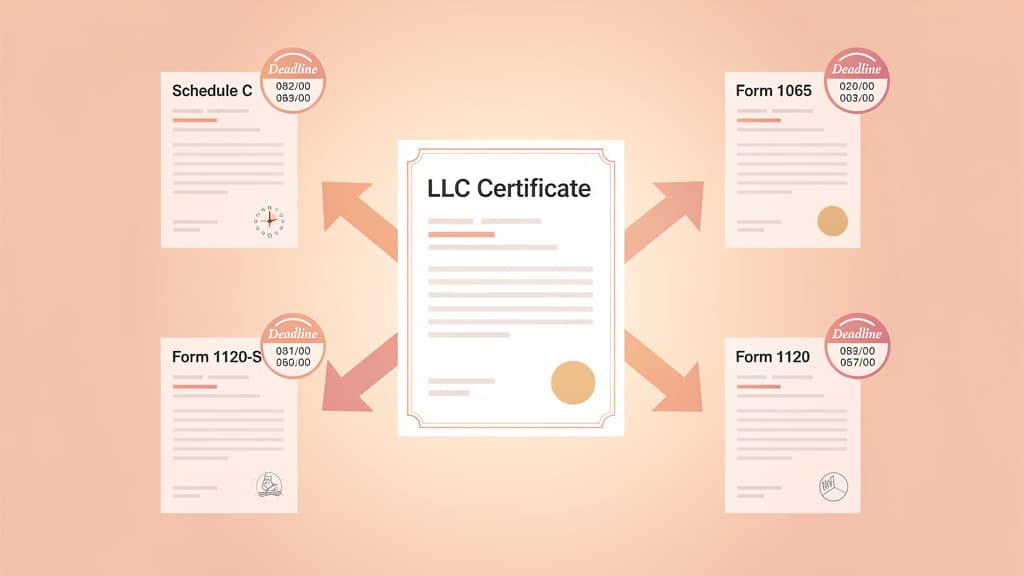
An LLC is a legal structure, not a tax classification. The IRS doesn't have a tax form called "LLC return." Instead, your LLC files based on its tax election — as a disregarded entity, partnership, S-Corp, or C-Corp. Same legal entity, four possible sets of deadlines. A single-member LLC files on April 15 with a personal return. Add one more member, and suddenly the deadline jumps forward to March 16. Elect S-Corp status for tax savings, and you're also on the March 16 timeline — but with payroll obligations on top.
When I built Anna Money for 60,000+ small businesses in the UK, entity classification was simpler. In the US, I've watched LLC owners miss deadlines they didn't know applied to them. A two-member LLC that files on April 15 thinking it has the same deadline as a sole proprietor is already a month late — and the penalty is $255 per member per month.
This guide maps out every 2026 deadline for each LLC tax classification so you know exactly which dates apply to your business.
| LLC Tax Election | IRS Tax Form | Annual Return Deadline | Extension Deadline |
|---|
| Single-member LLC (default) | Schedule C on Form 1040 | April 15, 2026 | October 15, 2026 |
| Multi-member LLC (default) | Form 1065 | March 16, 2026 | September 15, 2026 |
| LLC electing S-Corp | Form 1120-S | March 16, 2026 | September 15, 2026 |
| LLC electing C-Corp | Form 1120 | April 15, 2026 | October 15, 2026 |
Legal basis: IRC §6072 (time for filing), IRC §301.7701-3 (check-the-box regulations), IRC §6654 (underpayment of estimated tax)

The IRS uses "check-the-box" regulations under IRC §301.7701-3 to determine how your LLC is taxed. Unless you file an election to change it, the default rules apply automatically.
Single-member LLC: Treated as a "disregarded entity." The IRS ignores the LLC for income tax purposes. All income and expenses flow directly to the owner's Form 1040 on Schedule C. You file as if you were a sole proprietor.
Multi-member LLC: Treated as a partnership by default. The LLC files an information return (Form 1065) and issues Schedule K-1 to each member. Members report their share of income on their personal returns.
LLC owners can elect different tax treatment by filing the appropriate form with the IRS:
- S-Corp election: File Form 2553 (Election by a Small Business Corporation). The LLC files Form 1120-S and issues K-1s to members. Members who work in the business must take a reasonable salary.
- C-Corp election: File Form 8832 (Entity Classification Election). The LLC files Form 1120 and pays corporate income tax. Distributions to members are taxed again as dividends.
The election you make — or don't make — determines which deadlines apply to your LLC. For a deeper comparison, see our LLC Tax Benefits Guide.
A single-member LLC taxed as a disregarded entity follows the individual tax return timeline. Your business income is reported on Schedule C attached to your Form 1040.
Your Schedule C is part of your personal tax return. File Form 1040 with Schedule C by April 15, 2026. You'll also file Schedule SE to calculate self-employment tax on your net business income.
Extension: File Form 4868 by April 15 for an automatic 6-month extension to October 15, 2026. The extension gives you more time to file, not more time to pay. Estimate and pay any tax owed by April 15 to avoid interest and penalties.
As a single-member LLC owner, you're responsible for both income tax and self-employment tax. Since there's no employer withholding taxes from your pay, you must make quarterly estimated payments using Form 1040-ES.
| Quarter | Income Period | Payment Due |
|---|
| Q1 | Jan 1 – Mar 31 | April 15, 2026 |
| Q2 | Apr 1 – May 31 | June 15, 2026 |
| Q3 | Jun 1 – Aug 31 | September 15, 2026 |
| Q4 | Sep 1 – Dec 31 | January 15, 2027 |
You must make estimated payments if you expect to owe $1,000 or more in tax for the year after subtracting withholding and refundable credits. Use the Self-Employment Tax Calculator to estimate your quarterly amounts.
Single-member LLC owners pay self-employment tax of 15.3% (12.4% Social Security + 2.9% Medicare) on net earnings up to the Social Security wage base — $176,100 for 2025, $184,500 for 2026. The Medicare portion applies to all net earnings with no cap. Net earnings above $200,000 ($250,000 for married filing jointly) are subject to an additional 0.9% Medicare surtax.
For a complete guide to single-member LLC filing, see Single-Member LLC Taxes 2026.
A multi-member LLC taxed as a partnership files its own information return — Form 1065 — separate from any member's personal return. This is where the deadline shifts significantly: one month earlier than the individual return.
Form 1065 is due by the 15th day of the 3rd month after the tax year ends. For calendar-year LLCs, that's March 15. In 2026, March 15 falls on a Sunday, so the deadline moves to March 16, 2026.
The LLC itself doesn't pay income tax on Form 1065 — it's an information return. But it generates Schedule K-1 for each member, reporting their share of income, deductions, and credits. Members need these K-1s to complete their personal returns by April 15.
Extension: File Form 7004 by March 16 for an automatic 6-month extension to September 15, 2026.
The LLC must issue K-1s to all members by the Form 1065 due date (March 16) or, if extended, by the extended due date (September 15). Late K-1s cascade into problems — members can't file their personal returns without them and may need to file their own extensions.
The penalty for filing Form 1065 late is $255 per member per month (or fraction of a month), for up to 12 months. For a 3-member LLC that files 2 months late: 3 × $255 × 2 = $1,530.
This penalty applies even if the LLC owes no tax itself. It's an information return penalty — the IRS penalizes the failure to report, not the failure to pay.
Each member is individually responsible for estimated tax payments on their share of LLC income. Members follow the same quarterly schedule as single-member LLC owners (April 15, June 15, September 15, January 15) based on their K-1 income.
General partners in a multi-member LLC owe self-employment tax at 15.3% on their distributive share of partnership income. Limited partners generally owe SE tax only on guaranteed payments for services.
For detailed partnership filing requirements, see Multi-Member LLC Tax Filing 2026.
Electing S-Corp status can reduce self-employment tax for profitable LLCs, but it changes your compliance obligations. The LLC files Form 1120-S instead of Form 1065, and members who work in the business must receive a reasonable salary with payroll tax withholding.
To be treated as an S-Corp for the 2026 tax year, your LLC must have filed Form 2553 by March 16, 2026 (75 days after January 1, or by the due date of the entity return for the tax year the election is to take effect — whichever is relevant). For newly formed LLCs, the election must be filed within 75 days of formation.
If you missed this deadline, the IRS offers late election relief under Revenue Procedure 2013-30, provided you meet certain requirements. See Convert LLC to S-Corp for the full process and late election options.
Form 1120-S follows the same timeline as partnership returns — due by the 15th day of the 3rd month after the tax year ends. In 2026, that's March 16 (shifted from Sunday, March 15).
Like Form 1065, Form 1120-S is an information return. The S-Corp doesn't pay entity-level income tax (with limited exceptions). Income flows through to members via Schedule K-1.
Extension: File Form 7004 by March 16 for an automatic 6-month extension to September 15, 2026.
The penalty mirrors the partnership penalty: $255 per shareholder per month, up to 12 months. A 2-shareholder S-Corp that's 4 months late faces: 2 × $255 × 4 = $2,040.
S-Corp members who perform services must receive a "reasonable salary" subject to standard payroll taxes. This creates additional deadlines:
- Form 941 (quarterly payroll tax return): April 30, July 31, November 2 (Oct 31 is Saturday), February 1 (2027)
- Payroll tax deposits: Monthly or semi-weekly, depending on your deposit schedule
- Form 940 (annual FUTA): February 1, 2027 (Jan 31 is Sunday)
- W-2s: February 1, 2027 (to employees and SSA)
The tradeoff: you pay payroll taxes on the salary portion only, and the remaining profit distributed via K-1 is not subject to self-employment tax. For many LLC owners earning above $60,000-$80,000 in net profit, this produces meaningful tax savings.
S-Corp shareholders still make personal estimated tax payments on their K-1 income (the portion not covered by W-2 withholding) following the standard quarterly schedule: April 15, June 15, September 15, January 15.
Some LLCs elect C-Corp taxation — typically for venture capital fundraising or reinvesting profits at the 21% corporate rate. This election means the LLC pays tax at the entity level, and distributions are taxed again to members.
Form 1120 is due by the 15th day of the 4th month after the tax year ends. For calendar-year filers, that's April 15, 2026.
Unlike partnership and S-Corp returns, the C-Corp return is not just informational. The LLC pays corporate income tax (21% flat rate) on its taxable income directly on Form 1120.
Extension: File Form 7004 by April 15 for an automatic 6-month extension to October 15, 2026.
C-Corps make their own estimated tax payments at the entity level — this is separate from any personal estimated payments members might owe on dividends.
Corporate estimated payments are due quarterly:
| Quarter | Payment Due |
|---|
| Q1 | April 15, 2026 |
| Q2 | June 15, 2026 |
| Q3 | September 15, 2026 |
| Q4 | December 15, 2026 |
Note: The Q4 date for corporations is December 15, not January 15 (which applies to individuals). Corporations that owe $500 or more in tax must make estimated payments.
The penalty for filing Form 1120 late is 5% of unpaid tax per month (or fraction of a month), up to 25%. If the return is more than 60 days late, the minimum penalty is the lesser of $525 or 100% of the unpaid tax.
C-Corp taxation means profits are taxed twice: once at the corporate level (21%) and again when distributed to members as dividends (0%, 15%, or 20% depending on the member's income level). Members who receive dividends report them on their personal returns and may owe estimated payments on that dividend income.
Self-employment tax is one of the biggest differences between LLC tax classifications.
| LLC Classification | SE Tax Applies? | Rate | SS Wage Base (2025 / 2026) |
|---|
| Single-member LLC | Yes — on all net earnings | 15.3% | $176,100 / $184,500 (SS portion) |
| Multi-member LLC (general partners) | Yes — on distributive share | 15.3% | $176,100 / $184,500 (SS portion) |
| Multi-member LLC (limited partners) | Only on guaranteed payments | 15.3% | $176,100 / $184,500 (SS portion) |
| LLC taxed as S-Corp | Only on W-2 salary | 15.3% (split employer/employee) | $176,100 / $184,500 (SS portion) |
| LLC taxed as C-Corp | Only on W-2 salary | 15.3% (split employer/employee) | $176,100 / $184,500 (SS portion) |
For single-member and multi-member LLCs, the deductible half of SE tax (7.65%) reduces your adjusted gross income. Use the Self-Employment Tax Calculator to see how this affects your bottom line.
Federal deadlines are only part of the picture. Most states impose their own filing requirements on LLCs, and these don't always align with federal dates.
Franchise taxes: Several states charge an annual franchise tax or LLC fee regardless of income. California imposes an $800 minimum franchise tax. Texas requires an annual franchise tax report (due May 15). Delaware charges an annual LLC tax of $300 (due June 1).
State income tax returns: In states with income tax, LLCs generally follow state filing deadlines that mirror federal dates — but not always. Some states have different deadlines for pass-through entities.
Annual reports: Many states require an annual or biennial report to maintain LLC good standing. Deadlines vary widely — some align with the LLC's formation date, others have fixed calendar dates.
State estimated payments: If your state has income tax, you may owe state estimated tax payments quarterly, often following the same schedule as federal estimated payments.
If your LLC operates in Alaska, Florida, Nevada, New Hampshire (interest/dividends only), South Dakota, Tennessee, Texas, Washington, or Wyoming, you won't have a state income tax return — but franchise tax or gross receipts tax may still apply. Check your state's Secretary of State website for LLC-specific compliance deadlines.
| Single-Member LLC | Multi-Member LLC | LLC as S-Corp | LLC as C-Corp |
|---|
| Tax form | Schedule C (Form 1040) | Form 1065 | Form 1120-S | Form 1120 |
| Filing deadline | April 15, 2026 | March 16, 2026 | March 16, 2026 | April 15, 2026 |
| Extension deadline | October 15, 2026 | September 15, 2026 | September 15, 2026 | October 15, 2026 |
| Extension form | Form 4868 | Form 7004 | Form 7004 | Form 7004 |
| K-1 issued? | No | Yes | Yes | No |
| Entity pays tax? | No | No | No | Yes (21%) |
| SE tax | On all net earnings | On distributive share (general partners) | On W-2 salary only | On W-2 salary only |
| Estimated payments | Individual (1040-ES) | Individual (1040-ES) | Individual (1040-ES) | Corporate + individual on dividends |
| Late penalty | Individual penalties | $255/member/month | $255/shareholder/month | 5% of unpaid tax/month |
| Payroll required? | No | No | Yes (reasonable salary) | If members are employees |
Use the LLC Tax Deadline Calendar to see all these dates organized chronologically for your specific entity type.
State formation and IRS tax classification are separate things. If you formed a multi-member LLC and never filed Form 2553 or Form 8832, you're a partnership by default — even if you think of yourself as an S-Corp. Check your prior tax returns to confirm your actual classification before relying on any deadline.
Multi-member LLCs and S-Corp-electing LLCs file a full month before individual returns. If your LLC files Form 1065 or Form 1120-S, your deadline is March 16 — and the $255-per-member-per-month penalty starts accruing immediately after that date.
Form 2553 must be filed by March 16 for calendar-year LLCs that want S-Corp treatment for 2026 (or within 75 days of formation for new LLCs). File it late without qualifying for relief, and you're stuck with your default classification for the entire tax year. The IRS offers late election relief under Revenue Procedure 2013-30, but it requires meeting specific conditions — don't count on it.
Missing a state franchise tax payment, annual report, or state estimated tax payment can result in penalties, interest, or administrative dissolution of your LLC. California's $800 franchise tax, Texas's franchise tax report, and Delaware's $300 annual fee all have their own deadlines that don't align with federal dates.
The core problem with LLC tax deadlines is that they depend on your specific tax election — and most LLC owners don't think about their classification until filing season. Jupid addresses this by identifying your LLC's tax treatment and tracking only the deadlines that apply to your entity type.
When you connect your bank account, Jupid automatically categorizes your income and expenses with 95.9% accuracy. Instead of sorting through transactions at year-end, your books stay current throughout the year. For quarterly estimated payments, that means you always have a real-time view of your tax liability based on actual numbers — not a rough estimate from last year.
Jupid's WhatsApp and iMessage AI accountant lets you check your status from anywhere. Ask "When is my LLC return due?" or "How much should my Q2 estimated payment be?" and get an answer based on your entity type and real transaction data.
Whether you access Jupid through the web interface, Claude Code, or other AI tools, the data stays consistent. Your LLC's financial picture is always up to date, and you're never surprised by a deadline you didn't know existed.
Connect your bank to Jupid and let the system track your LLC's specific deadlines.
- IRC §301.7701-3 — Classification of certain business entities (check-the-box regulations)
- IRC §6072 — Time for filing income tax returns
- IRC §1361–1362 — S corporation eligibility and election requirements
- IRC §6654 — Failure to pay estimated income tax (individuals)
- IRC §6655 — Failure to pay estimated income tax (corporations)
- IRC §6698 — Failure to file partnership return penalty
- IRC §6699 — Failure to file S corporation return penalty
- IRC §7503 — When a deadline falls on Saturday, Sunday, or holiday
| Item | 2026 Amount |
|---|
| Self-employment tax rate | 15.3% (12.4% SS + 2.9% Medicare) |
| Social Security wage base | $176,100 (2025) / $184,500 (2026) |
| Additional Medicare Tax threshold | $200,000 ($250,000 MFJ) |
| Partnership/S-Corp late filing penalty | $255 per member/shareholder per month |
| C-Corp late filing penalty | 5% of unpaid tax per month (max 25%) |
| C-Corp estimated tax threshold | $500 |
| Individual estimated tax threshold | $1,000 |
| Corporate tax rate | 21% |
| Standard deduction (single) | $15,750 (2025) / $16,100 (2026) |
Your LLC's tax deadlines are determined by one decision: how the LLC is classified for federal tax purposes. A default single-member LLC follows the April 15 individual timeline. A default multi-member LLC files a month earlier on March 16. Electing S-Corp or C-Corp status changes the form you file, the deadlines you face, and the penalties for missing them.
The most expensive mistake is assuming all LLCs have the same deadline. They don't. Confirm your classification, mark the right dates, and make your estimated payments on time throughout the year. If you're unsure which deadlines apply to your LLC, review your most recent tax return — the form number tells you everything you need to know.
Free download: Get the printable 2026 Tax Deadline Calendar (PDF) — every federal due date for all entity types on a single page. Planning ahead? The 2027 calendar (PDF) is also available, and an interactive version with calendar exports is at jupid.com/tax-deadline-calendar.
Disclaimer
This article provides general information about 2026 LLC tax deadlines and should not be considered tax advice. Tax deadlines can shift when they fall on weekends or federal holidays, and specific deadlines may differ for fiscal-year filers or LLCs in special circumstances. State deadlines, franchise taxes, and annual report requirements vary by state and are not fully covered here. For advice specific to your situation, consult with a qualified tax professional or refer to IRS Publication 509 for the official tax calendar.
Tax Year: 2026
Last Updated: July 29, 2026