

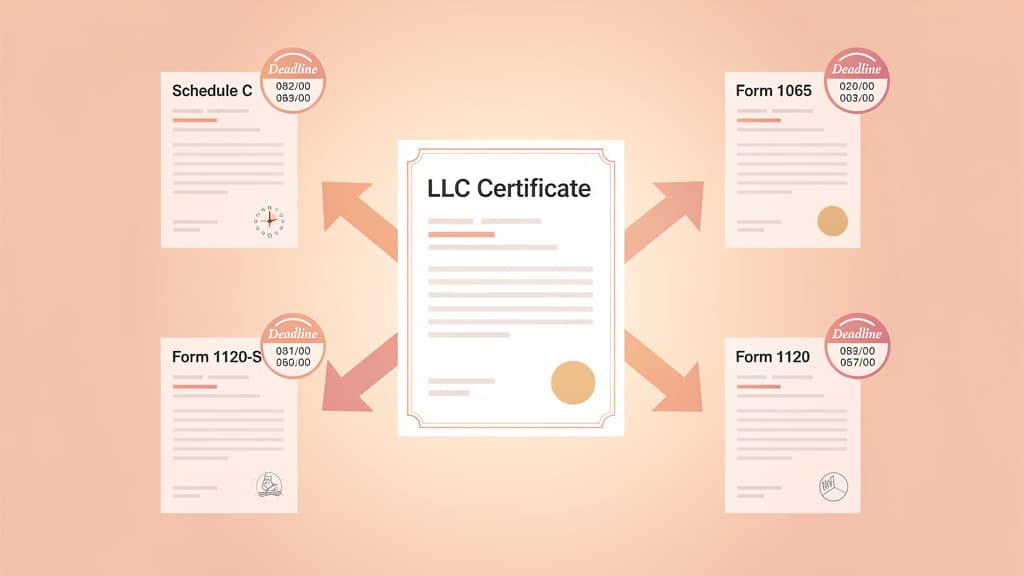
Tax FilingMar 20, 2026
LLC Tax Deadlines 2026: Filing Dates by Entity Election
Every 2026 LLC tax deadline by entity election: single-member, multi-member, S-Corp, and C-Corp filing dates, extensions, estimated payments, and penalties.
Read more
Fact-checked by Jupid experts
Reviewed by our in-house tax team before publishing. Every figure is validated against:
Last reviewed: August 20, 2026

Published: March 19, 2026 Tax Year: 2026
The next partnership deadline is September 15, 2026: it is both the extended Form 1065 due date for partnerships that filed Form 7004, and the Q3 estimated-payment date for the partners themselves. The original deadline was March 16, 2026 (March 15 fell on a Sunday), so if your partnership extended, the return and every Schedule K-1 must go out by September 15 — a late partnership return delays every partner's personal filing. The late-filing penalty runs at $255 per partner per month, for up to 12 months, even though the partnership itself pays no federal income tax.
Key takeaways:
| Deadline | What's Due | Who It Applies To |
|---|---|---|
| Mar 16, 2026 | Form 1065 partnership return | All partnerships and multi-member LLCs |
| Mar 16, 2026 | Schedule K-1 distributed to partners | Partnership must issue to each partner |
| Apr 15, 2026 | Q1 estimated tax payment | Individual partners on K-1 income |
| Apr 15, 2026 | Partner individual returns (Form 1040) | Partners reporting K-1 income |
| Jun 15, 2026 | Q2 estimated tax payment | Individual partners |
| Sep 15, 2026 | Q3 estimated tax payment | Individual partners |
| Sep 15, 2026 | Extended Form 1065 due | Partnerships that filed Form 7004 |
| Oct 15, 2026 | Extended partner individual returns | Partners who filed Form 4868 |
| Jan 15, 2027 | Q4 estimated tax payment | Individual partners |
Legal basis: IRC §6072, IRC §6698, IRC §6654

Every domestic partnership must file Form 1065, U.S. Return of Partnership Income, for each tax year in which it receives income, has expenses, or has a filing requirement. This includes:
A partnership itself does not pay federal income tax. It's a pass-through entity — income, deductions, gains, losses, and credits flow through to the individual partners via Schedule K-1.
The statutory deadline for Form 1065 is the 15th day of the 3rd month after the partnership's tax year ends. For calendar-year partnerships, that's March 15. In 2026, March 15 falls on a Sunday, so the deadline shifts to Monday, March 16, 2026 (IRC §7503).
This is one month before the individual return deadline (April 15). The IRS designed it this way so that partners receive their K-1s in time to complete their personal returns.
Form 1065 captures the partnership's total ordinary business income or loss, rental income, investment income, capital gains and losses, Section 179 deductions, partner capital accounts, and balance sheet information. The partnership then allocates each item to individual partners according to the partnership agreement.
The penalty for filing Form 1065 late is $255 per partner per month (or fraction of a month), for up to 12 months (IRC §6698, as adjusted by Rev. Proc. 2024-40 for returns required to be filed in 2026). This adds up fast.
| Partners | 1 Month Late | 3 Months Late | 6 Months Late | 12 Months Late (Max) |
|---|---|---|---|---|
| 2 | $510 | $1,530 | $3,060 | $6,120 |
| 3 | $765 | $2,295 | $4,590 | $9,180 |
| 5 | $1,275 | $3,825 | $7,650 | $15,300 |
| 10 | $2,550 | $7,650 | $15,300 | $30,600 |
A 5-partner firm that files 6 months late owes $7,650 — and that's before any interest or individual-level penalties.
Interactive
What does a late Form 1065 cost?
The penalty is head-count math: every partner multiplies every month. Set your numbers and watch it stack.
Anyone who was a partner at any point during the year counts.
Late-filing penalty (IRC §6698)
$7,650
5 partners × $255 × 6 months — before interest or any late-filing penalties on the partners' own returns.
Uses this guide's §6698 rate — $255 per partner per month or partial month (returns required to be filed in 2026), capped at 12 months. It applies even when the partnership owes zero entity-level tax; interest and partner-level penalties are separate. Reasonable cause or first-time abatement can reduce it.
Model other IRS penalties in the full toolThe partnership must furnish each partner with a copy of their Schedule K-1 by the filing deadline of the partnership return — March 16, 2026 for calendar-year partnerships. In practice, K-1s are usually attached to the Form 1065 filing and distributed simultaneously.
For a complete breakdown of every K-1 box and where each number goes on your personal return, see our Schedule K-1 Guide.
Schedule K-1 (Form 1065) shows each partner's distributive share of partnership items. The key boxes: Box 1 (ordinary business income), Box 4 (guaranteed payments), Box 8-11 (capital gains), Box 12 (Section 179), Box 14 (self-employment earnings), Box 19 (distributions), and Box 20 (QBI data for the Section 199A deduction).
Partners report K-1 amounts on their personal Form 1040. The main destination is Schedule E, Part II (Supplemental Income and Loss), but certain items flow to other schedules:
This is why late K-1s create problems. Without the K-1, a partner can't accurately complete their 1040.
Partnerships don't pay income tax, but partners do. Each partner is responsible for making their own estimated tax payments based on their share of partnership income — plus any other income they earn.
| Quarter | Income Period | Payment Due Date |
|---|---|---|
| Q1 | Jan 1 – Mar 31, 2026 | April 15, 2026 |
| Q2 | Apr 1 – May 31, 2026 | June 15, 2026 |
| Q3 | Jun 1 – Aug 31, 2026 | September 15, 2026 |
| Q4 | Sep 1 – Dec 31, 2026 | January 15, 2027 |
Use the Quarterly Tax Calculator to estimate your payments based on projected K-1 income.
Partners can avoid underpayment penalties by paying the lesser of:
For partners in a growing business, the prior-year safe harbor is often the smarter approach — you pay based on last year's known income and avoid penalties even if current-year income rises.
New partners with no prior-year K-1 income can't use the prior-year safe harbor for their partnership income portion. Estimate conservatively — use projected K-1 income for the year and divide by four.
If the partnership can't file Form 1065 by March 16, it can request an automatic 6-month extension by filing Form 7004 (Application for Automatic Extension of Time to File Certain Business Income Tax, Information, and Other Returns).
There's no tax payment required with Form 7004 for partnerships since the partnership itself doesn't owe income tax. But the extension affects partners downstream.
When a partnership extends its return, K-1s are delayed until the extended return is filed (September 15). Without K-1 data, partners can't complete their personal returns by April 15, so they'll need to file Form 4868 for a personal extension (to October 15). And the extension doesn't change estimated tax payment deadlines — partners must still make quarterly payments based on projected income.
This cascade is one of the most common sources of frustration for partnership owners. The partnership gets 6 extra months to file, but partners are stuck making estimated payments without final K-1 numbers.
General partners owe self-employment tax on their distributive share of partnership income (IRC §1402(a)). This applies to:
The self-employment tax rate is 15.3% — 12.4% for Social Security (on income up to $184,500 in 2026) and 2.9% for Medicare (no cap). An additional 0.9% Medicare surtax applies to SE income above $200,000 ($250,000 for married filing jointly).
Guaranteed payments to partners (Box 4 of Schedule K-1) are also subject to SE tax, regardless of whether the partner is general or limited.
Partners need to factor SE tax into their estimated payments. A partner expecting $100,000 in ordinary income from the partnership doesn't just owe income tax — they owe approximately $14,130 in SE tax ($100,000 × 92.35% × 15.3%; half of that amount is then deductible on their income tax return, but the deduction doesn't reduce the SE tax itself). See our Self-Employment Tax Guide and Schedule SE Instructions for full calculations.
Limited partners are generally exempt from self-employment tax on their distributive share of partnership income (IRC §1402(a)(13)). A limited partner only owes SE tax on guaranteed payments for services — not on their allocable share of partnership income. This is one of the key tax differences between general and limited partners.
For LLC members, the picture is murkier. The IRS proposed regulations in 1997 to clarify how LLC members should be classified for SE tax purposes, but those regulations were never finalized. In practice, active LLC members who participate in management are generally treated like general partners (subject to SE tax), while passive members with no management role have a stronger argument for limited partner treatment. The distinction is fact-specific — if you're an LLC member trying to determine your SE tax exposure, get professional advice.
Since the 2020 tax year, the IRS requires partnerships to report partner capital accounts on Schedule K-1 using the tax basis method. This means the partnership must track each partner's capital account based on:
A partner's tax basis in the partnership determines:
Partnerships that don't maintain proper tax basis capital accounts risk incorrect K-1 reporting, which means individual partners may report wrong amounts on their personal returns.
Item L on Schedule K-1 (Partner's Capital Account Analysis) must show beginning balance, contributions, current year income/gains, current year losses/deductions, withdrawals/distributions, and ending balance — all on a tax basis. Partnerships that previously used GAAP, Section 704(b), or other methods had to convert to tax basis.
A multi-member LLC defaults to partnership tax treatment under IRS check-the-box regulations (Treasury Regulation §301.7701-3). Unless the LLC files Form 8832 to elect corporate treatment or Form 2553 to elect S-Corp treatment, it files Form 1065 as a partnership.
This means every deadline, penalty, and requirement in this guide applies equally to multi-member LLCs that haven't elected otherwise.
For a detailed guide to multi-member LLC tax treatment, allocations, and compliance, see our Multi-Member LLC Tax Filing Guide.
If your LLC has two or more members, you must file Form 1065 — not Schedule C. Some business owners add a spouse or partner to their LLC without realizing it changes the filing requirement from Schedule C (sole proprietorship) to Form 1065 (partnership). The result: wrong return filed, potential penalties from the IRS, and no K-1s issued to the other member.
The one exception: qualified joint ventures in community property states, where a married couple can elect to file as two sole proprietors instead of a partnership.
A late partnership return doesn't just trigger the $255/partner/month penalty on the entity — it delays K-1 delivery to every partner, who then can't file their own returns on time. A 4-partner firm that files 3 months late owes $255 x 4 x 3 = $3,060 in partnership penalties alone, before any individual-level late-filing penalties.
The fix: file on time or file Form 7004 by March 16. The extension costs nothing and buys six months.
Partnership income isn't just subject to income tax. Active partners owe self-employment tax at 15.3% on their distributive share. New partners who budget only for income tax on K-1 income can face a surprise bill of thousands of dollars when the SE tax calculation hits.
Example: A general partner with $120,000 in ordinary income from the partnership owes roughly $16,956 in SE tax alone (before the income tax deduction for the employer-equivalent half).
The IRS has required tax basis capital account reporting since 2020, but some partnerships still don't track basis properly. Errors in capital account reporting lead to wrong K-1 amounts, wrong personal returns, and potential IRS notices. The partnership — not individual partners — is responsible for maintaining accurate capital accounts. If your K-1 shows an Item L that doesn't match your records, raise it with the partnership before filing.
Running a partnership means tracking more than just your own income — you need visibility into how partnership revenue and expenses affect each partner's tax obligations. Jupid handles this by connecting to your bank accounts and automatically categorizing income and expenses with 95.9% accuracy, so the numbers behind your allocations are always current.
Through Jupid's WhatsApp and iMessage AI, any partner can ask about their estimated tax status, upcoming payment deadlines, or how current-quarter income compares to projections. Instead of waiting for your accountant to run the numbers, you get answers based on real bank transactions in real time.
Jupid tracks estimated tax obligations at the individual partner level. When quarterly payments approach, each partner knows their number — based on actual year-to-date income, not last quarter's rough estimate. This matters most for partnerships with variable income, where each quarter looks different.
The system works through a web interface, Claude Code, and other AI tools — so whether you're reviewing allocations on your laptop or checking a deadline from your phone, the data is there.
Connect your bank to Jupid and give every partner real-time visibility into their tax obligations.
| Item | 2026 Amount |
|---|---|
| Form 1065 late filing penalty | $255 per partner per month (up to 12 months) |
| Self-employment tax rate | 15.3% (12.4% SS + 2.9% Medicare) |
| Social Security wage base | $184,500 |
| Additional Medicare tax | 0.9% on SE income above $200,000 |
| Safe harbor (AGI ≤ $150K) | 100% of prior year tax |
| Safe harbor (AGI > $150K) | 110% of prior year tax |
| Section 179 maximum deduction | $2,560,000 |
| 1099-NEC reporting threshold | $2,000 |
| Bonus depreciation | 100% (permanent — property acquired after Jan 19, 2025, per OBBBA) |
| QBI deduction | 20% (permanent via OBBBA 2025) |
Partnership tax compliance has more moving parts than sole proprietorship or even S-Corp taxation. The entity files Form 1065, generates K-1s, and then each partner independently handles their own estimated payments, SE tax, and personal return. Miss the entity deadline and the penalties hit at $255 per partner per month. Miss the K-1 distribution and every partner's personal filing gets delayed.
The two most important things a partnership can do: file Form 1065 (or Form 7004) by March 16, and make sure every partner knows their estimated tax obligations for the quarterly payment dates. Everything else follows from those two actions.
If your partnership has already filed for 2026, focus on the estimated payment schedule. If you extended, September 15 is your target — start preparing now so K-1s reach partners well before the October 15 extended personal deadline.
Bookmark the partnership tax deadline calendar and set reminders for each date. See also our guides on when business taxes are due and multi-member LLC tax filing.
Free download: Get the printable 2026 Tax Deadline Calendar (PDF) — every federal due date for all entity types on a single page. Planning ahead? The 2027 calendar (PDF) is also available, and an interactive version with calendar exports is at jupid.com/tax-deadline-calendar.
Disclaimer
This article provides general information about 2026 partnership tax deadlines and should not be considered tax advice. Tax deadlines may shift when they fall on weekends or holidays, and specific requirements may differ based on your partnership's fiscal year, state of formation, or special circumstances. State filing requirements vary and are not fully covered here. For advice specific to your situation, consult with a qualified tax professional or refer to IRS Publication 541 (Partnerships) and Publication 509 (Tax Calendars).
Tax Year: 2026 Last Updated: July 29, 2026

CEO & Co-Founder
Fintech CEO with 10+ years building accounting and financial technology products. Previously co-founded and scaled an AI-powered accounting platform to $30M revenue and 100K+ business users, achieving 30,000 customers per accountant through automation — recognized by CNBC as a top fintech company. Holds a Master's in Management Information Systems. At Jupid, he leads the development of AI-native bookkeeping, tax, and compliance tools designed for freelancers and small business owners.
Every 2026 LLC tax deadline by entity election: single-member, multi-member, S-Corp, and C-Corp filing dates, extensions, estimated payments, and penalties.

Every 2026 S-Corp tax deadline in one guide: Form 1120-S, K-1 distribution, estimated taxes, payroll deposits, and penalty amounts you need to know.
Every 2026 California tax deadline: FTB filing dates, franchise tax, LLC fees, estimated payments, PTE elections, and extensions for individuals and businesses.
Set up in minutes. Cancel anytime.
Join 1,000+ businesses using Jupid to save time and money. Start simplifying your finances today.
30-day money-back guarantee