Published: June 8, 2026
Small business owners often do not begin by searching for a bank account.
They begin with much more practical questions.
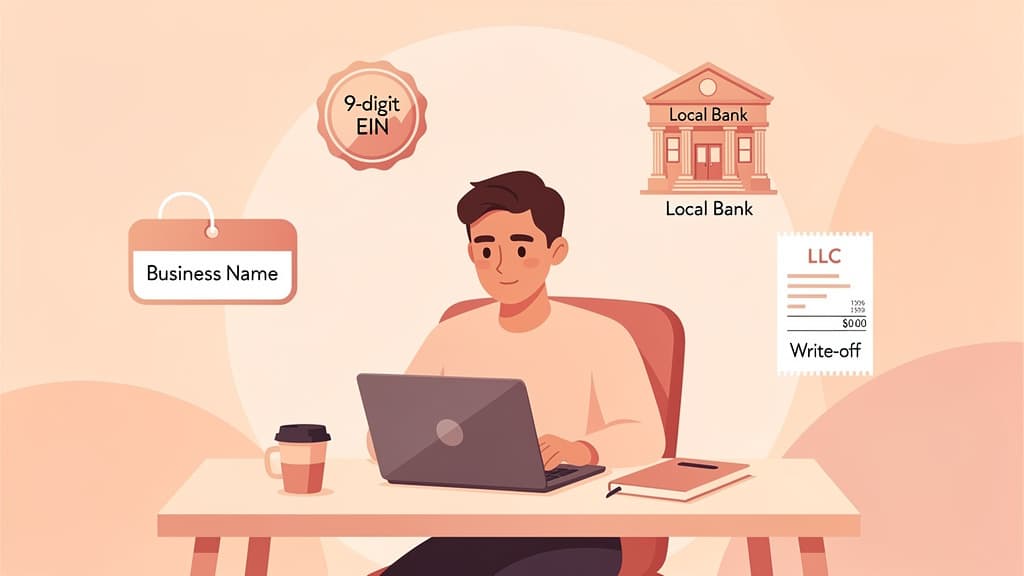
- Can I use this business name?
- Do I need an LLC, or can I stay a sole proprietor?
- How do I get an EIN?
- What can I write off?
- How much should I set aside for 1099 taxes?
- What documents will I need before asking for funding?
These questions may look small on their own, but together they say something important: small business intent often shows up before the business looks like a business banking relationship.
At Jupid, we have been building and testing practical tools and educational content for small business owners across formation, taxes, deductions, bookkeeping, and funding readiness. The signal from that work has been clear. Owners are not usually looking for abstract education. They are looking for a next step they can understand and act on.
That is why tools like business name generators, LLC formation guides, EIN content, 1099 tax calculators, quarterly tax calculators, deduction explainers, and funding-readiness resources matter. They sit close to the moments when a person is trying to make the business more real.
Our own search data shows just how large and fast-growing this demand is. At the start of 2026, the small business questions we cover generated only low thousands of weekly search impressions. By spring, that had grown into the hundreds of thousands per week across Google and Bing. In the peak week of the 2026 tax season, April 13-19, Jupid's content appeared more than 400,000 times in search results and drew roughly 1,750 visits in a single week. Organic visits overall grew more than 10x over the same period.
And the demand is unmistakably about becoming and running a business. The questions driving it are self-employment and 1099 taxes, quarterly estimated taxes, LLC setup and fees, business-name availability, and business deductions. These are the exact decisions owners work through while they are forming a company and getting it off the ground, long before they ever apply for a business account or a loan.
The important part is not just the traffic. It is what the traffic represents.
Many early-stage owners are trying to answer operational questions before they are ready to talk to a business banker, apply for funding, or choose a full financial stack. They may already be earning income, testing a side business, forming an LLC, accepting client payments, or using a personal account "just for now." But from the institution's perspective, that person may still look like a retail account holder, a consumer customer, or a member who has not raised their hand.
This is where community banks and credit unions have an interesting opportunity.
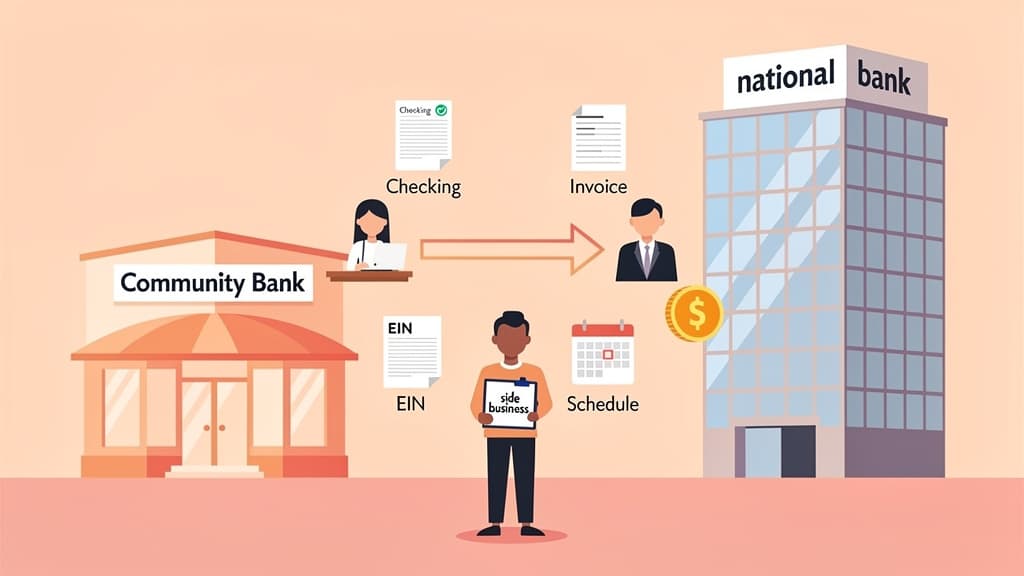
If the first answers a small business owner finds come from Google, Reddit, LegalZoom, an online lender, a national bank's content library, or a fintech tool, the relationship may start somewhere else before the local institution ever sees the opportunity.
The goal is not for every FI to become a legal, tax, or lending advisor. The goal is much simpler: help owners understand the next step, route them to the right resource, and make the institution visible at the moment when the business relationship is forming.
Public guidance points in the same direction. The SBA's startup path includes choosing a business structure, registering the business, getting an EIN, applying for licenses and permits, opening a business bank account, and thinking about funding. SBA loan application requirements also commonly include business history, loan purpose, current financials, historical financials or tax returns, collateral when applicable, and supporting documentation. IRS guidance for small businesses emphasizes recordkeeping, EINs, self-employment taxes, business expenses, and tax readiness.
In other words, the early questions are not separate from business banking. They are often the path toward it.
Here is a simple way for an FI team to think about it.
If someone in your community searches for these questions, where do they land today?
- Can I use this business name?
- Do I need an LLC or another business structure?
- How do I get an EIN?
- What do I need to open a business bank account?
- What records or documents do I need before asking for funding?
If the answer is unclear, that is the gap.
These questions are useful because they are practical, early, and connected to real next steps. They also create natural handoffs: business account opening, payments, bookkeeping and tax readiness, business lending education, local small business support, or an introduction to a business banker.
Small business banking relationships often start earlier than the application, the branch appointment, or the loan request.
- They may start when someone is choosing a name.
- They may start when someone is trying to understand whether they need an EIN.
- They may start when someone realizes their personal and business finances are mixed together.
- They may start when someone wants funding but does not yet have clean records.
For community banks and credit unions, the question is not only "How do we serve small businesses once they come to us?"
The earlier question is: "How do small businesses know to come to us in the first place?"
Practical tools and simple educational resources can help answer that question. They give owners a reason to engage before the formal banking conversation starts, and they give FI teams a clearer way to recognize business intent before the relationship moves elsewhere.
Pick five common early-stage business questions and try to answer them from your institution's website:
- "Do I need an LLC?"
- "How do I get an EIN?"
- "What do I need to open a business bank account?"
- "How much should I set aside for 1099 taxes?"
- "What documents do I need for a small business loan?"
If a business owner cannot quickly find a useful answer, the opportunity may not be that the institution lacks small business services. It may be that the institution is not yet visible at the moment the owner starts looking.
If your team is thinking about where early small business intent shows up in your own community, Jupid can help map the questions owners are already asking and show how those moments could turn into useful FI-branded tools, content, or handoffs.
Talk to our FI success team about early small business intent mapping.