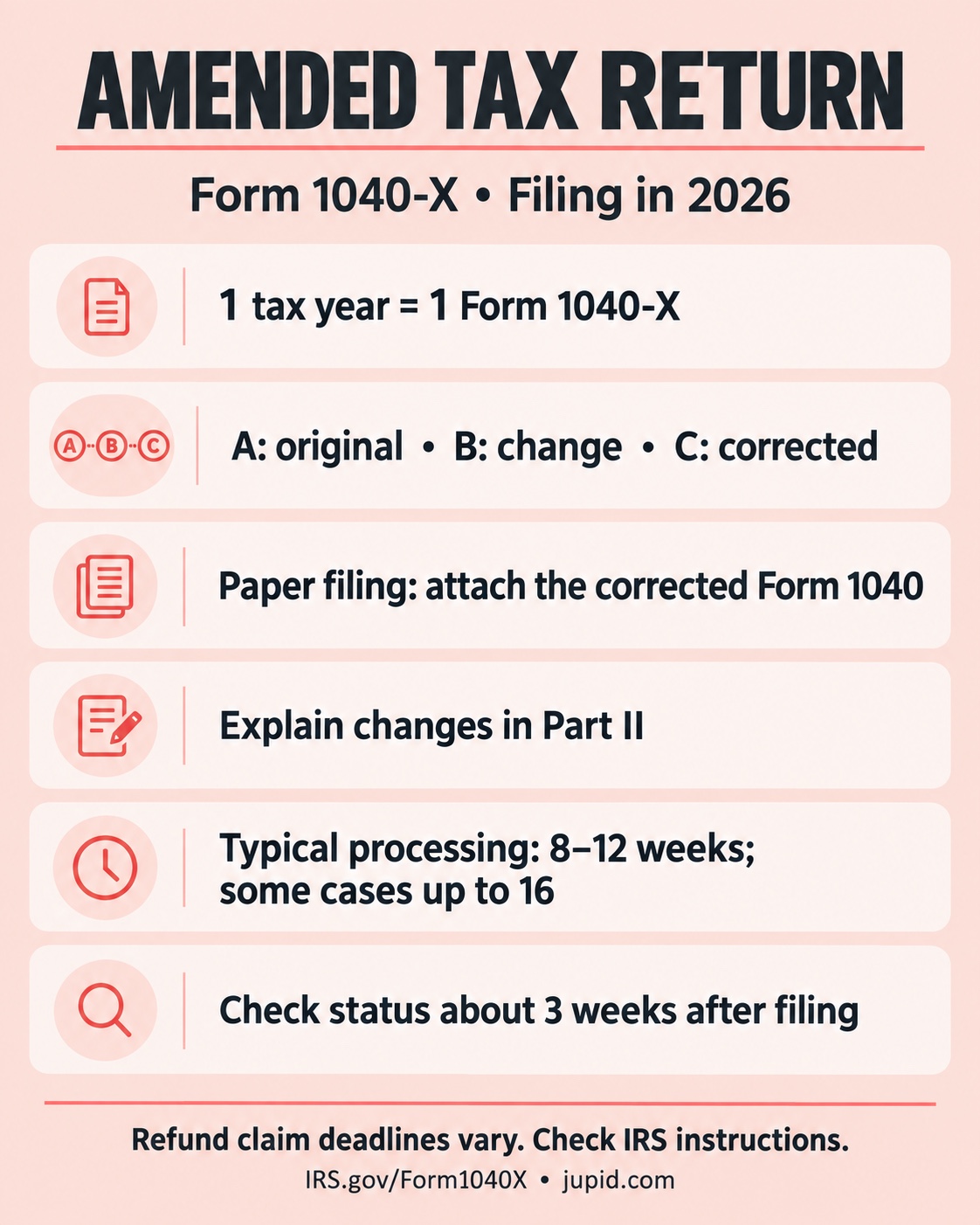
An amended tax return corrects a return you already filed: individuals use Form 1040-X to change income, deductions, credits, dependents, or filing status. The IRS currently advises allowing 8–12 weeks for processing, with some cases taking up to 16 weeks. A missing 1099 can require a correction; a simple arithmetic error usually does not. Start by identifying what changed, which tax year it belongs to, and whether the IRS has already contacted you. IRS amendment guidance and processing FAQs explain these distinctions.
This guide covers amendments filed during 2026, often for a 2025 or earlier return. It uses the December 2025 revision of Form 1040-X. Correcting a 2024 return means using 2024 tax rules, even when you submit the correction in 2026.
Key takeaways:
File a separate Form 1040-X for each tax year you correct.
The usual refund-claim window is three years after filing or two years after payment, whichever is later, subject to lookback limits and exceptions.
Columns A, B, and C show the original or adjusted amount, the change, and the corrected amount. Explain changes in Part II.
Paper amendments now require a completed, corrected Form 1040, 1040-SR, or 1040-NR, plus supporting and changed schedules.
Check Where's My Amended Return? about three weeks after filing. The ordinary refund tracker serves a different purpose.
File Form 1040-X when the information on an accepted individual return needs a substantive correction. Common triggers include an omitted W-2, unreported freelance income, an eligible deduction you missed, or a corrected investment statement that changes your gain or loss. Compare the new document with what you actually reported before deciding that another form means another filing.
What happened
Practical next step
A late 1099 reveals income missing from your return
Recalculate that year's return and prepare an amendment
A corrected 1099 repeats income you already reported accurately
Compare the figures; avoid adding the same income twice
You discover an eligible expense omitted from Schedule C
Recompute profit and related taxes before preparing 1040-X
The IRS rejected your original e-file
Correct and resubmit the original through your software
Only an arithmetic calculation is wrong
The IRS generally corrects arithmetic; review its notice
The IRS sends a notice proposing changes
Follow that notice's response process and deadline
The IRS filing guide distinguishes changes to tax information from errors it corrects itself. Keep that distinction in mind when a preparer or software program asks why you are amending.
Choose what changed and the status of your original individual return. No personal or financial details are needed.
Prepare Form 1040-X for the affected tax year
Recalculate the original tax year, compare corrected figures with the return as filed or adjusted, and attach the required return and schedules. Check the refund-claim deadline and any state amendment separately.
An amendment does not extend the original payment deadline. Arrange payment promptly if extra tax is due.
General federal individual-return guidance, checked September 2026. This does not calculate a deadline, promise a refund, or replace an IRS notice.
If you are claiming an additional refund, the IRS advises waiting for the original refund before filing the amendment. Accepting that payment does not prevent a further refund claim. However, waiting for processing does not extend a refund-claim deadline or the deadline to pay tax. If either is close, get help with the timing rather than leaving the correction unattended. See the IRS amendment guidance and Publication 17.
A missing attachment is not automatically a reason to amend. If all reported figures are correct and the IRS asks for a document, send what the request specifies. If the document reveals omitted income or an incorrect credit, you have a substantive correction to evaluate.
A CP2000 notice needs particular care. The IRS generally says not to file an amended return merely to repeat the changes proposed in that notice. Respond using the notice's instructions. If you discover additional changes beyond its proposal, the IRS describes how to include an amendment with your response. Sending an unrelated 1040-X through the ordinary channel can complicate matching the two cases. IRS CP2000 instructions. Our CP2000 notice guide covers the full reply, including when a 1040-X marked "CP2000" belongs with it.
Form 1040-X also does not correct a partnership's Form 1065 or a corporation's income tax return. A sole proprietor's Schedule C belongs to the individual return, so a correction normally flows through Form 1040-X. An S-corporation shareholder may need a corrected K-1 and an individual amendment, while the corporation handles its own filing separately.
For an ordinary refund claim, IRC Section 6511 generally gives you the later of three years from filing the return or two years from paying the tax. A return filed before its regular due date is generally treated as filed on that due date under IRC Section 6513.
There are two questions to check: whether the claim is timely and how much tax falls inside the applicable refund lookback period. Passing the first test does not automatically make every old payment refundable. Extensions, later payments, disaster relief, and special claims can change the analysis. Publication 556 explains the distinction between the filing period and the amount recoverable. IRS Publication 556
For example, someone who paid additional tax recently may still have a two-year claim window even though an ordinary three-year window has passed. That does not necessarily reopen a refund of all withholding from the original year. Keep the original filing confirmation, any extension, payment dates, and notices together so a preparer can establish the correct deadline.
The refund-claim window is not permission to delay paying omitted tax. If a correction increases your bill, act promptly; the original payment due date still matters. Special situations such as foreign tax credits, worthless securities, and carrybacks need their own deadline analysis.
Gather the filed return, any IRS adjustments, the document that caused the correction, and the tax-year-specific schedules affected by it. If you cannot locate your return, an IRS transcript can help reconstruct reported information. A transcript is not always a substitute for the full return and every attachment.
Make a working copy before editing a saved return in tax software. You need a reliable record of the original figures to compare against the corrected calculation. Name your files by tax year and version, such as “2025 filed” and “2025 corrected,” so the old PDF does not accidentally become the submission copy.
For a business correction, trace the change through the return. A missed expense can change Schedule C profit, Schedule SE tax, the deductible part of that tax, and the qualified business income deduction. Our Schedule C instructions explain the profit calculation; use the matching year's instructions for the actual amendment. A current-year self-employment tax calculator is useful for planning, but its current constants should not be substituted for an older return's rules.
Use the current IRS form PDF alongside its instructions. The map below was checked against the December 2025 revision. Check the revision again before filing: line numbers and attachment requirements can change independently of the tax year being corrected.
Enter the year of the return you are correcting at the top. Check the appropriate filing-status box even when your status stays the same.
Column A is the amount originally reported, incorporating previous IRS adjustments or amendments where applicable. Column B is the increase or decrease. Column C is the corrected result. A decrease belongs in parentheses. For example, an eligible deduction that rises from $2,000 to $2,600 has A = $2,000, B = $600, and C = $2,600; the tax consequences must still be recalculated separately.
Adjusted gross income, itemized or standard deduction, and the difference
Line 4a
Qualified business income deduction
Line 4b
Applicable Schedule 1-A deductions for tips, overtime, car-loan interest, and seniors
Line 5
Corrected taxable income
Lines 6–8
Income tax and nonrefundable credits
Line 9
Reserved; do not reuse an old form's treatment
Lines 10–11
Other taxes and total tax
Lines 12–15
Withholding, estimates, and specified refundable credits
Line 16
Payments with the extension, original return, or afterward
Lines 17–19
Total payments, original overpayment, and remaining amount available
Lines 20–23
Additional tax due or additional overpayment, refund, and estimate allocation
Part I
Dependent information when applicable
Part II
Explanation of changes
Part III
Direct-deposit details for an electronically filed amendment
The original overpayment on line 18 matters even if you directed it toward next year's estimated tax. Ignoring it can make your corrected return appear to claim the same dollars twice.
Explain the item, why it changed, and the supporting schedule. For an illustrative correction: “A bank interest statement was omitted from the original return. The attached corrected return includes the interest and recalculates adjusted gross income, taxable income, and tax.” Add the actual amounts and affected schedules from your records. “Fixing my taxes” gives the reviewer too little information.
Form 1040-X reconciles the corrected liability with payments and the original overpayment. It does not simply pay the entire refund shown on a newly calculated Form 1040 again.
Consider Dorian, an illustrative filer correcting a 2025 return during 2026. His original total tax was $9,000, withholding was $10,000, and he already received a $1,000 refund. His preparer has now recomputed the full return. There are no other payments or credits in these examples.
Reconciliation item
Correction increases tax
Correction decreases tax
Corrected total tax, line 11 column C
$9,600
$8,400
Total payments, line 17
$10,000
$10,000
Original overpayment, line 18
$1,000
$1,000
Available payments, line 19
$9,000
$9,000
Additional tax due, line 20
$600
$0
Additional overpayment, line 21
$0
$600
In the second case, the corrected return's overall refund is $1,600, but Dorian already received $1,000. Only the additional $600 remains. In the first case, the extra $600 tax is payable even though he originally received a refund. Interest or penalties, if applicable, are separate from this reconciliation.
These are payment-reconciliation examples, not estimates of the tax on a particular omitted income item. They deliberately start with a fully recalculated tax figure so that a $600 change in tax is never confused with $600 of income.
Electronic filing is available for eligible amended individual returns using supported tax software. The IRS generally limits e-file amendments to the current and two prior tax periods; the ordinary 2026 filing-season window covers 2025, 2024, and 2023 returns. Eligibility also depends on the original filing and software support, so confirm the specific return inside the software. Older eligible refund claims may still be filed on paper. IRS amended-return FAQs
For paper filing, the December 2025 form explicitly requires a completed corrected Form 1040, 1040-SR, or 1040-NR, plus supporting documents and new or changed schedules. Complete Part II and sign the paper return by hand. Check the current mailing instructions for your situation instead of reusing an address from an old blog post. Send each tax year's amendment separately and retain evidence of mailing.
Electronic submission still needs an acceptance confirmation. Saving a corrected PDF or receiving a software preparation summary does not establish that the IRS accepted the amendment.
Use Where's My Amended Return?, not the ordinary Where's My Refund? service. Allow roughly three weeks for the amendment to appear. The online tool and automated phone line, 866-464-2050, report stages such as received, adjusted, and completed.
The published processing estimate is 8–12 weeks, with some cases taking up to 16 weeks. These are estimates, not an appointment for a deposit. Errors, missing information, identity checks, or specialist review can extend processing. An “adjusted” status means an account change, which can be a refund, balance due, or no change in tax; it does not by itself promise money.
If the status service directs you to contact the IRS, follow its instructions. Avoid sending another copy merely because the first is slow. Keep the submission confirmation and respond to any correspondence. Our tax refund schedule guide separates original-return timing from amendment timing.
Pay additional federal tax promptly through an appropriate IRS payment option, selecting the correct tax year and payment reason. An amendment does not reset the original due date. Interest can accrue from that date, and filing late can have other consequences. If full payment is difficult, compare IRS payment plans while continuing the filing process.
Do not assume that voluntarily amending erases every penalty. The qualified-amended-return rules in Treasury Regulation Section 1.6664-2 have specific conditions and cutoff events. They are not a universal exemption from interest, payment penalties, or consequences of an IRS examination.
A federal correction can also change state taxable income, credits, or estimated payments. Review the affected state's amendment rules and deadlines separately; do not put a state return inside the federal mailing. The IRS does not complete your state correction for you.
An amendment is easier to review when the income and expense records behind it are organized. Jupid connects to your bank and helps categorize business transactions, so you can work from a clearer record of receipts and spending. Use that record to identify items worth checking against the filed return, then have your tax professional determine the correct treatment and affected schedules. Keep the original return, corrected version, and supporting documents together. This guide does not imply that Jupid prepares or submits Form 1040-X for you. Try Jupid.
If you use Claude, ChatGPT, or another AI agent to amend a return, our open-source Form 1040-X skill first checks whether you need to amend at all, since the IRS fixes math errors itself and a CP2000 you fully agree with needs no 1040-X. It then rebuilds column A from your return as the IRS last adjusted it, recomputes every schedule the change touches using that year's rules, reconciles your original refund, tests the three-year and two-year refund deadlines and the lookback cap, and picks e-file or the correct paper address. Review the draft before you file.
For Claude Code, clone the repo and run cp -r jupid-skills/forms/form-1040-x ~/.claude/skills/. For the Anthropic SDK, load SKILL.md into the system prompt and the references/ files on demand. For browser-automation runtimes, filing.md covers the e-file or paper-file workflow.
Reviewed September 9, 2026. This article provides general education, not personalized tax, legal, or accounting advice. Refund limitations, filing-status changes, IRS notices, and special elections can require individual analysis. Consult a qualified tax professional for your return.
Fintech CEO with 10+ years building accounting and financial technology products. Previously co-founded and scaled an AI-powered accounting platform to $30M revenue and 100K+ business users, achieving 30,000 customers per accountant through automation — recognized by CNBC as a top fintech company. Holds a Master's in Management Information Systems. At Jupid, he leads the development of AI-native bookkeeping, tax, and compliance tools designed for freelancers and small business owners.