California taxes capital gains as ordinary income at the same 1% to 12.3% rates it applies to wages, plus a 1% Behavioral Health Services Tax on taxable income over $1,000,000, so the top California rate on a gain is 13.3% for tax year 2026. The state has no separate long-term rate: stock held for ten years and crypto held for ten days run through the same brackets. The 9.3% bracket alone covers taxable income from $75,197 to $384,109 for single filers and from $150,394 to $768,218 for joint filers under the 2026 schedules the Franchise Tax Board (FTB) published in October 2026.
The 2026 schedules cover sales made in 2026 and reported on returns filed in 2027. Because the gain stacks on your other income, its effective state rate sits below the top marginal rate: 9.66% on the $400,000 example below.
Key takeaways:
2026 rates: 1% to 12.3% of taxable income, plus 1% on taxable income over $1,000,000, for a 13.3% top rate
No long-term discount: California taxes short-term and long-term gains alike; only the federal return uses 0%, 15% and 20%
The 12.3% bracket starts at $768,213 single, $1,536,426 joint and $1,044,771 head of household (2026)
Home sales: California follows the federal $250,000 / $500,000 exclusion, and escrow withholds 3⅓% of the price on most other California real estate sales over $100,000 (Form 593)
QSBS gain is fully taxable in California, and a 2026 California AGI of $1,000,000 or more removes the prior-year safe harbor for estimated tax
California capital gains tax rates for 2026 are the regular income tax brackets of Revenue and Taxation Code (R&TC) Section 17041, indexed each year by the California Consumer Price Index. The FTB's October 2026 Tax News announced them after a 3.4% adjustment, with a 2026 standard deduction of $5,900 (single) and $11,800 (joint and head of household).
2026 rate
Single or married filing separately: taxable income over
Married filing jointly or qualifying surviving spouse
Taxable income here means Form 540, line 19: California adjusted gross income minus the standard or itemized deduction. Above $100,000 you compute the tax with these schedules; at $100,000 or less you look up the tax in the 2026 California Tax Table, which lists it in $100 steps. For 2025 returns, filed in 2026, the 12.3% bracket started at $742,953 single and $1,485,906 joint.
The Behavioral Health Services Tax (the Mental Health Services Tax before 2025) is 1% of taxable income above $1,000,000, reported on Form 540, line 62. R&TC Section 17043 switches off the filing-status and joint-return rules for this tax, so a married couple reaches it at the same $1,000,000 as a single filer. A joint return between $1,000,000 and $1,536,426 pays 12.3% at the margin (11.3% plus 1%), and 13.3% above that.
The 10.3%, 11.3% and 12.3% brackets come from Propositions 30 and 55 and were written to expire after tax year 2030 (California Constitution, Article XIII, Section 36). Proposition 3 on the November 3, 2026 ballot makes them permanent; the Secretary of State's unofficial count on November 23, 2026 showed it passing 60.9% to 39.1%, with certification due by December 11, 2026. The 2026 brackets above apply either way.
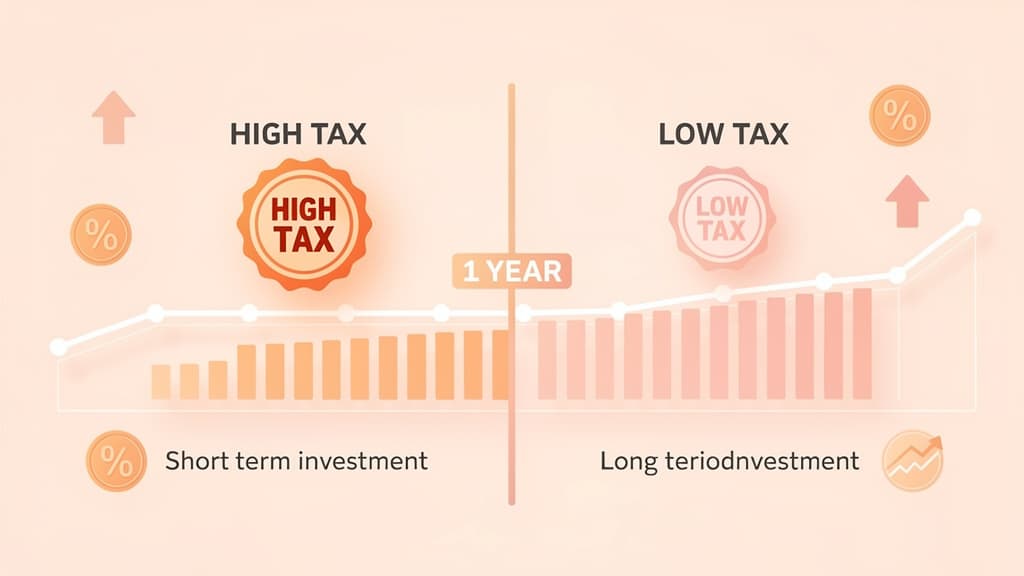
California long-term capital gains tax uses the same rates as short-term gains. The FTB's capital gains page says California does not have a lower rate for capital gains and taxes all of them as ordinary income, and the Schedule CA (540) instructions add that no special rate for long-term gains exists. The one-year holding period in IRC Section 1222 changes only the federal side.
Holding period
Federal, tax year 2026
California, tax year 2026
One year or less (short-term)
Ordinary rates, 10% to 37%
1% to 12.3%, plus 1% over $1,000,000
More than one year (long-term)
0%, 15% or 20%; 15% starts at $49,450 single / $98,900 joint, 20% above $545,500 / $613,700
Same as short-term
Net investment income tax
3.8% above MAGI of $200,000 single / $250,000 joint
Holding past one year saves federal tax only: a short-term trader and a buy-and-hold investor with the same income and gain owe California the same amount.
California calculates capital gains tax by adding the gain to your other taxable income and running the total through the brackets; the tax on the gain is the increase in Form 540, line 31. The gain fills the brackets from where your other income stops, so its first and last dollars can face different rates.
Odessa is single and lives in Oakland. Her 2026 California taxable income without any sale is $95,000. She sells index fund shares bought in 2015 for a $400,000 long-term gain, which lifts her taxable income to $495,000.
Slice of Odessa's gain
Taxable income range
2026 rate
California tax
$289,109
$95,000 to $384,109
9.3%
$26,887
$76,818
$384,109 to $460,927
10.3%
$7,912
$34,073
$460,927 to $495,000
11.3%
$3,850
$400,000
$38,649
Checked against Schedule X: the tax on $495,000 is $43,802 and the tax on $95,000 is $5,153, a difference of $38,649. That is 9.66% of the gain. Applying 13.3% to the whole $400,000 would give $53,200 and overstate her California bill by $14,551. Her taxable income stays under $1,000,000, so the 1% tax does not apply.
Enter your filing status, your California taxable income without the sale, and the gain. The gain is stacked on top of that income through the official 2026 brackets.
$
Wages, business profit and other income, after deductions.
$
Short-term or long-term: California taxes both the same.
California tax on a $400,000 gain (2026)
$38,649
9.66% of the gain. The last dollar of it is taxed at 11.3%.
Gain taxed at 9.3%$289,109
Gain taxed at 10.3%$76,818
Gain taxed at 11.3%$34,073
Flat 13.3% on the whole gain, for comparison$53,200
The 13.3% headline rate overstates this sale by $14,551. California reaches 13.3% only on taxable income above $1,000,000 that also sits in the 12.3% bracket.
Tax year 2026 FTB rate schedules X, Y and Z plus the 1% Behavioral Health Services Tax on taxable income over $1,000,000 (R&TC 17043). Taxable income means Form 540, line 19, after the $5,900 / $11,800 standard deduction or itemized deductions. Below $100,000 the FTB Tax Table can differ by a few dollars. For a home sale, enter the gain left after the federal $250,000 / $500,000 exclusion. Exemption credit phase-outs, AMT, and credits for tax paid to other states are not modeled. Federal tax is separate.
The full California capital gains tax calculator adds the federal tax and NIIT for the same sale. It applies California's 13.3% top rate to the whole gain, so read its state line as a ceiling.
How much capital gains tax you pay in California depends on where your other income ends. These three 2026 sales run through the FTB schedules exactly as the return does.
Esteban
Odessa
Bao and Thuy
Filing status
Single
Single
Married filing jointly
Taxable income before the sale
$45,000
$95,000
$300,000
Gain
$20,000 (crypto held 8 months)
$400,000 (index funds)
$1,500,000 (company stock)
Regular tax on the gain
$1,310
$38,649
$161,235
1% over $1,000,000
$0
$0
$8,000
California tax on the gain
$1,310
$38,649
$169,235
Effective state rate on the gain
6.55%
9.66%
11.28%
Flat 13.3% would say
$2,660
$53,200
$199,500
Esteban's crypto gain is short-term for the IRS, yet California treats it exactly like Odessa's long-term gain. Bao and Thuy's gain carries them through four brackets and past $1,000,000, so the $800,000 above that line pays the extra 1%, and their AGI of $1,000,000 or more changes how they must pay estimated tax (see below).
Federal and California capital gains taxes stack on the same gain, and neither gives a credit for the other. A California resident in the top brackets pays up to 37.1% on a long-term gain (20% federal, 3.8% NIIT, 13.3% California) and up to 54.1% on a short-term gain (37%, 3.8% and 13.3%).
Odessa's federal side, assuming her federal and California AGI are both $100,900 and she takes the $16,100 federal standard deduction for 2026: her federal taxable income before the sale is $84,800, so the whole $400,000 gain lands in the 15% band, which runs to $545,500 for single filers. That is $60,000. Her MAGI rises to $500,900, and NIIT applies to the $300,900 above $200,000, adding $11,434. Federal tax of $71,434 plus California tax of $38,649 comes to $110,083, or 27.5% of the gain.
The California tax is deductible federally only if you itemize, and only inside the state and local tax cap: $40,400 for 2026, reduced by 30% of MAGI above $505,000 and never below $10,000 (IRC Section 164(b)(7)). For the same sale priced in other states, see the states with no capital gains tax list.
California follows the federal home sale exclusion in IRC Section 121: up to $250,000 of gain ($500,000 on a joint return) is excluded if you owned the home and lived in it as your main home for at least two of the five years before the sale. FTB Publication 1001 confirms California conforms. Gain above the exclusion is taxed at your ordinary California rates in the year of sale.
Farid and Lorena, married filing jointly in San Diego, sell their home of 11 years in 2026 for $1,450,000. With $700,000 of basis (a $610,000 purchase plus $90,000 of improvements) and $75,000 of selling costs, their gain is $675,000. After the $500,000 exclusion, $175,000 is taxable, and on top of $140,000 of other California taxable income it adds $16,140 of California tax, 9.22% of the taxable gain.
Form 593, the California Real Estate Withholding Statement, collects part of the tax at closing. The escrow company withholds 3⅓% of the total sales price unless an exemption applies or the seller elects the alternative calculation, which for individuals is 12.3% of the estimated gain. The 2026 Form 593 instructions exempt, among others:
Sales with a price of $100,000 or less
A principal residence under the Section 121 two-of-five-years test, or property last used as your principal residence
A loss or zero gain, computed in Part VI of the form
A Section 1031 like-kind exchange, unless you receive more than $1,500 of cash or other property or the exchange fails
Farid and Lorena certify the principal residence exemption, so escrow withholds nothing, but they still owe the $16,140 with their return. Had the house been a rental they never lived in, escrow would withhold $48,285 (the FTB's .0333 times $1,450,000), credited against their 2026 California tax. Nonresident sellers face the same rules, and installment sales withhold on the down payment and each later principal payment.
A second home or rental gets no exclusion. Depreciation you claimed raises the gain; federally that part can be taxed at up to 25% as unrecaptured Section 1250 gain, while California taxes the whole gain at ordinary rates, using California basis where its depreciation differed. If you exchange California real property for property outside California under Section 1031, file Form FTB 3840 for the year of the exchange and for every later year until the deferred California-source gain is recognized (Form 3840 instructions).
Stock, ETF, mutual fund and crypto gains move from federal Form 8949 and Schedule D to the California return unchanged unless your California basis differs. The FTB has no separate rate for digital assets, so a 2026 crypto sale uses the same brackets as a stock sale.
RSUs are taxed as wages when they vest, so your basis in the shares is their value at vesting and only later growth is capital gain. Form 1099-B can show a basis of $0, or none, for RSU shares; the 2025 Instructions for Form 8949 fix an incorrect basis with code B in column (f), and the correction flows to California.
In an asset sale of a business, federal law splits the price into depreciation recapture, ordinary income and capital gain, while California taxes every piece at the same ordinary rates. An installment sale, reported to California on Form FTB 3805E, spreads the gain across the years you collect and can keep each year below the higher brackets and the $1,000,000 line.
For tax years beginning on or after January 1, 2025, California conforms to the Internal Revenue Code as of January 1, 2025, with exceptions that hit gains directly. The 2025 Schedule D (540) instructions and Pub 1001 list these (the 2026 versions are not out yet):
Federal rule
California treatment
Qualified small business stock exclusion and rollover (Sections 1202 and 1045), including the 2025 expansion
No exclusion and no rollover; enter the entire gain
Qualified opportunity zone deferral and exclusion (Sections 1400Z-1 and 1400Z-2)
No deferral or exclusion
Bonus depreciation (Section 168(k)), made permanent at 100% in 2025
Not allowed, so California basis stays higher and the California gain on sale is smaller
Section 179 expensing
$25,000 limit, phase-out from $200,000 (Pub 1001)
Self-created patents and inventions, no longer capital assets federally since 2018
Still capital assets in California
When a difference like these exists, California Schedule D (540) computes the California gain; otherwise the federal amount carries over unchanged. QSBS is the costliest gap: a founder can owe nothing federally under a 100% Section 1202 exclusion and still owe California up to 13.3% on the full gain, as the QSBS guide shows.
Your residence on the sale date decides which state taxes a gain on stock, crypto and other intangible property; real estate is taxed where it sits. FTB Publication 1100 applies these rules:
California real property produces California-source gain for a nonresident, including installment payments received years after a move.
Stock sold while you were a California resident stays taxable by California even if installment payments arrive after you move (Pub 1100, Example 8).
A part-year resident files Form 540NR and pays tax on resident-period income plus California-source income, at the rate California would apply to total income for a full-year resident.
Residency is a question of fact, and FTB Publication 1031 lists the ties the FTB weighs, from where your spouse and children live to where you vote and keep bank accounts.
California nets capital gains and losses the way the IRS does and limits a net capital loss against other income to $3,000 a year ($1,500 married filing separately) on line 9 of Schedule D (540); the rest carries forward on line 6. The California carryover can differ from the federal one: if you were a nonresident in a year that produced part of the loss, the instructions require you to recompute it as if you had always lived in California. Losses realized by December 31, 2026 offset 2026 gains at your top California bracket; the tax-loss harvesting guide covers timing and the wash sale rule.
California estimated tax follows a 30%, 40%, 0% and 30% schedule, due April 15, June 15 and September 15, 2026, and January 15, 2027 (2026 Form 540-ES instructions). Payments are required if you expect to owe at least $500 ($250 married filing separately) after withholding and credits. To avoid the penalty, prepay the smaller of 90% of 2026 tax or 100% of 2025 tax (110% if 2025 California AGI was over $150,000, or $75,000 married filing separately).
The rule that catches sellers: once 2026 California AGI reaches $1,000,000 ($500,000 married filing separately), the prior-year option disappears and only 90% of the 2026 tax counts. Bao and Thuy fall under it.
A gain realized in the autumn does not have to be prepaid back to April: the annualization schedule on Form FTB 5805 matches each installment to the period you received the income. Filing the 2026 return by January 31, 2027 with full payment replaces the January 15 installment. The California estimated tax payments guide walks through the worksheet.
Applying 13.3% to the whole gain. Odessa's $400,000 gain costs $38,649 in California, not $53,200. Only taxable income above $1,000,000 that also sits in the 12.3% bracket faces 13.3%.
Carrying the federal 0% bracket over. A long-term gain that is tax-free federally because 2026 federal taxable income stays under $49,450 (single) is taxed by California from the first dollar.
Excluding QSBS gain on the California return. Enter the entire gain in column (e) of Schedule D (540).
Treating a Form 593 exemption as a tax exemption. The principal residence certification stops withholding at escrow; gain above $250,000 or $500,000 is still taxed on your return.
Relying on 110% of last year's tax in a million-dollar year. At $1,000,000 of 2026 California AGI, only 90% of 2026 tax meets the safe harbor.
Skipping Form FTB 3840 after year one. It is due every year until the deferred California gain is recognized.
The input that sets your California rate on a gain is taxable income without the sale, and for freelancers and small business owners most of it is business profit that changes every month. Jupid is an AI accountant in WhatsApp and iMessage that connects to your bank accounts and categorizes each transaction automatically at 95.9% accuracy, so your year-to-date profit is current when you decide whether to sell in December or January. Ask in chat what you have earned so far this year, get the answer from your own books in real time, and run the sale through the brackets above. Try Jupid
Selling California real estate: give escrow a signed Form 593 with any exemption before closing
Gain pushes 2026 California AGI to $1,000,000 or more: base the January 15, 2027 payment on 90% of 2026 tax, or file and pay in full by January 31, 2027
California gain differs from federal (QSBS, depreciation, opportunity zone funds): complete Schedule D (540)
Exchanged California property for out-of-state property: attach Form FTB 3840 to every California return until the gain is recognized
This guide is for general educational purposes and does not constitute tax, legal, or accounting advice. Rates and thresholds are for tax year 2026 as published by the FTB and IRS and were last reviewed on November 24, 2026; residency, basis and deduction details change the result for any individual sale. For advice specific to your situation, consult a qualified tax professional.
Fintech CEO with 10+ years building accounting and financial technology products. Previously co-founded and scaled an AI-powered accounting platform to $30M revenue and 100K+ business users, achieving 30,000 customers per accountant through automation — recognized by CNBC as a top fintech company. Holds a Master's in Management Information Systems. At Jupid, he leads the development of AI-native bookkeeping, tax, and compliance tools designed for freelancers and small business owners.