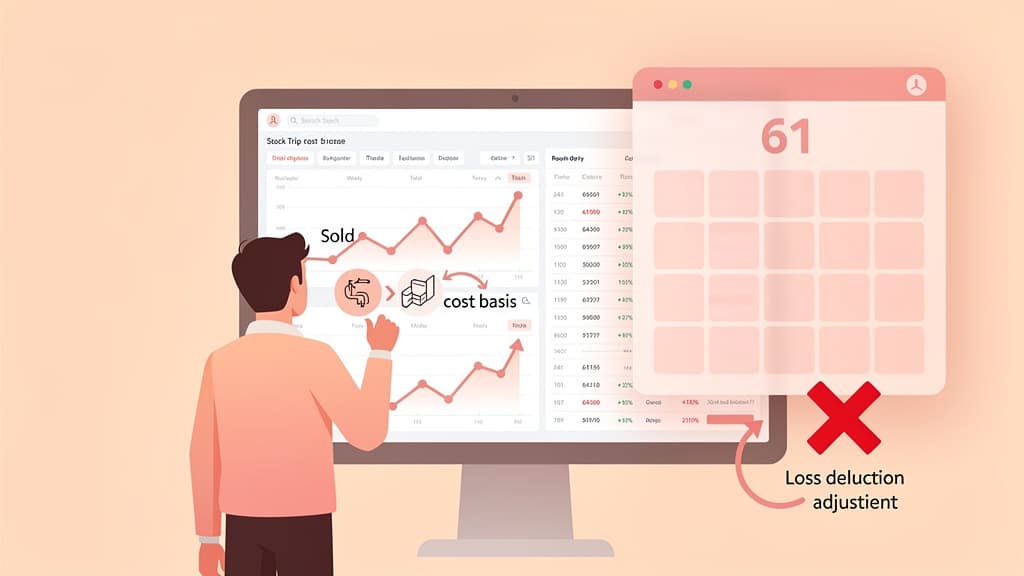
Tax loss harvesting is selling an investment for less than you paid so the realized loss cancels capital gains on your 2026 return, then deducts up to $3,000 of ordinary income ($1,500 if married filing separately), with the rest carried forward to later years with no expiration date (IRC §1211(b) and §1212(b)). For the loss to count in 2026, the sale needs a trade date no later than Thursday, December 31, 2026, the last trading day of the year. You can reinvest the cash the same day in a similar fund, but buying the same or a substantially identical security within 30 days before or after the sale cancels the loss under the wash sale rule.
Key takeaways:
Losses net in a fixed order on Schedule D: short-term against short-term (line 7), long-term against long-term (line 15), then across (line 16). Only a net loss reaches the $3,000 deduction on line 21
Unused losses carry forward indefinitely and keep their character; the $3,000 deduction uses up short-term losses first (Publication 550)
In the 2026 24% bracket, $10,000 of harvested loss is worth $2,400 against short-term gains and $1,500 against long-term gains. Against long-term gains in the 0% bracket it is worth nothing
The trade date controls: a sale on December 31, 2026 that settles in January is a 2026 loss
Capital losses do not reduce self-employment tax, and crypto held directly is outside the wash sale rule under current law (November 24, 2026)
Tax loss harvesting is an investing tactic that turns a paper loss in a taxable brokerage account into a realized capital loss, which then lowers the tax on gains you took during the year. The loss exists only once you sell; a fund that is down 30% but still in your account does nothing for your return.
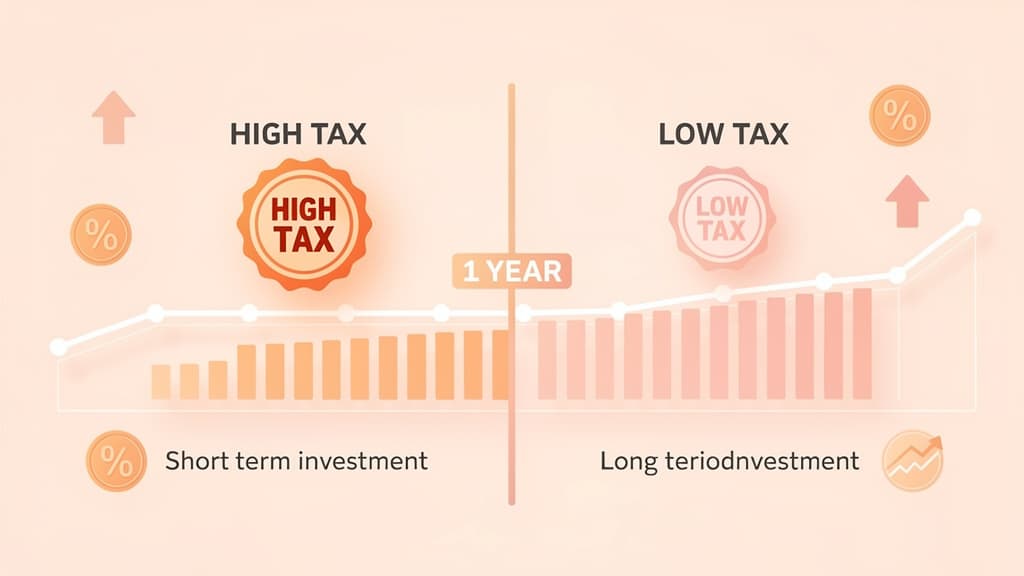
IRC §1222 splits every gain and loss in two. Short-term means the asset was held one year or less, and those gains are taxed at ordinary rates of 10% to 37% in 2026. Long-term means more than one year, taxed at 0%, 15%, or 20% under the breakpoints in Rev. Proc. 2025-32.
Harvesting is mostly a deferral, because the replacement you buy has a lower cost basis and the avoided gain can return when you sell it. The saving becomes permanent when the loss cancels gains taxed at a higher rate than the later gain will be, when the $3,000 deduction comes out of ordinary income, or when the replacement is never sold because it passes to heirs with a basis reset to market value at death (IRC §1014).
Schedule D (Form 1040) runs every loss through a set order, and the order decides what the loss is worth.
Step
What happens
Line on the 2025 and 2026 Schedule D
1
Short-term losses offset short-term gains
Part I, line 7
2
Long-term losses offset long-term gains, including fund capital gain distributions
Part II, line 15
3
A net loss in one part offsets a net gain in the other
Part III, line 16
4
A net loss deducts up to $3,000 ($1,500 married filing separately) from ordinary income
Line 21, then Form 1040 line 7a
5
The rest carries to next year as short-term or long-term loss
Capital Loss Carryover Worksheet, then next year's lines 6 and 14
The 2026 draft Schedule D keeps these line numbers.
Steps 1 and 2 make the holding period of the loser matter. Take someone in the 24% bracket with $6,000 of short-term gains and $9,000 of long-term gains who harvests an $8,000 loss:
Loss harvested
What it cancels
Federal tax saved
$8,000 short-term
All $6,000 of short-term gains (24%) and $2,000 of long-term gains (15%)
$1,740
$8,000 long-term
$8,000 of long-term gains (15%)
$1,200
The short-term loss is worth $540 more because it reaches the gains taxed at the ordinary rate first. When a loss exceeds all your gains combined, its character no longer changes this year's tax and only decides whether the carryover is short-term or long-term.
A harvested loss is worth the tax rate on whatever it cancels. The table prices $10,000 of loss in each 2026 federal bracket, assuming the amounts stay inside one bracket.
2026 bracket (single / married filing jointly taxable income)
Against short-term gains
Against long-term gains
$3,000 against ordinary income
10% (up to $12,400 / $24,800)
$1,000
$0
$300
12% (up to $50,400 / $100,800)
$1,200
$0
$360
22% (up to $105,700 / $211,400)
$2,200
$1,500
$660
24% (up to $201,775 / $403,550)
$2,400
$1,500
$720
24% with MAGI over $200,000 / $250,000
$2,780
$1,880
$720
32% (up to $256,225 / $512,450)
$3,580
$1,880
$960
35%, taxable income up to $545,500 / $613,700
$3,880
$1,880
$1,050
35%, above those amounts
$3,880
$2,380
$1,050
37% (over $640,600 / $768,700)
$4,080
$2,380
$1,110
The 0% long-term rate covers taxable income up to $49,450 single and $98,900 joint, so the top $950 (single) or $1,900 (joint) of the 12% bracket already sits in the 15% zone. The higher rows add the 3.8% net investment income tax (IRC §1411), which applies to the smaller of net investment income or MAGI above $200,000 single and $250,000 joint, thresholds that are not indexed. A net capital loss also flows into Form 8960 line 5a, so the $3,000 piece can trim NIIT by up to $114 if you have other investment income. To estimate the gains themselves with state tax, use the capital gains tax calculator.
What would harvesting this loss save on your 2026 return?
Enter the gains you have already realized this year, the loss sitting in your account, and your bracket. The netting runs in the Schedule D order.
$
Net, from sales of assets held one year or less.
$
Held more than one year, plus fund capital gain distributions.
$
Cost basis minus today's value of the losing position.
Federal tax saved on your 2026 return
$3,510
About 18¢ per dollar of loss this year, with the rest carried to 2027.
Tax on these gains without harvesting$2,790
Loss absorbed by short-term gains$6,000
Loss absorbed by long-term gains$9,000
Deducted from ordinary income (Schedule D line 21)$3,000
Carried forward to 2027$2,000 short-term
The $2,000 short-term carryover goes on your 2027 Schedule D (line 6) and keeps its character until it is used up. There is no expiration date.
Federal estimate for tax year 2026 (Rev. Proc. 2025-32 rates, IRC §1211(b) and §1212(b)). One marginal rate per bracket: a large harvest that drops you into a lower bracket is not modeled. The $3,000 deduction is $1,500 if married filing separately and cannot exceed your taxable income. Not counted: state tax, the QBI deduction cap for business owners, and the up to $114 of NIIT the $3,000 piece can save if you have other investment income. A repurchase of the same or a substantially identical security within 30 days cancels the loss.
Hana is a single product designer whose salary leaves her $120,000 of taxable income in 2026 before her investment sales. In the spring she sold shares bought in January for a $6,000 short-term gain, and in the summer she sold an index fund held since 2021 for a $9,000 long-term gain. A software stock she bought in March 2026 for $32,000 is worth $12,000 in December: a $20,000 short-term loss she has not realized yet.
She sells the stock on Friday, December 11, 2026 and buys a broad technology sector ETF the same day, which keeps her in the sector without buying a substantially identical security.
Schedule D line
Without the harvest
With the harvest
Line 7, net short-term
$6,000
($14,000)
Line 15, net long-term
$9,000
$9,000
Line 16, total
$15,000
($5,000)
Line 21, deduction against ordinary income
$0
($3,000)
Carryover to 2027
$0
$2,000 short-term
Without the harvest, her gains cost $1,440 at 24% plus $1,350 at 15%, or $2,790. With it, the gains disappear and the $3,000 deduction saves another $720. Total federal saving for 2026: $3,510, about 18 cents per dollar of loss, plus a $2,000 short-term carryover for line 6 of her 2027 Schedule D. Running her full return through the 2026 rate schedule gives the same answer: tax on $126,000 of ordinary income plus $9,000 of long-term gain is $24,188, and tax on $117,000 after the harvest is $20,678. The Schedule D guide walks through the Capital Loss Carryover Worksheet behind the $2,000, and the tool above opens on her numbers.
Her wash sale window runs from November 11, 2026 to January 10, 2027. The first safe date to buy the original stock back is Monday, January 11, 2027, and no dividend reinvestment or IRA purchase of that stock can land inside the window.
The last day to harvest a 2026 loss is Thursday, December 31, 2026. The NYSE is open that day; it closes early at 1:00 p.m. ET on Thursday, December 24, and is closed on Friday, December 25 and on New Year's Day, Friday, January 1, 2027.
The trade date is what counts. Publication 550's example is stock sold on December 31 whose sale settles in January: the gain or loss belongs to the year of the trade. Since May 28, 2024, most U.S. securities trades settle one business day after the trade (T+1, per the SEC), which moves the cash and leaves the tax year alone. An order that does not fill on December 31 can only execute in 2027, and the next trading day is Monday, January 4, 2027.
December is the deadline, and often a worse time than the moment a position falls. A loss that shows up in a spring sell-off can be gone by year end, and the wash sale clock works the same way in any month.
IRC §1091 disallows a loss if, within 30 days before or after the sale, you buy substantially identical stock or securities, acquire them in a fully taxable trade, or enter into a contract or option to buy them. The disallowed loss is added to the replacement shares' basis and their holding period includes the old one, so the deduction is postponed. Our wash sale rule guide has the 61-day window dates for late 2026 and a checker.
Publication 550 counts a purchase by your spouse or by a corporation you control, and a purchase in your IRA or Roth IRA. Under Rev. Rul. 2008-5 the IRA version is the worst case: the loss is disallowed and the IRA's basis does not increase, so the loss is gone for good. Brokers flag a wash sale in box 1g of Form 1099-B only when the replacement has the same CUSIP and sits in the same account, so a rebuy anywhere else is yours to catch.
"Substantially identical" has no bright-line test. Publication 550 says to weigh all the facts and circumstances and that stock of one corporation is ordinarily not substantially identical to stock of another. Options on the same stock clearly count. Two funds tracking the same index are a gray area with no IRS ruling on point, while moving from an S&P 500 fund to a total stock market fund, or from one company to a sector ETF, is the standard swap.
Yes, and under current law with fewer limits. Section 1091 covers "stock or securities," and the Joint Committee on Taxation wrote in September 2026 that digital assets are not expressly within its scope and that the IRS has issued no guidance applying the rule to them (JCX-47-26). As of November 24, 2026, selling a coin at a loss and buying it back the next day keeps the loss. Tokenized securities are the exception: the Schedule D instructions apply the wash sale rules to digital assets that are also stock or securities.
That could change for this year's trades. H.R. 10357, the Digital Asset Tax Certainty Act, would extend §1091 to traded digital assets, and the version the Ways and Means Committee approved 38 to 5 on September 16, 2026 reaches dispositions after September 14, 2026 (JCX-50-26). Congress.gov shows no later action as of November 24, 2026. Waiting 31 days to rebuy, or moving into a coin that is not economically equivalent, keeps the loss under current law and under the bill as drafted.
For 2026 sales, U.S. crypto brokers report gross proceeds on Form 1099-DA and must add basis only for covered assets: coins acquired after 2025 in an account where the broker provides custody (2026 Instructions for Form 1099-DA). Older or transferred-in coins arrive without basis, so the loss you claim rests on your own records. The Form 1099-DA guide shows which Form 8949 box each sale goes in.
In a low-income year the better move can be the reverse: sell winners on purpose to realize long-term gains at 0%. The wash sale rule covers only losses, so you can buy the same fund back right away at a higher basis.
Arjun and Bao file jointly and expect $62,000 of 2026 taxable income because Arjun's new business is in its first year. With the 0% rate covering taxable income up to $98,900, they can realize $36,900 of long-term gains for $0 of federal tax. Sold later in the 15% bracket, the same gain would cost $5,535. The cautions: the gain raises AGI, which can shrink AGI-based credits and deductions; California and other states that tax gains as ordinary income still tax it; and short-term gains or extra income eat the 0% room dollar for dollar. For 2027 the 0% band rises to $102,100 joint and $51,050 single (Rev. Proc. 2026-35).
Publication 550 treats a mutual fund's capital gain distributions as long-term gains however long you owned the fund; they appear in Form 1099-DIV box 2a and go on Schedule D line 13 or straight to Form 1040 line 7a. A distribution paid in December is a gain your harvested losses can offset, and buying a fund just before it pays one hands you a taxable gain on money you just invested.
A special rule catches quick round trips. If you hold fund or REIT shares six months or less, receive a capital gain distribution, and then sell at a loss, the loss is long-term up to the amount of the distribution (IRC §852(b)(4)). A reinvested distribution also counts as a purchase for the wash sale rule if you sold shares of the same fund at a loss within 30 days.
Robo-advisers harvest by swapping between funds that track different indexes, and direct indexing accounts hold an index's individual stocks and sell the losers one by one, so both can harvest all year. Neither sees your IRA, your spouse's account, or a fund you buy elsewhere, and the wash sale rule counts all of them. Weigh the account fee against the values in the bracket table.
A harvested loss lowers income tax only. Net earnings from self-employment exclude gain or loss from capital assets (IRC §1402(a)(3)(A)), so Schedule SE stays the same. Capital gains and losses are also excluded from qualified business income (IRC §199A(c)(3)(B)(i)).
The QBI deduction can still move. IRC §199A(a) caps it at 20% of taxable income minus net capital gain, and short-term gains and the $3,000 deduction both sit inside that figure. Had Hana earned her income as a sole proprietor with no other income and the standard deduction, that cap would limit her QBI deduction, and the harvest would cut it by 20% × ($6,000 + $3,000) = $1,800. At 24% that costs $432, so her federal saving would be $3,078. The tool does not model this.
Business property follows other rules. Equipment, vehicles, and real estate used in a business and held more than a year are §1231 property: a net §1231 loss is fully ordinary with no $3,000 cap, and a net §1231 gain is long-term capital gain except to the extent of net §1231 losses from the five prior years, which are recaptured as ordinary income (IRC §1231(a) and (c)). Those sales go on Form 4797. Stock originally issued to you by a qualifying small corporation can produce an ordinary loss of up to $50,000 a year, or $100,000 on a joint return (IRC §1244).
If you pay quarterly estimates, the fourth 2026 payment is due January 15, 2027, and the 2026 Form 1040-ES lets you skip it if you file by February 1, 2027 and pay in full. A December harvest lowers the tax that payment has to cover. In conversations with small business owners while building Jupid, the harvest is easier to size once the year's business profit is already known, because that profit sets the bracket.
A harvested loss can lower state income tax as well. California taxes capital gains as ordinary income and limits the capital loss deduction to $3,000 ($1,500 married or RDP filing separately) on Schedule D (540) line 9.
If Hana lived in California, her income would fall in the 9.3% bracket, which runs from $75,197 to $384,109 of 2026 California taxable income for single filers (FTB 2026 tax rate schedules). Her loss would cancel $15,000 of gains and deduct $3,000, about $18,000 × 9.3% = $1,674 of extra state saving. California has no lower long-term rate, so a short-term and a long-term loss are worth the same at the state level.
Retirement and tax-advantaged accounts. Losses inside an IRA, 401(k), HSA, or 529 plan are not deductible.
Long-term gains in the 0% bracket. A loss that cancels gains already taxed at 0% saves nothing, and the netting order gives you no way to skip them; gain harvesting may fit better.
Small positions. A $500 loss used against ordinary income in the 12% bracket saves $60, which a bid-ask spread, a fee, or weeks out of the market can exceed.
A higher rate later. If you expect to sell the replacement in a higher bracket than today's, the extra gain from the lower basis can cost more than the harvest saved.
Rebuying in an IRA within 30 days. Rev. Rul. 2008-5 makes that loss permanent, and no 1099-B flags it.
Leaving an order to fill on December 31. A limit order that misses executes on Monday, January 4, 2027 at the earliest, in the wrong tax year.
Letting the broker pick the shares. Publication 550 makes you use the oldest shares first when you cannot adequately identify the shares sold, and those may be a gain lot. Choose specific lots at the sale.
Dropping the carryover next year. The worksheet result goes on lines 6 and 14 of the 2027 Schedule D, and Publication 550 counts the allowable deduction against the carryover whether or not you claimed it.
Jupid keeps the business side of your return current while you work on the investment side; it does not trade or harvest losses for you. Jupid connects to your bank accounts and categorizes business transactions automatically with 95.9% accuracy, so by December you know roughly what your Schedule C profit and your bracket look like, which is the number the harvest table depends on. You can ask the AI accountant in WhatsApp or iMessage how a $3,000 capital loss deduction changes this year's estimate and get an answer in real time. Try Jupid
Download the 2026 realized gain and loss report from every taxable brokerage and crypto account
List each losing lot with its purchase date and mark it short-term or long-term
Check the last 30 days of purchases in your accounts, your spouse's, and every IRA, and turn off dividend reinvestment on the positions you plan to sell
Sell with a trade date no later than Thursday, December 31, 2026, choosing specific lots
Buy a replacement that is not substantially identical, or set a reminder for day 31 after the sale
In early 2027, compare your trade confirmations with box 1g of each 2026 Form 1099-B
Reviewed November 24, 2026 against Publication 550 (2025), the 2025 Schedule D and its instructions, the 2026 draft Schedule D, Rev. Proc. 2025-32, and the status of H.R. 10357 on congress.gov. Worked examples are illustrative and use federal rates for tax year 2026. This guide is general education, not tax, legal, or investment advice. For advice on your situation, consult a qualified tax professional.
Fintech CEO with 10+ years building accounting and financial technology products. Previously co-founded and scaled an AI-powered accounting platform to $30M revenue and 100K+ business users, achieving 30,000 customers per accountant through automation — recognized by CNBC as a top fintech company. Holds a Master's in Management Information Systems. At Jupid, he leads the development of AI-native bookkeeping, tax, and compliance tools designed for freelancers and small business owners.