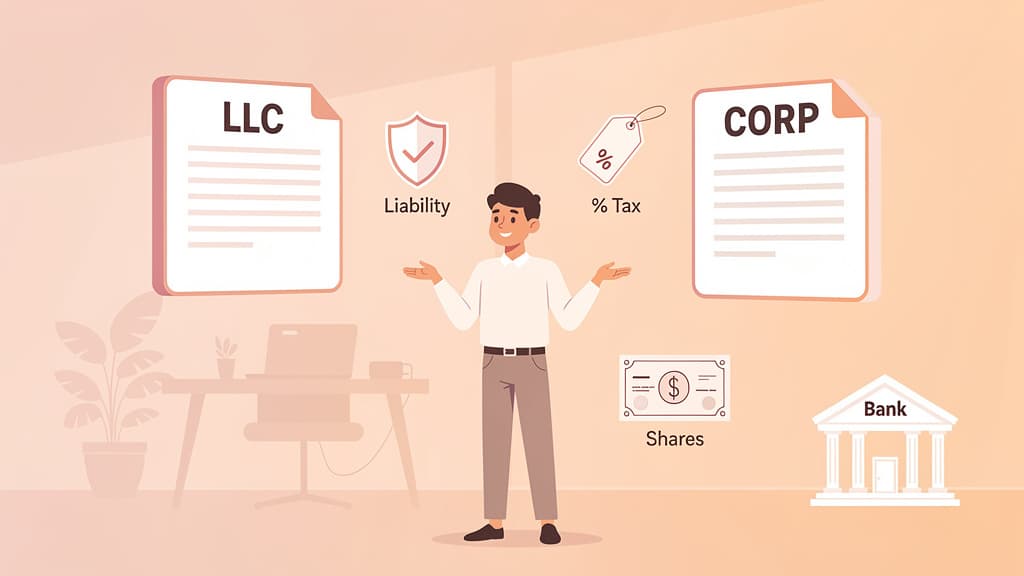
An LLC and a corporation protect your personal assets equally — the real differences are tax and capital. A default LLC passes profit through to your personal return once, keeps the permanent 20% QBI deduction, and pays 15.3% self-employment tax on net profit. A C corporation pays a flat 21% at the entity level, then dividends are taxed again on your return, with no QBI deduction. Form an LLC if customers fund your business; form a C corporation if investors do.
Key takeaways:
- Form an LLC if you're a freelancer, consultant, agency, or e-commerce seller funded by your own revenue: one layer of tax, the 20% QBI deduction, minimal formalities
- Form a C corporation if you're raising venture capital, issuing stock options, or reinvesting most profits for years (retained earnings taxed at the flat 21%)
- The S corp is not a third entity type — it's a tax election either an LLC or a corporation can make once profits justify it
- Conversion is one-way cheap: LLC → corporation is a routine, usually tax-free step before a funding round; corporation → LLC triggers liquidation tax
- 2025-2026 rule changes: federal BOI reporting is switched off for US-formed companies, the QBI deduction is permanent, and the Texas franchise-tax threshold is $2.65M for 2026 reports
A note from experience: at Anna Money, where we served 60,000+ small businesses in the UK, most owners either over-engineered their structure on day one or never revisited it as the business grew. When I started Jupid, I formed an LLC first and added complexity only when the numbers justified it. That order of operations is right for the vast majority of small businesses, and wrong for a specific minority. This guide will help you figure out which group you're in.
Here's the difference between an LLC and a corporation across the factors that actually drive the decision:
| Factor | LLC (default taxation) | C Corporation | S Corp Election (LLC or corp) |
|---|
| What it is | Legal entity | Legal entity | Federal tax status, not an entity |
| Federal income tax | Pass-through to owners | Flat 21% at the entity, dividends taxed again | Pass-through via Schedule K-1 |
| Self-employment / payroll tax | 15.3% SE tax on all net profit | Payroll tax on salaries only | Payroll tax on required salary; distributions skip FICA |
| QBI deduction (20%) | Yes | No | Yes, on pass-through income |
| Owners | Unlimited members; people, funds, or other companies | Unlimited shareholders, multiple stock classes | Max 100 shareholders, US individuals, one stock class |
| Raising VC money | Difficult; most funds won't invest in LLCs | The standard; preferred by every VC | Not compatible with VC ownership rules |
| Stock options for employees | Awkward (profits interests) | Standard option pools | Limited by one-class-of-stock rule |
| Annual formalities | Minimal; no board or required meetings | Board, bylaws, minutes, annual meetings | Same as the underlying entity, plus payroll |
| Tax filing | Schedule C (single-member) or Form 1065 | Form 1120 | Form 1120-S + K-1s |
If you read nothing else: taxation and fundraising are the two forks in the road. Liability protection, which gets most of the attention, is roughly equivalent.
A limited liability company is a state-level legal entity that separates your business from your personal assets. If the business is sued or can't pay its debts, creditors generally can't reach your house or savings, as long as you keep finances separate and don't sign personal guarantees.
The IRS doesn't have an "LLC" tax category. By default, a single-member LLC is a disregarded entity (you report profit on Schedule C of your personal return), and a multi-member LLC is taxed as a partnership (Form 1065). Either way, profit passes through and is taxed once, at your personal rate. The IRS business structures page covers the default classifications.
What that means in practice:
- One layer of tax. Profit lands on your personal return whether you withdraw it or not.
- Self-employment tax on everything. All net profit is hit with 15.3% SE tax (12.4% Social Security up to the annual wage base, 2.9% Medicare with no cap).
- The 20% QBI deduction. Pass-through owners can deduct up to 20% of qualified business income under IRC §199A. The One Big Beautiful Bill Act of 2025 made this deduction permanent, which removed the biggest long-term tax argument against pass-through structures. See our LLC tax benefits guide for the full list.
- Almost no formalities. No board, no required annual meetings, no minutes. You file your state's annual or biennial report and keep your operating agreement current.
If you're currently a sole proprietor and wondering whether an LLC is worth it at all, start with our sole proprietorship vs LLC comparison.
When people compare "LLC vs Inc.", the "Inc." is a C corporation, the default form of corporation in every state. It's a fully separate legal and tax entity: the corporation earns income, files its own return (Form 1120), and pays its own tax.
The federal corporate rate is a flat 21%, set by the Tax Cuts and Jobs Act and codified in IRC §11 (IRS: corporations). That sounds attractive next to top personal rates, but there's a catch: the money is still inside the corporation. To get it into your pocket as an owner, the corporation pays you a salary (deductible, taxed as wages) or a dividend (not deductible, taxed again on your personal return). That second layer is the famous double taxation.
What corporations do better than LLCs:
- Stock. Corporations issue shares, which are easy to split, sell, option, and vest. This is the plumbing every startup equity arrangement runs on.
- Multiple share classes. Preferred stock for investors, common for founders and employees. LLCs can imitate this with custom operating agreements, but it's bespoke legal work instead of a standard template.
- Investor compatibility. Venture funds have tax reasons (their own LP structures) to avoid pass-through entities. A Delaware C corp is the default container for venture-backed companies, full stop.
- Retained earnings at 21%. If you reinvest profit rather than distribute it, the C corp's flat rate can beat personal rates for high earners.
- QSBS potential. Stock in a qualifying C corp held long enough may allow founders to exclude a large share of capital gains at exit under IRC §1202. This is a genuinely big deal for startup founders and doesn't exist for LLC interests.
What they cost you: corporate formalities (board, bylaws, annual meetings, minutes), a separate corporate tax return, no QBI deduction, and double taxation on profits you pull out as dividends.
This trips up almost everyone. You don't form an S corp. You form an LLC or a corporation, then file Form 2553 with the IRS to elect S corporation tax treatment.
The election keeps pass-through taxation but changes how self-employment tax works: you pay yourself a reasonable W-2 salary (subject to payroll taxes), and remaining profit flows to you as distributions that skip the 15.3% FICA hit. For a business clearing $60,000+ in consistent profit, that typically saves real money; below that, payroll and tax-prep costs eat the savings.
The trade-offs: required payroll, a separate Form 1120-S return, ownership restrictions (max 100 shareholders, US individuals only, one class of stock), and IRS scrutiny of lowball salaries. We've written a complete breakdown with worked math at every income level in our S corp vs LLC guide.
The key insight for this article: the S corp election is available to LLCs. You don't need to incorporate to get S corp tax savings. That removes the most common bad reason small business owners form corporations.
Let's make double taxation concrete. Say your business earns $100,000 in net profit and you want the cash personally.
As a default LLC (single owner, single filer, ignoring state tax):
- Self-employment tax: $100,000 × 92.35% × 15.3% ≈ $14,130
- The profit, minus half the SE tax and the QBI deduction, is taxed at your personal rates
- Total federal hit: roughly $26,000–27,000 depending on your situation
As a C corporation distributing everything as dividends:
- Corporate tax: $100,000 × 21% = $21,000
- Remaining $79,000 paid as a qualified dividend, taxed at 15% for most owners: $11,850
- Total federal hit: $32,850, and more if the 3.8% net investment income tax applies
For an owner who takes the profits home, the C corp loses. The C corp only wins when profit stays in the company: $100,000 reinvested costs $21,000 in tax inside a C corp versus potentially $30,000+ passed through to a high-bracket owner who never touched the money.
That's the honest framing: LLCs (and S corps) are built for owners who take profits out. C corps are built for owners who leave profits in or sell equity.
Liability protection is essentially a tie. Both structures shield personal assets if you respect the entity: separate bank account, no commingling funds, contracts signed in the company's name. Courts pierce the veil of sloppy LLCs and sloppy corporations alike. (This is one of the quiet reasons clean bookkeeping matters more than founders think; mixed personal and business transactions are Exhibit A in veil-piercing cases.)
Compliance burden is not a tie. A corporation must maintain bylaws, hold and document annual shareholder and board meetings, and keep minutes, on top of its own federal tax return. An LLC files its state report and its tax forms, and that's mostly it. If you're a one-person business, every hour spent on corporate formalities is an hour of pure overhead. Keep an eye on dates either way; our LLC tax deadlines guide lists the federal and state ones that matter.
Whichever you pick, you'll need an EIN before opening a bank account or filing returns; here's how Form SS-4 works.
Maria, freelance UX designer, ~$85,000 profit. No investors, no employees, profits go to her checking account. An LLC is the obvious call: liability protection, one layer of tax, QBI deduction, minimal admin. Once her profit holds steady above $60K–70K, an S corp election on top of the LLC likely saves her $3,000–5,000 a year in FICA.
Dev and Priya, two-person agency, ~$300,000 profit split between them. Multi-member LLC taxed as a partnership, then an S corp election once they're comfortable running payroll. A C corp would cost them five figures a year in double taxation for zero benefit; they have no plans to raise money or grant equity.
Sam, building a fintech app, raising a pre-seed round. Delaware C corporation from day one. Investors require it, the option pool needs real stock, and QSBS could make the first ~$10M+ of exit gains federally tax-free if the requirements are met. The double-taxation math is irrelevant because the company won't distribute profits for years.
Lena, e-commerce brand, $1.2M revenue, reinvesting heavily. Edge case. If she's pulling little money out and stacking inventory and ad spend, retained earnings at the 21% corporate rate can beat pass-through tax at her bracket. But the moment she wants the cash personally, the second layer of tax shows up. Most owners in her shoes still pick LLC + S corp election for flexibility, but it's worth modeling both with a CPA.
The pattern: the C corp is a specialist's tool for equity-funded growth. The LLC is the general-purpose vehicle for everyone else.
Texas is one of the friendliest states in the country to form a business in, and notably, it treats LLCs and corporations almost identically on cost.
Formation: Filing a certificate of formation costs $300 for either an LLC (Form 205) or a for-profit corporation (Form 201), per the Texas Secretary of State fee schedule.
No state income tax. Texas has no personal income tax, so LLC and S corp pass-through profit faces zero state income tax. That makes pass-through structures even more attractive in Texas than the federal math alone suggests.
The franchise tax applies to both. Texas levies a franchise (margin) tax on LLCs and corporations alike, administered by the Texas Comptroller. The current rates are 0.375% for retail and wholesale businesses and 0.75% for everyone else, applied to taxable margin, not gross revenue.
Most small businesses owe nothing. The no-tax-due threshold is $2.65 million in annualized revenue for 2026 reports (Comptroller, 2026 franchise tax forms), up from $2.47 million in 2024–2025. If you're under it, you owe no franchise tax and no longer have to file a No Tax Due Report, but you must still file a Public Information Report (PIR) or Ownership Information Report (OIR) each year. Plenty of Texas owners miss that and end up with a forfeited entity.
Texas verdict: since the state taxes LLCs and corporations the same way, the choice comes down purely to the federal and fundraising factors above. For most Texas small businesses, that means an LLC. Step-by-step formation instructions are in our guide to starting an LLC in Texas.
California is the opposite of Texas: structure choice changes your state tax bill, and the minimums are real money.
The $800 floor. Every LLC doing business in California owes a minimum $800 annual franchise tax, profitable or not, starting in year one. The first-year exemption (AB 85) only covered LLCs formed in 2021–2023 and has expired (California FTB, LLCs). Corporations get one break LLCs don't: a newly incorporated corporation is exempt from the $800 minimum in its first taxable year, though it still pays tax on any net income (California FTB, corporations).
The LLC gross receipts fee is the trap. On top of the $800, California LLCs pay a fee based on total California income (gross, not profit):
| California total income | Annual LLC fee (plus the $800) |
|---|
| $250,000 – $499,999 | $900 |
| $500,000 – $999,999 | $2,500 |
| $1,000,000 – $4,999,999 | $6,000 |
| $5,000,000+ | $11,790 |
Because it's keyed to revenue, a high-volume, low-margin LLC (e-commerce, wholesale) can owe $6,800+ in a year it barely broke even.
Corporation rates. California C corps pay 8.84% of net income; S corps pay 1.5% of net income, each subject to the $800 minimum after year one. Note the comparison: a high-revenue, low-profit business might actually pay less as an S corp (1.5% of slim profits) than as an LLC (fee on gross receipts). This is a California-specific quirk worth modeling before you default to the LLC.
Other CA gotchas:
- "Doing business" reaches across state lines. Formed in Nevada or Delaware but living in or operating from California? You must register as a foreign entity and pay the $800 minimum anyway. The Delaware-LLC-to-dodge-California-tax trick does not work.
- Statement of Information: corporations file annually, LLCs every two years; missing it triggers a $250 penalty.
- The $800 is due even in years with zero activity, until you formally dissolve.
California verdict: the LLC is still right for most small businesses, but check the gross receipts fee against the S corp's 1.5% before deciding, and budget the $800 from day one. Our guide to starting an LLC in California walks through the filings.
Structure isn't permanent, and the conversion paths are asymmetric:
- LLC → C corporation: straightforward. Texas and California both allow statutory conversion (one filing converts the entity in place), and the IRS generally treats it as a tax-free incorporation under IRC §351. Startups do this routinely right before a priced funding round; investors' counsel handles it as standard paperwork.
- LLC → S corp taxation: no conversion at all. File Form 2553 and keep your LLC. An LLC can also elect C corp taxation with Form 8832 without changing its legal form.
- C corporation → LLC: painful. The IRS treats it as a liquidation, which can trigger tax at both the corporate and shareholder level on appreciated assets. This is the strongest argument for not incorporating "just in case."
The practical rule: start as simple as your funding plans allow, because complexity is easy to add and expensive to remove.
If you researched this topic in 2024, every article warned about Corporate Transparency Act beneficial ownership (BOI) filings with FinCEN. That requirement is gone for domestic companies. In March 2025, FinCEN issued an interim final rule that removed the BOI reporting requirement for all US-formed companies and US persons; only foreign entities registered to do business in the US still report (FinCEN announcement).
So neither a new Texas LLC nor a California corporation owes FinCEN a BOI report today. One caveat: a few states are building their own ownership-disclosure regimes (New York's LLC Transparency Act is the prominent example), so check your state's rules if you form outside Texas or California.
The entity choice takes a week. Living with it takes years, and both structures only protect you if business and personal finances stay cleanly separated, every transaction is categorized, and you can actually see your profit when the S corp question comes up.
That's the part Jupid handles. Connect your business bank account and Jupid's AI accountant categorizes transactions automatically with 95.9% accuracy, keeps business and personal spending separated, and answers questions over WhatsApp or iMessage like you'd text your accountant:
- "What's my net profit this year so far?"
- "Am I at the point where an S corp election would save me money?"
- "How much did I spend on contractors last quarter?"
Clean books from day one mean your liability protection holds up, your tax filings match reality, and you'll know exactly when your profit justifies a structure change instead of guessing.
Get started with Jupid
- LLC and corporation offer the same personal asset protection. The decision is about tax and capital, not safety.
- Default to the LLC if your business is funded by customers rather than investors. One layer of tax, the permanent 20% QBI deduction, minimal formalities, and the S corp election available when profits grow.
- Choose the C corporation when outside equity is the plan: VC funding, employee stock options, QSBS at exit, or years of reinvested profit at the 21% rate.
- In Texas, the state is neutral: $300 to form either, no income tax, and no franchise tax until ~$2.65M in revenue (file the PIR regardless).
- In California, run the numbers: the $800 minimum hits everyone, LLC fees scale with gross revenue, and S corps pay 1.5% of net income, which sometimes flips the answer.
- LLC to corporation is cheap to do later. Corporation to LLC is not. When uncertain, take the simpler structure first.