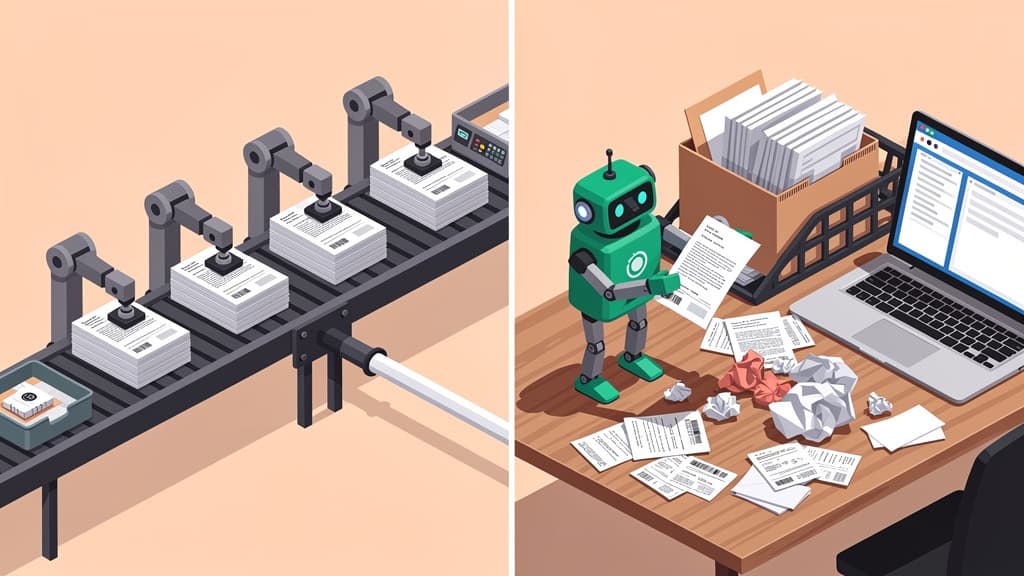
In 2026, nearly every AI agent marketed to accounting firms is a back-office agent: it runs inside the firm, on data the firm already holds, closing the books, categorizing transactions, extracting figures, or drafting the next document request. None of them stands on the client's side to find the documents that never arrived, which is where most of a return's calendar time is lost. Two axes, where an agent runs and what it touches, expose the one quadrant nobody has claimed.
Key takeaways:
Sort every agent by two questions: where does it run (inside your firm, or on the client's side) and what does it do about documents (asks for them, finds them, or works only after they arrive)
The 2026 agent rush is almost entirely back office: close agents (FloQast, Double), read-after-arrival extraction (Liscio, TaxDome auto-rename), and intake agents that automate the asking (Canopy Coworker, in beta; Soraban)
Every one of them either presupposes the documents already arrived or automates asking for them again
The empty quadrant is a client-side agent: one that runs on the client's side and does the finding, which is exactly where the weeks of delay live
Compliance posture flips on which side the agent stands: a back-office agent touching client-identifiable data is a §7216 preparer-disclosure question; a client-side agent works on the client's own data under the client's own approval, before it reaches the preparer
An AI agent is software that takes multi-step actions toward a goal and checks in for approval, as distinct from a chatbot, which only answers the question in front of it. A chatbot drafts an email when you ask; an agent reads the prior-year return, decides which documents are missing, drafts the requests, and queues them for a human to release. The 2026 sales pitch across the profession leans on that distinction, and most of it is earned. The agents shipping to firms this year do real, bounded work that used to eat junior hours.
The question a firm owner has to ask underneath the pitch is narrower than "is this agent good." It is "which part of my problem does this agent touch." That is where the two axes come in, and where most of the market turns out to be crowded into a single corner.
Nearly every agent a firm can buy today runs inside the firm's own systems, on data the firm already possesses. The rush is not limited to software vendors, either: the same automate-the-production thesis is pulling in AI-native buyers who acquire accounting firms outright. Three families cover the field. For the full vendor-by-vendor map of the collection tools around them, our guide to client document collection software goes deeper than this section can.
FloQast, a close-management platform, ships an AI agent builder with prebuilt agents for the month-end close: on its own site FloQast describes a reconciliation agent that matches transactions across sources, a task agent that handles checklist work, and a journal-entry agent that drafts and posts entries, all aimed at what it calls a continuous close. Double, formerly Keeper, now leads with month-end-close AI that works "with the complete context of your ledger." These agents are impressive and entirely downstream: every figure they touch came from a document that already arrived. They are the loudest part of the agent rush and they sit off the document-collection problem completely. If you want the tool-by-tool comparison of that category, our best AI bookkeeping tools guide covers it; here they matter only as proof that the rush is a back-office rush.
Liscio, a client-experience platform for firms, markets File Intelligence that reads a document and renames it the instant it is dropped. TaxDome, a practice-management suite, promotes AI auto-renaming meant to end filenames like "4353458223.pdf." Both do genuine work, and both start their clock at the same point: after the client has already found the file and uploaded it. The reading, sorting, and renaming is back-office work on an object that has already crossed the threshold.
The agents closest to the collection problem still work on the firm's side of it. Canopy, a practice-management platform, now has Canopy Coworker in beta and describes it as identifying missing information from prior-year work and suggesting personalized request lists, with a review queue so staff approve items before they execute. Soraban, the closest analog in this space, says it runs the full return workflow from collecting documents to final signature and reports 89% client adoption in year one across more than 350 firms. Both are real and useful. Both automate the request. Soraban's own Collect step, by its description, chases and organizes automatically, which means the client still performs the search. FileInvite is blunt enough to name the pattern outright: its platform layer is literally labeled "Collect & Chase." The tactics that genuinely raise response rates on this side are worth doing, and our guide to getting clients to send documents lays them out. They improve the asking. They do not do the finding.
Put the collection problem on a grid. One axis is where the agent runs: inside your firm, or on the client's side of the request. The other is what it does about a requested document: automate the asking for it, or do the finding of it. Plot the shipping agents and a hole opens up.
Not reachable from here: a firm-side agent cannot open the client's Gmail, Downloads folder, or bank session
Runs on the client's side
A reminder app by another name
Unclaimed: the client-side document agent
Two cells do the explaining. The top-right cell is empty for a structural reason, not a market-timing one: an agent that lives inside your firm has no way to reach a folder that sits on the client's laptop, so it can never do the finding, only the asking. And a client-side agent that merely nags is a reminder app wearing a new label, which puts the bottom-left cell out of contention too. That leaves exactly one quadrant worth claiming, and nobody has.
The close and extraction agents from the last section do not appear on this map at all. They act after collection is finished, so they answer a different question. That is the quiet finding of the 2026 agent rush: the category everyone is buying operates on documents that already showed up.
Two questions sort the 2026 market: where a slow return loses its time, and how long a complete packet takes to arrive.
Start on the client's side: a finding agent
No back-office agent can reach the places the documents hide — a client's Gmail, Downloads folder, or bank session. Your wait lives in the unclaimed quadrant: an agent that runs on the client's side, does the finding, and delivers into the portal you already run.
Compliance posture: a client-side agent works on the client's own data, under the client's own approval, before it reaches the preparer — a different §7216 structure, not an exemption from handling data responsibly.
Verdicts follow the article's two-axis map and its illustrative return timeline (~2 weeks waiting vs ~3 hours of prep — not a benchmark). Vendor capabilities are their own published claims as of mid-2026.
A client-side agent is an AI agent that runs on the client's side of a request and locates the requested documents, as distinct from a back-office agent that works on data the firm already holds. The vocabulary is worth fixing now, because the profession keeps calling both things "an AI agent" and then wondering why buying one never shortens the wait for a client's paperwork.
The mechanism is specific. The firm sends a request. The client approves which sources the agent may look through, a named inbox, the Downloads folder, a bank or Stripe session. The agent searches only those approved sources, assembles candidate files into a packet, and flags gaps such as a missing March statement or a wrong-account file it set aside. The client reviews and approves the packet. The finished packet lands in the firm's existing destination, TaxDome, Canopy, SafeSend, or SharePoint. What was a multi-account scavenger hunt for the client becomes a single review step, and the firm's stack does not change.
That is the quadrant back-office agents cannot enter. The documents are not late because the client is careless. They are late because they live somewhere no firm-side tool can reach: a personal inbox, a platform dashboard behind a login, a Downloads folder that functions as a filing system by accident.
Consider Renata, a partner at a five-person tax firm, tracking one individual return from open to filed. The numbers below are illustrative, not a benchmark, but the shape holds for most firms in season.
Stage of one return
Elapsed time
Which agent helps today
Firm opens the engagement and sends the request
Day 0
Intake agent drafts the request list (back office)
Client hunts across bank, Stripe, HSA provider, prior CPA
Close and extraction agents compress this (back office)
Return prepared, reviewed, sent for signature
Days 15–24
Prep and e-sign tools help (back office)
The three hours of hands-on work attracted three different agents. The fourteen days of waiting attracted none. A firm that buys a close agent to fix a slow filing season is buying speed for the stage that was never the bottleneck. The bottleneck is the two weeks in row two, and it sits in the one quadrant the agent rush skipped.
At Anna Money, where we worked with more than 60,000 small businesses, the categorization was the part we could automate; the residual delay was always the document sitting in an inbox the owner had not opened since last April. Automating the work you already have is easier than reaching the work that has not shown up, which is precisely why the market did the easy part first.
The side an agent runs on is not only an efficiency question. It changes the compliance posture, and IRC §7216 is where that becomes concrete. Section 7216 is a criminal statute that penalizes a tax return preparer who discloses or uses a client's tax return information for a purpose other than preparing the return. Our guide to whether accountants can use ChatGPT walks through the full rule and the 2026 case law behind it.
A back-office agent that ingests client-identifiable tax return information puts the firm squarely on the preparer-disclosure side of that rule. If the agent routes that data to an outside model, the firm has to satisfy itself that the arrangement is not an impermissible third-party disclosure. That is exactly why the serious back-office vendors talk so much about private models, no training on client data, and control environments; our private AI for accountants guide covers how firms handle that exposure.
A client-side agent stands before that line rather than across it. It works on the client's own data, on the client's side, under the client's own approval, and hands the firm a finished packet. A client organizing their own documents is not a "tax return preparer" disclosing to a third party, so the specific disclosure §7216 governs, preparer to outside AI, does not occur, because the finding happens before the data ever reaches the preparer. This does not erase every duty a firm carries once the packet arrives, and the client-side agent still has to handle the client's data responsibly. The structural posture is simply different, and that difference is the point of the quadrant.
The one design pattern the credible agents share, back office or client side, is that a human approves before the agent executes. Canopy describes a review queue where staff approve AI-drafted items before they run. FloQast markets its automation as auditable, with traceable checkpoints. The pattern is not decoration; it is what makes an agent safe to put near real client data and real filings.
A client-side agent inherits the same discipline in its own form: the client approves every source the agent may look through, and the client approves the finished packet before anything moves. Nothing is searched without permission and nothing is sent without a review. When a vendor cannot tell you where the human sits in the loop, that is the answer to whether the agent is ready for your firm.
The honest boundaries matter as much as the pitch, because an agent that promises to erase the chase is selling a fourth reminder with better branding.
It is not a replacement for your portal or practice-management software. It delivers into TaxDome, Canopy, SafeSend, or SharePoint. It is a supply line into the stack you run, not a swap for it.
It does not roam the client's computer on its own. The client approves where it may look, source by source, and unapproved folders stay untouched.
It does not run on its own. The client approves which sources it may search, and nothing is sent without the client approving the packet.
It cannot find a document that was never issued. If a platform never sent a 1099-K because the client fell under the reporting threshold, the fix is a payout report, not a deeper search.
It does not make accounting judgments. The close agents and the humans still do that work; the client-side agent only assembles the inputs.
Paper in a shoebox still needs a person with a scanner. Software cannot find what was never digital.
Buying a close agent to fix a collection delay. The close agent compresses the three hours of prep, not the two weeks of waiting. Match the agent to the stage that is actually slow.
Reading "agentic" as "autonomous." Every serious agent gates on human approval. A pitch that skips the review step is describing a risk, not a feature.
Hearing "chases automatically" as "finds." An intake agent that automates the asking still leaves the client to run the search. Ask which one the vendor means.
Treating a client-side finding agent as a portal to rip and replace. It is the supply line into the portal you already own, which is what keeps the compliance and integration story simple.
Jupid is the client-side agent the map above leaves empty. It does not run in your back office next to your close software. It runs on the client's side, where the missing documents live. Your firm sends a request, the client approves which sources Jupid may look through, Jupid locates the files and assembles a packet, and the client approves that packet before anything is sent. What reaches your side is organized, and it lands in the destination you already use: TaxDome, Canopy, SafeSend, or SharePoint. Jupid runs under SOC 2 controls and adds a supply line to your stack rather than another portal to it. Start with a single recurring request: see the Client Document Agent and book a 30-minute walkthrough.
This guide is for general educational purposes and does not constitute tax, legal, accounting, or security advice. Vendor capabilities and statistics cited above are the vendors' own published claims as of mid-2026, not independent benchmarks, and product availability changes; verify current features and your own §7216 obligations before relying on any tool. For advice specific to your firm's situation, consult a qualified professional.
Fintech CEO with 10+ years building accounting and financial technology products. Previously co-founded and scaled an AI-powered accounting platform to $30M revenue and 100K+ business users, achieving 30,000 customers per accountant through automation — recognized by CNBC as a top fintech company. Holds a Master's in Management Information Systems. At Jupid, he leads the development of AI-native bookkeeping, tax, and compliance tools designed for freelancers and small business owners.