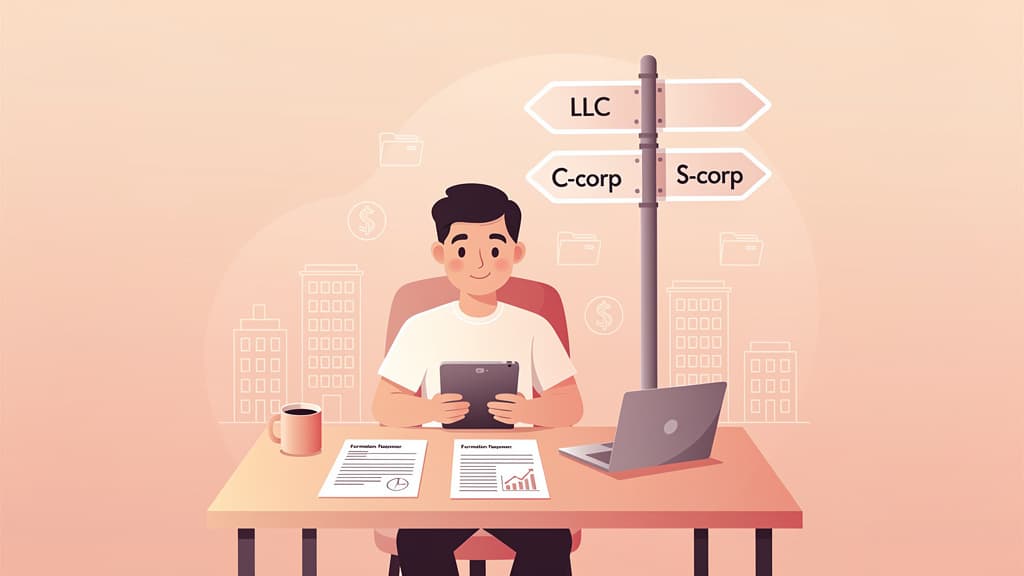
A California LLC pays a minimum of $800 per year in state franchise tax for 2026, and once its total California income reaches $250,000, a gross-receipts fee of $900 to $11,790 is added on top. The Franchise Tax Board (FTB) collects both, the $800 is owed even with zero revenue, and everything is reported on Form 568, the Limited Liability Company Return of Income. Here is the complete 2026 bill, deadline by deadline, with worked examples.
Key takeaways:
Every LLC organized, registered, or doing business in California owes the $800 annual franchise tax, due April 15, 2026 for calendar-year LLCs (pay with voucher FTB 3522)
The LLC fee adds $900 to $11,790 once total California income reaches $250,000, and it is charged on gross receipts plus cost of goods sold, not on profit
The estimated fee (Form 3536) is due June 15, 2026; underestimating costs a 10% penalty unless you pay at least last year's fee
Form 568 for the 2026 tax year is due March 15, 2027 for multi-member LLCs and April 15, 2027 for single-member LLCs
The AB 85 first-year exemption expired: LLCs formed in 2024 or later pay the $800 in year one
California charges LLCs through three separate state obligations, each with its own form, deadline, and penalty. A fourth small filing goes to a different agency entirely.
Obligation
Amount (2026)
Form
Due
Annual franchise tax
$800 flat
FTB 3522
April 15, 2026 (calendar-year LLCs)
LLC fee
$0–$11,790, based on gross receipts
FTB 3536 (estimate), trued up on Form 568
June 15, 2026 estimate; balance with the return
Return of income
No separate tax; reports income and the fee
Form 568
March 15 or April 15, 2027
Statement of Information
$20
SOS Form LLC-12
Every 2 years, to the Secretary of State
These are entity-level charges. The LLC's profit still passes through to the members, who pay California personal income tax on it through California estimated tax payments during the year. Owners weighing California against Texas can compare this bill with our sister guide to the Texas franchise tax, where an LLC owes nothing until $2,650,000 of annualized revenue.
Every LLC that is organized in California, registered with the California Secretary of State, or doing business in California owes the $800 annual tax under Revenue and Taxation Code (R&TC) Section 17941. Profit is irrelevant: an LLC with zero revenue, a dormant LLC, and an LLC that lost money all owe the same $800 every year until the LLC is formally cancelled.
The payment is due the 15th day of the 4th month of the tax year, which is April 15, 2026 for calendar-year LLCs, paid with voucher FTB 3522 or through FTB Web Pay. Note the direction: the $800 you pay in April 2026 covers 2026 itself, not the prior year. The full calendar of state dates is in our California tax deadlines guide.
An LLC formed in Wyoming, Delaware, or anywhere else still owes the $800 and files Form 568 if it is doing business in California under R&TC Section 23101. You are doing business in the state if any of the following applies:
The LLC engages in any transaction for financial gain in California, including through a member, manager, or agent acting in the state on its behalf
The LLC is organized or commercially domiciled in California
California sales, property, or payroll exceed indexed thresholds:
Test (2025 thresholds, the latest the FTB has published)
Doing business if CA amount exceeds
Sales
$757,070 or 25% of total sales
Real and tangible property
$75,707 or 25% of total property
Payroll compensation
$75,707 or 25% of total payroll
The FTB indexes these amounts annually; 2026 figures were not yet posted as of August 2026, so check the FTB's doing-business page before relying on a number near the line. Your distributive share of any partnership's California sales, property, and payroll counts toward your own totals.
In practice the first test catches most people. A Wyoming LLC whose only owner manages it from a Los Angeles apartment is doing business in California, and the FTB actively pursues exactly this pattern. Forming out of state does not remove California obligations; it usually adds a second state's fees on top. If you operate from California, forming the LLC in California is almost always the cheaper structure.
LLCs formed in 2024 or later pay the $800 in their first year. Assembly Bill 85 waived the first-year tax only for LLCs that organized between January 1, 2021 and December 31, 2023, and the Legislature did not extend it. Many guides online still describe the waiver as current; the FTB's own LLC page confirms it ended.
For a new LLC, the first $800 is due by the 15th day of the 4th month after you file Articles of Organization. Form your LLC on July 20, 2026, and the first payment is due October 15, 2026. Form it in October 2026 and you hit the back-to-back trap: the first-year $800 lands January 15, 2027, and the 2027 annual tax follows on April 15, 2027, which means $1,600 to the FTB within three months. If a late-year launch can wait until January, waiting avoids a full year of tax; December filers should read the 15-day rule below.
The LLC fee is a second, separate charge under R&TC Section 17942 that applies on top of the $800 once total California income reaches $250,000:
Total California income (2026)
LLC fee
Under $250,000
$0
$250,000 – $499,999
$900
$500,000 – $999,999
$2,500
$1,000,000 – $4,999,999
$6,000
$5,000,000 or more
$11,790
"Total income" is the trap. The statute defines it as gross income plus cost of goods sold attributable to California, computed on Schedule IW of Form 568. Deductions never touch it. An e-commerce LLC with $1.2 million in sales and $95,000 of profit owes the same $6,000 fee as one with $1.2 million in sales and $900,000 of profit, and a loss year above the threshold still owes the full fee. At Anna Money we supported 60,000+ small businesses, and the bills that hurt most were always the ones charged on revenue instead of profit; California's LLC fee is the American classic of that genre.
One narrow relief exists for stacked structures: income that already ran through the fee at one LLC is excluded from the total income of a member LLC, so the same dollars are not charged twice.
Enter your expected total California income (gross receipts plus cost of goods sold, not profit) to see the $800 annual tax plus your LLC fee tier.
$
Schedule IW total: gross income plus cost of goods sold.
Your 2026 FTB bill as an LLC
$6,800
Fee tier: $1,000,000 – $4,999,999 of total California income.
Annual franchise tax (FTB 3522, due April 15)$800
LLC fee (estimate due June 15 via Form 3536)$6,000
2026 amounts per FTB and R&TC §17941/§17942: $800 annual tax due April 15, estimated fee (Form 3536) due June 15, fee based on total California income, not net profit. S-corp comparison uses California's 1.5% tax on net income ($800 minimum) and ignores federal payroll costs.
If your LLC expects to owe any fee, you must estimate it and pay by the 15th day of the 6th month, June 15, 2026 for calendar-year LLCs, using Form FTB 3536. Pay too little and the FTB adds 10% of the underpayment to your fee under R&TC Section 17942(d).
There is a clean safe harbor: no penalty applies if your June 15 payment equals at least 100% of the fee you owed for the preceding year. A growing business can pay last year's fee on June 15, settle the larger balance with the return, and never owe the 10%. Two more mechanics worth knowing: if your projected income stays under $250,000, you skip Form 3536 entirely, and any fee balance is still due by the return's original due date even when you file on extension.
Form 568, the Limited Liability Company Return of Income, is the annual FTB return for every LLC classified as a partnership or a disregarded entity that is organized, registered, or doing business in California. The due date depends on classification:
LLC classification
Form 568 for tax year 2026 due
Automatic extension to
Multi-member (taxed as a partnership)
March 15, 2027
October 15, 2027
Single-member owned by an individual
April 15, 2027
October 15, 2027
The extension is paperless and automatic, but it extends filing only. The $800, the fee balance, and any nonconsenting nonresident member tax remain due on the original date: an extending LLC pays a remaining fee balance with Form 3536 and uses FTB 3537 only when it owes nonconsenting nonresident member tax.
Inside the return (our line-by-line Form 568 instructions cover every line), Schedule IW computes total California income and sets your fee tier, Side 1 reports the $800 and the fee, and multi-member LLCs attach Schedule K and a California Schedule K-1 (568) for each member, mirroring the federal K-1s with state adjustments. Nonresident members either sign FTB 3832 consenting to California taxation or the LLC pays tax on their share at the top marginal rate through Schedule T. Mainstream tax software e-files Form 568 alongside the federal return.
California follows your federal check-the-box classification under Treasury Regulation Section 301.7701-3, and R&TC Section 23038 requires the same classification for state and federal purposes. What changes is which return carries the income:
Single-member LLC (disregarded entity). The LLC is a disregarded entity federally, so profit lands on the owner's Schedule C under the IRS Schedule C instructions and flows to the California 540. The LLC itself still files Form 568 and pays the $800 plus any fee. Our single-member LLC tax guide covers the federal side in full.
Multi-member LLC (partnership). The LLC files federal Form 1065 per the IRS Form 1065 instructions and Form 568 for California; members pay their own income tax on the K-1 profit.
LLC electing corporation status. An LLC that elects corporate taxation (S-corp elections run under IRC Section 1362; entity classification under IRC Section 7701) files Form 100 or 100S instead of Form 568. It owes the $800 minimum franchise tax but not the gross-receipts LLC fee.
California taxes S-corporations at 1.5% of California net income with an $800 minimum. Because the LLC fee runs on receipts and the S-corp tax runs on profit, the comparison flips with your margin:
Scenario ($1.2M CA receipts)
As LLC (partnership)
As CA S-corp
$95,000 net income
$800 + $6,000 fee = $6,800
1.5% × $95,000 = $1,425
$600,000 net income
$800 + $6,000 fee = $6,800
1.5% × $600,000 = $9,000
Low-margin, high-volume businesses often pay less state tax as S-corps; high-margin businesses often do better staying under the fee. The state numbers are only half the decision, though: an S-corp adds payroll requirements and changes self-employment tax at the federal level, so run both layers before electing.
Rachel runs a single-member marketing consultancy LLC in San Diego with $180,000 of California receipts and about $120,000 of profit for 2026.
Item
Amount
When
Annual franchise tax (FTB 3522)
$800
April 15, 2026
LLC fee ($180,000 is under $250,000)
$0
No Form 3536 needed
Form 568
Filed with her 2026 return
April 15, 2027
Statement of Information (SOS)
$20
Every second year
Her entire entity-level cost is $800 per year. Her personal California income tax on the $120,000 of profit is separate and runs through quarterly estimated payments. One detail worth knowing at filing time: the $800 annual tax is not deductible on the California return, though it is a deductible business expense federally; the LLC fee, by contrast, is deductible on both.
Kenji and a co-founder run a two-member LLC selling kitchen equipment: $1.2 million of California receipts in 2026, $95,000 of net profit, and $980,000 of total income in 2025 (which put the 2025 fee at $2,500).
Date
Payment
Amount
April 15, 2026
Annual tax, FTB 3522
$800
June 15, 2026
Estimated fee, FTB 3536 (safe harbor: 2025's fee)
$2,500
March 15, 2027
Form 568 plus fee balance ($6,000 − $2,500)
$3,500
Total for 2026
$6,800
Because Kenji paid at least 100% of his 2025 fee by June 15, the 10% underestimate penalty cannot apply even though his final fee more than doubled. Had he paid nothing in June, the penalty would have been 10% of the $6,000 underpayment, or $600. The bigger lesson is the ratio: $6,800 of entity charges against $95,000 of profit is roughly 7.2% of profit gone before any income tax, purely because the fee keys off receipts.
The 15-day rule (R&TC Section 17946). An LLC whose first taxable year is 15 days or less and that does no business in that window owes nothing for it. For calendar-year LLCs, that means forming on or after December 17, 2026 and waiting until January to operate.
Short-form cancellation (SOS Form LLC-4/8). A California LLC that cancels within 12 months of filing its Articles of Organization, never conducted business, and has no debts avoids the first-year $800 entirely.
Deployed-military exception. An LLC solely owned by a deployed member of the U.S. Armed Forces that operates at a loss or ceases operating is exempt for that year (rule runs through 2029).
Sole proprietors and general partnerships. The $800 applies to registered entities. An unincorporated freelancer owes no franchise tax, which is exactly the trade-off against losing the liability shield.
What does not get you out: operating at a loss, never opening a bank account, "not using" the LLC, or Public Law 86-272, which protects only net-income taxes and does nothing against the $800 or the fee. And the AB 85 first-year waiver is not current law for any LLC formed after December 31, 2023.
The Statement of Information, SOS Form LLC-12, goes to the California Secretary of State, not the FTB. It is due within 90 days of forming and then every two years, inside a six-month window ending with your anniversary month, and costs $20 filed at bizfileonline.sos.ca.gov. Miss it and the SOS assesses a $250 penalty (collected by the FTB) and can eventually suspend the LLC. A $20 filing is the cheapest compliance item on this page; put it on a recurring reminder.
5% of the unpaid amount plus 0.5% per month, up to 40 months (R&TC §19132)
Estimated fee underpaid at June 15
10% of the shortfall (R&TC §17942(d))
Form 568 filed late, multi-member LLC
$18 per member per month, up to 12 months, max $216 per member (R&TC §19172)
Statement of Information not filed
$250, assessed by the SOS
Ignoring an FTB demand to file
25% demand penalty, plus suspension or forfeiture
Suspension is the penalty that does real damage: a suspended LLC loses the right to sue, defend itself, or enforce its contracts, and contracts signed while suspended are voidable by the other side.
The $800 accrues every year until the Secretary of State cancels the LLC, so letting a dead company "go dormant" just stacks tax, penalties, and interest. The clean exit has three steps:
File a final Form 568, check the Final Return box, and pay the $800 plus any fee for that last year.
Stop doing business in California after the final year ends.
File a Certificate of Cancellation (Form LLC-4/7), plus a Certificate of Dissolution (LLC-3) unless all members voted to dissolve, within 12 months of filing that final return.
Complete all three and no further annual tax accrues. The FTB does not refund taxes already paid for earlier years, so the sooner a dead LLC is cancelled, the sooner the meter stops.
Our open-source skill library at github.com/jupid-tax/jupid-skills includes a dedicated forms/ca-form-568 skill that walks an AI agent through everything in this article. It checks whether your LLC is doing business in California under the Section 23101 tests, confirms the federal classification that decides which schedules attach, computes total California income on Schedule IW and the resulting fee tier, and drafts Form 568 with the 3522 and 3536 vouchers, including nonresident-member consents on FTB 3832. Load it into Claude or another agent and review the draft against your own receipts before filing.
Estimating the fee on profit. The fee runs on Schedule IW total income, gross receipts plus cost of goods sold. Budgeting 2% of expected profit instead of checking the receipts tier is how a $6,000 bill arrives unplanned.
Skipping the June 15 estimate. Waiting to pay the whole fee with the return costs 10% of the underpayment. Paying last year's fee by June 15 makes the penalty impossible.
Assuming the first year is free. That rule died with 2023 formations. An LLC formed in 2026 owes its first $800 by the 15th day of the 4th month after filing with the SOS.
Deducting the $800 on the California return. The annual tax is not deductible for California purposes; only the gross-receipts fee is. Both are deductible federally.
Running an out-of-state LLC from a California couch. A member managing the company from California makes the LLC "doing business" here, which means the $800, the fee, and Form 568 apply no matter where it was formed.
The LLC fee is decided by gross receipts, so the only way to see the June 15 estimate coming is to know your running revenue all year. Jupid is an AI accountant in WhatsApp and iMessage that connects to your bank and categorizes every transaction at 95.9% accuracy, which keeps your California receipts total live instead of reconstructed in June. Ask "where am I against the $250,000 fee line?" and the answer reflects real numbers, with time to set aside $900 or $6,000 before the voucher is due. It also tracks the April, June, and March dates so none of them arrive as a surprise. Try Jupid.
This guide is for general educational purposes and does not constitute tax, legal, or accounting advice. California LLC obligations depend on your formation date, classification, income sourcing, and whether you do business in other states. For advice specific to your situation, consult a qualified tax professional.
Fintech CEO with 10+ years building accounting and financial technology products. Previously co-founded and scaled an AI-powered accounting platform to $30M revenue and 100K+ business users, achieving 30,000 customers per accountant through automation — recognized by CNBC as a top fintech company. Holds a Master's in Management Information Systems. At Jupid, he leads the development of AI-native bookkeeping, tax, and compliance tools designed for freelancers and small business owners.